
Join Our JEE Preparation Group
Prep with like-minded aspirants; Get access to free daily tests and study material.
Sign in
Please select an account to continue using cracku.in
↓ →
Join Our JEE Preparation Group
Prep with like-minded aspirants; Get access to free daily tests and study material.
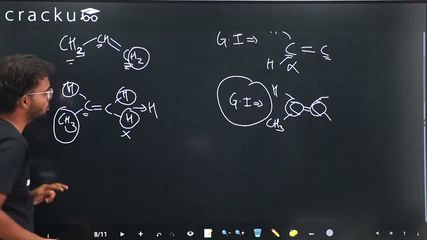
Geometrical (cis-trans) isomerism in alkenes arises when each carbon of the $$C = C$$ double bond carries two different groups. This creates restricted rotation about the double bond and the possibility of arranging the substituents either on the same side (cis) or on opposite sides (trans).
Let us analyse every option.
Case A:
Propene: $$CH_2 = CH-CH_3$$
Left (first) carbon of the double bond has two identical groups (two hydrogens). Therefore, no geometrical isomerism is possible.
Case B:
2-Methylpropene (isobutene): $$(CH_3)_2C = CH_2$$
Right carbon possesses two identical hydrogens. Hence geometrical isomerism is not feasible.
Case C:
2-Butene: $$CH_3-CH = CH-CH_3$$
Both carbons of the double bond have two different groups (one $$CH_3$$ and one $$H$$ each). Thus cis ($$CH_3$$ on same side) and trans ($$CH_3$$ on opposite sides) forms are possible. Geometrical isomerism exists.
Case D:
2-Methyl-2-butene: $$(CH_3)_2C = C(CH_3)H$$
Left carbon bears two identical $$CH_3$$ groups, so the necessary condition is not met; geometrical isomerism is absent.
Only 2-butene satisfies the required condition.
Hence, the correct choice is:
Option C which is: 2-butene
Was this solution helpful?
Click on the Email ☝️ to Watch the Video Solution
Create a FREE account and get:
_1.webp)

Educational materials for JEE preparation

Ask our AI anything

AI can make mistakes. Please verify important information.
AI can make mistakes. Please verify important information.
