
Join Our JEE Preparation Group
Prep with like-minded aspirants; Get access to free daily tests and study material.
Sign in
Please select an account to continue using cracku.in
↓ →
Join Our JEE Preparation Group
Prep with like-minded aspirants; Get access to free daily tests and study material.
The bond dissociation energy of B$$-$$F in BF$$_3$$ is $$646$$ kJ mol$$^{-1}$$ whereas that of C$$-$$F in CF$$_4$$ is $$515$$ kJ mol$$^{-1}$$. The correct reason for higher B-F bond dissociation energy as compared to that of $$C - F$$ is :
The energy needed to break a single chemical bond depends not only on the primary $$\sigma$$ overlap but also on any additional interaction (multiple-bond character) present between the two atoms.
Case 1: $$BF_3$$
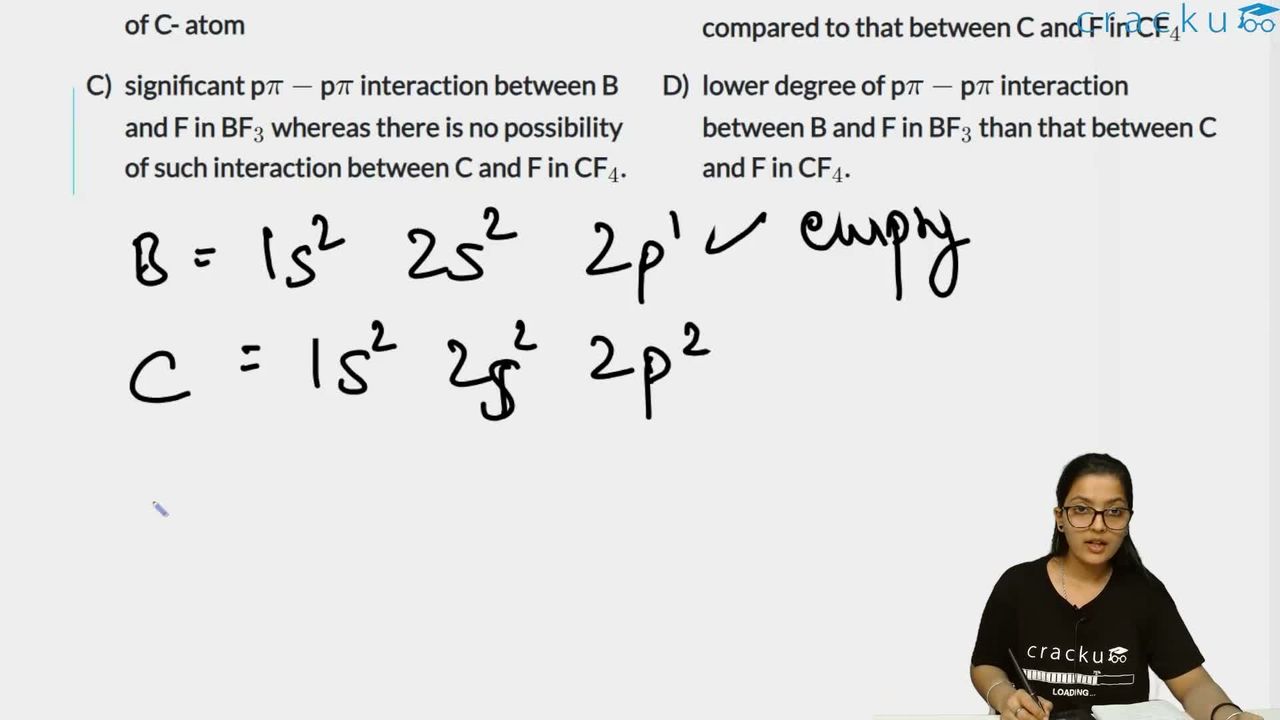
Boron has the valence configuration $$2s^22p^1$$ and hence possesses one empty $$2p$$ orbital.
Each fluorine atom carries three lone pairs located in its $$2p$$ orbitals. A filled $$2p$$ orbital of F can overlap sideways with the vacant $$2p$$ orbital of B, giving a $$p\pi\,$$-$$\,p\pi$$ back-donation (back bonding). This imparts partial double-bond character to every B-F linkage and increases the bond order from 1 to slightly more than 1. A higher bond order always translates into a higher bond dissociation energy. Consequently, $$B-F$$ in $$BF_3$$ requires as much as $$646\ \text{kJ mol}^{-1}$$ to break.
Case 2: $$CF_4$$
Carbon in $$CF_4$$ already has a complete octet (valence configuration $$2s^22p^2$$, forming four $$sp^3$$ $$\sigma$$ bonds). All of its valence orbitals are either fully involved in bonding or are filled; there is no low-lying vacant orbital to accept electron density. Therefore, fluorine’s lone pairs cannot participate in $$p\pi\,$$-$$\,p\pi$$ interaction with carbon. The C-F bond remains a pure single $$\sigma$$ bond whose dissociation energy is only $$515\ \text{kJ mol}^{-1}$$.
Thus, the higher B-F bond dissociation energy arises from the extra stabilisation supplied by significant $$p\pi\,$$-$$\,p\pi$$ back bonding, a feature absent in the C-F bonds of $$CF_4$$.
Hence, the correct explanation is:
Option C which is: significant $$p\pi\,$$-$$\,p\pi$$ interaction between B and F in $$BF_3$$ whereas there is no possibility of such interaction between C and F in $$CF_4$$.
Was this solution helpful?
Click on the Email ☝️ to Watch the Video Solution
Create a FREE account and get:
_1.webp)

Educational materials for JEE preparation

Ask our AI anything

AI can make mistakes. Please verify important information.
AI can make mistakes. Please verify important information.
