
Join Our JEE Preparation Group
Prep with like-minded aspirants; Get access to free daily tests and study material.
Sign in
Please select an account to continue using cracku.in
↓ →
Join Our JEE Preparation Group
Prep with like-minded aspirants; Get access to free daily tests and study material.
Dipole moment is a vector sum of individual $$\text{Xe-X}$$ bond moments. For the overall dipole moment to be zero, the molecular geometry must be perfectly symmetrical so that the bond moments cancel each other.
Case A (XeO$$\mathbf{_3}$$)
XeO$$\mathbf{_3}$$ has the steric number $$4$$ (three Xe-O bonds + one lone pair). According to VSEPR, the geometry is trigonal pyramidal, similar to $$\text{NH}_3$$. Bond moments do not cancel, so $$\mu \neq 0$$.
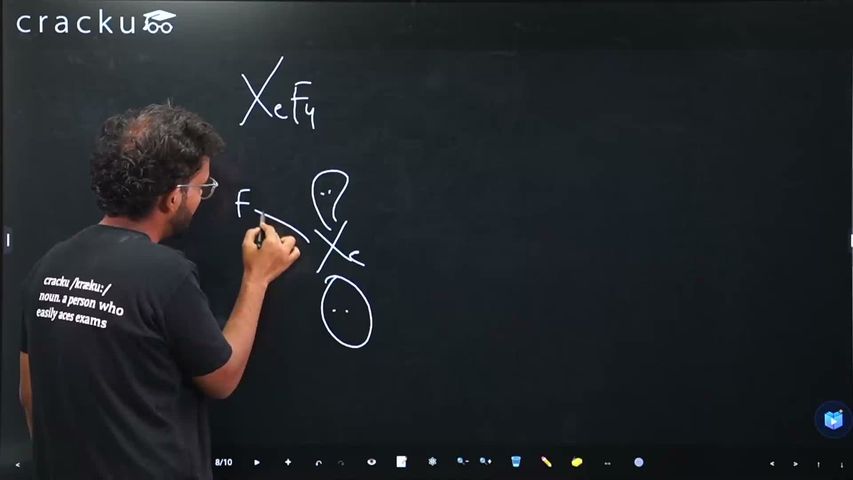
Case B (XeF$$\mathbf{_4}$$)
Steric number $$6$$ (four Xe-F bonds + two lone pairs). VSEPR gives an octahedral electron cloud with the two lone pairs occupying positions trans to each other. The real shape of the molecule is square planar. All four Xe-F bond moments lie in one plane and are symmetrically opposite; their vector sum is zero. Hence $$\mu = 0$$.
Case C (XeOF$$\mathbf{_4}$$)
Steric number $$6$$ (five bonds + one lone pair). The geometry becomes square pyramidal. The axial $$\text{Xe}=\text{O}$$ bond and the unequal arrangement around Xe create a non-zero resultant moment, so $$\mu \neq 0$$.
Case D (XeO$$\mathbf{_2}$$)
Steric number $$4$$ (two Xe-O bonds + two lone pairs). The geometry is bent (angular). The two bond moments add vectorially to give a net dipole moment, i.e., $$\mu \neq 0$$.
Only XeF$$\mathbf{_4}$$ has a completely symmetrical (square planar) structure that allows all individual bond moments to cancel exactly.
Therefore, the compound with zero dipole moment is
Option B which is: XeF$$\mathbf{_4}$$
Was this solution helpful?
Click on the Email ☝️ to Watch the Video Solution
Create a FREE account and get:
_1.webp)

Educational materials for JEE preparation

Ask our AI anything

AI can make mistakes. Please verify important information.
AI can make mistakes. Please verify important information.
