
Join Our JEE Preparation Group
Prep with like-minded aspirants; Get access to free daily tests and study material.
Sign in
Please select an account to continue using cracku.in
↓ →
Join Our JEE Preparation Group
Prep with like-minded aspirants; Get access to free daily tests and study material.
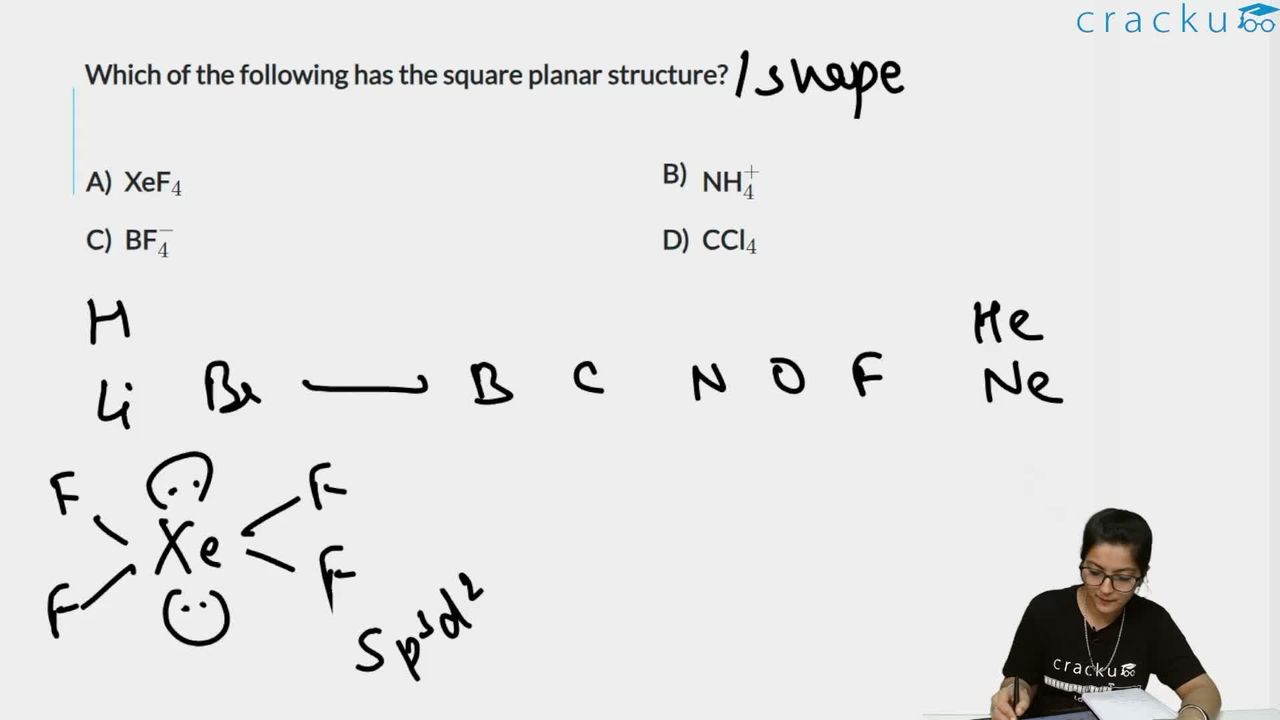
Option A: $$\text{XeF}_4$$ (Xenon Tetrafluoride)
Option B: $$\text{NH}_4^+$$ (Ammonium Ion)
Option C: $$\text{BF}_4^-$$ (Tetrafluoroborate Ion)
Option D: $$\text{CCl}_4$$ (Carbon Tetrachloride)
While the other three options possess an $$sp^3$$ tetrahedral geometry, only $$\text{XeF}_4$$ has the $$sp^3d^2$$ electronic distribution that yields a square planar molecular geometry.
Answer: Option A — $$\text{XeF}_4$$
Was this solution helpful?
Click on the Email ☝️ to Watch the Video Solution
Create a FREE account and get:
_1.webp)

Educational materials for JEE preparation

Ask our AI anything

AI can make mistakes. Please verify important information.
AI can make mistakes. Please verify important information.
