
Join Our JEE Preparation Group
Prep with like-minded aspirants; Get access to free daily tests and study material.
Sign in
Please select an account to continue using cracku.in
↓ →
Join Our JEE Preparation Group
Prep with like-minded aspirants; Get access to free daily tests and study material.
In any molecule, the net (resultant) dipole moment $$\mu_{\text{net}}$$ is the vector sum of the individual bond dipole moments. If the molecular geometry is such that the individual vectors cancel each other completely, the molecule is non-polar and its dipole moment becomes zero.
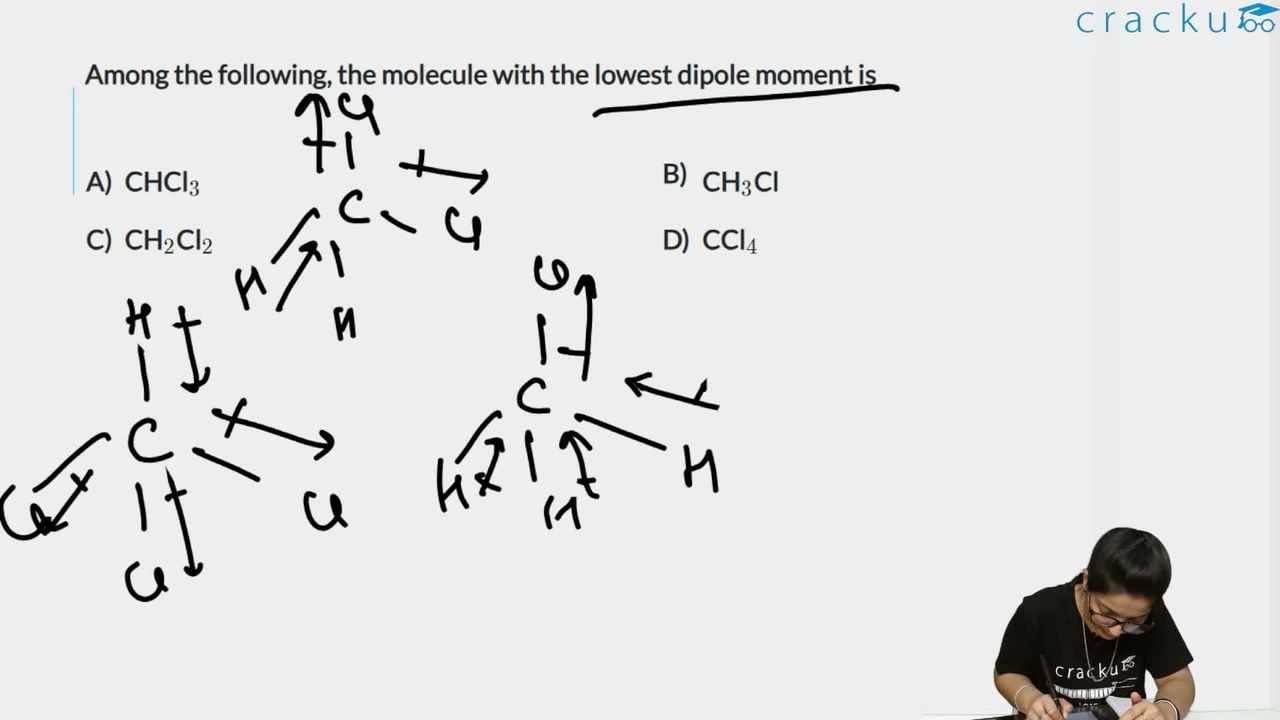
All the given molecules are derivatives of methane and have a tetrahedral geometry around the central carbon atom because carbon is $$sp^3$$-hybridised.
Case 1: $$\text{CCl}_4$$ All four positions of the regular tetrahedron are occupied by chlorine atoms. The four $$\text{C-Cl}$$ bond dipole moments are equal in magnitude and are directed from carbon toward the corners of a perfect tetrahedron. Owing to the high symmetry, these four vectors cancel completely: $$\mu_{\text{net}}(\text{CCl}_4)=0$$
Case 2: $$\text{CH}_3\text{Cl}$$ Here, one position is occupied by Cl (electronegative) and the other three by H (much less electronegative). The single $$\text{C-Cl}$$ bond dipole cannot be cancelled by the three comparatively weak and oppositely directed $$\text{C-H}$$ bond dipoles. Hence, $$\mu_{\text{net}}(\text{CH}_3\text{Cl}) \gt 0$$
Case 3: $$\text{CH}_2\text{Cl}_2$$ Two $$\text{C-Cl}$$ bonds are present, but they are not exactly opposite in a tetrahedron; therefore their dipole vectors do not cancel each other. The remaining two $$\text{C-H}$$ bonds also do not compensate this imbalance. Thus, $$\mu_{\text{net}}(\text{CH}_2\text{Cl}_2}) \gt 0$$
Case 4: $$\text{CHCl}_3$$ With three $$\text{C-Cl}$$ bonds pointing toward three corners and one $$\text{C-H}$$ bond toward the fourth, the three larger $$\text{C-Cl}$$ dipoles partially cancel among themselves, but an uncompensated component remains. Therefore, $$\mu_{\text{net}}(\text{CHCl}_3) \gt 0$$ (though smaller than that of $$\text{CH}_3\text{Cl}$$ and $$\text{CH}_2\text{Cl}_2$$).
Comparing all four cases, $$\text{CCl}_4$$ is the only molecule in which the bond dipole moments cancel completely, giving the lowest possible dipole moment, namely zero.
Hence, the molecule with the lowest dipole moment is
Option D which is: CCl$$_4$$
Was this solution helpful?
Click on the Email ☝️ to Watch the Video Solution
Create a FREE account and get:
_1.webp)

Educational materials for JEE preparation

Ask our AI anything

AI can make mistakes. Please verify important information.
AI can make mistakes. Please verify important information.
