
Join Our JEE Preparation Group
Prep with like-minded aspirants; Get access to free daily tests and study material.
Sign in
Please select an account to continue using cracku.in
↓ →
Join Our JEE Preparation Group
Prep with like-minded aspirants; Get access to free daily tests and study material.
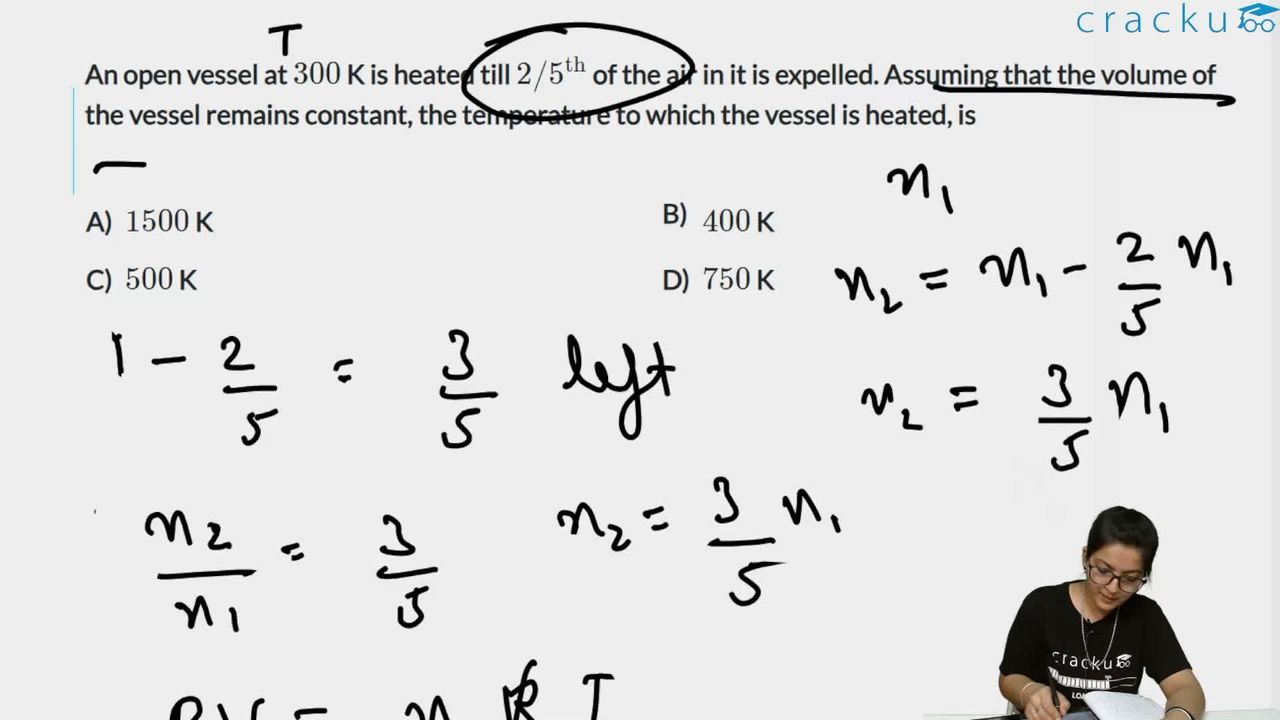
An open vessel at $$300$$ K is heated till $$2/5^{\text{th}}$$ of the air in it is expelled. Assuming that the volume of the vessel remains constant, the temperature to which the vessel is heated, is
For an open vessel the internal pressure is always equal to the external atmospheric pressure. Hence, while heating the vessel, the pressure $$P$$ remains constant. The vessel is rigid, so its volume $$V$$ is also constant.
Let the initial temperature, amount of air and pressure be
$$T_1 = 300 \text{ K}, \qquad n_1, \qquad P$$ respectively.
Using the ideal-gas equation for the initial state,
$$PV = n_1 R T_1 \quad -(1)$$
After heating, some air escapes until the pressure again equals $$P$$. Let the final temperature and number of moles left be $$T_2$$ and $$n_2$$. For this final state
$$PV = n_2 R T_2 \quad -(2)$$
Divide equation (1) by equation (2):
$$\frac{n_1}{n_2} = \frac{T_2}{T_1} \quad -(3)$$
The question states that $$\dfrac{2}{5}$$ of the air is expelled, so $$\dfrac{3}{5}$$ remains:
$$n_2 = \frac{3}{5} n_1 \; \Longrightarrow \; \frac{n_1}{n_2} = \frac{5}{3}$$
Substitute this ratio into equation (3):
$$\frac{5}{3} = \frac{T_2}{300} \; \Longrightarrow \; T_2 = 300 \times \frac{5}{3} = 500 \text{ K}$$
Hence the vessel must be heated to $$500 \text{ K}$$.
Option C which is: $$500$$ K
Was this solution helpful?
Click on the Email ☝️ to Watch the Video Solution
Create a FREE account and get:
_1.webp)

Educational materials for JEE preparation

Ask our AI anything

AI can make mistakes. Please verify important information.
AI can make mistakes. Please verify important information.
