
Join Our JEE Preparation Group
Prep with like-minded aspirants; Get access to free daily tests and study material.
Sign in
Please select an account to continue using cracku.in
↓ →
Join Our JEE Preparation Group
Prep with like-minded aspirants; Get access to free daily tests and study material.
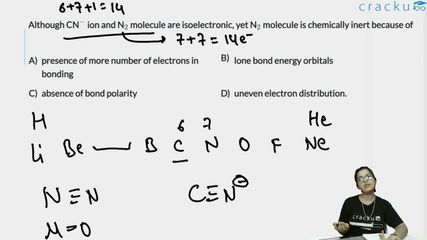
Although CN$$^-$$ ion and N$$_2$$ molecule are isoelectronic, yet N$$_2$$ molecule is chemically inert because of
N$$_2$$ and CN$$^-$$ are isoelectronic: each contains 14 electrons.
Both species therefore have the same total number of electrons and the same bond order, $$3$$, which means the N≡N and C≡N bonds are equally strong.
Yet their chemical behaviour is very different: molecular nitrogen is remarkably inert under ordinary conditions, whereas the cyanide ion is highly reactive.
The key point is that reactivity is governed not only by bond order or bond energy but also by charge distribution (polarity).
1. Polarity of N$$_2$$: The two atoms in N$$_2$$ are identical and have exactly the same electronegativity. Hence the bonding electron pair is shared equally, giving zero dipole moment. There is no partial positive (δ$$^+$$) or partial negative (δ$$^-$$) end in the molecule. Without any charge separation, there is no site for an incoming reagent to attack; the molecule is non-polar and chemically inert.
2. Polarity of CN$$^-$$: The atoms C and N have different electronegativities, so the C≡N bond is polar. In addition, the overall negative charge resides mainly on the more electronegative nitrogen. Therefore CN$$^-$$ possesses a pronounced electron-rich centre, making it an excellent nucleophile and highly reactive.
Thus, even though both species are isoelectronic and possess strong triple bonds, the absence of bond polarity in N$$_2$$ is the primary reason for its extraordinary chemical inertness.
Option C which is: absence of bond polarity
Was this solution helpful?
Click on the Email ☝️ to Watch the Video Solution
Create a FREE account and get:
_1.webp)

Educational materials for JEE preparation

Ask our AI anything

AI can make mistakes. Please verify important information.
AI can make mistakes. Please verify important information.
