
Join Our JEE Preparation Group
Prep with like-minded aspirants; Get access to free daily tests and study material.
Sign in
Please select an account to continue using cracku.in
↓ →
Join Our JEE Preparation Group
Prep with like-minded aspirants; Get access to free daily tests and study material.
The dipole moment $$\mu$$ of a molecule is the vector sum of all individual bond dipole moments.
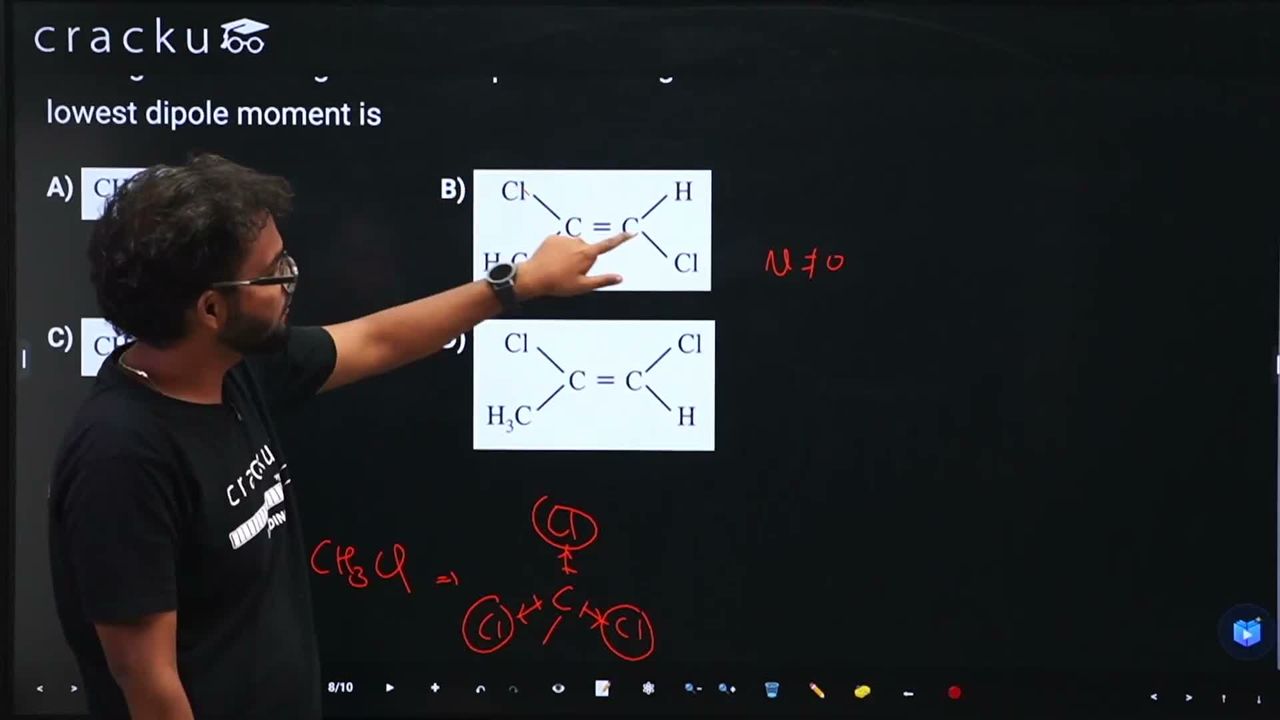
If the individual bond dipoles cancel one another because of molecular symmetry, the net dipole moment becomes zero or very small. Therefore, to identify the compound with the lowest (here, effectively zero) dipole moment, we must look for the molecular geometry in which all $$C-Cl$$ bond dipoles point symmetrically in opposite directions.
This is a tetrahedral molecule with a highly polar $$\text{C}-\text{Cl}$$ bond and three less-polar $$\text{C}-\text{H}$$ bonds. The dipoles reinforce each other, resulting in a very high net dipole moment ($$\mu \approx 1.87\text{ D}$$).
This is a tetrahedral molecule where two $$\text{C}-\text{Cl}$$ bonds and two $$\text{C}-\text{H}$$ bonds accumulate their dipoles in the same general direction. Their vectors do not cancel out, yielding a significant net dipole moment ($$\mu \approx 1.60\text{ D}$$).
Option D: cis-1,2-dichloroprop-1-ene
In this cis isomer, both highly polar $$\text{C-Cl}$$ bonds are locked on the same side of the double bond Instead of opposing each other, both chlorine atoms pull electron density toward the exact same side of the molecule. Because these two strong vectors point in the same general direction, they reinforce one another. Their forces add together, causing a severe shift in electron density to one side of the molecule, resulting in a very high net dipole moment.
Hence, Option B is correct.
Was this solution helpful?
Click on the Email ☝️ to Watch the Video Solution
Create a FREE account and get:
_1.webp)

Educational materials for JEE preparation

Ask our AI anything

AI can make mistakes. Please verify important information.
AI can make mistakes. Please verify important information.
