
Join Our JEE Preparation Group
Prep with like-minded aspirants; Get access to free daily tests and study material.
Sign in
Please select an account to continue using cracku.in
↓ →
Join Our JEE Preparation Group
Prep with like-minded aspirants; Get access to free daily tests and study material.
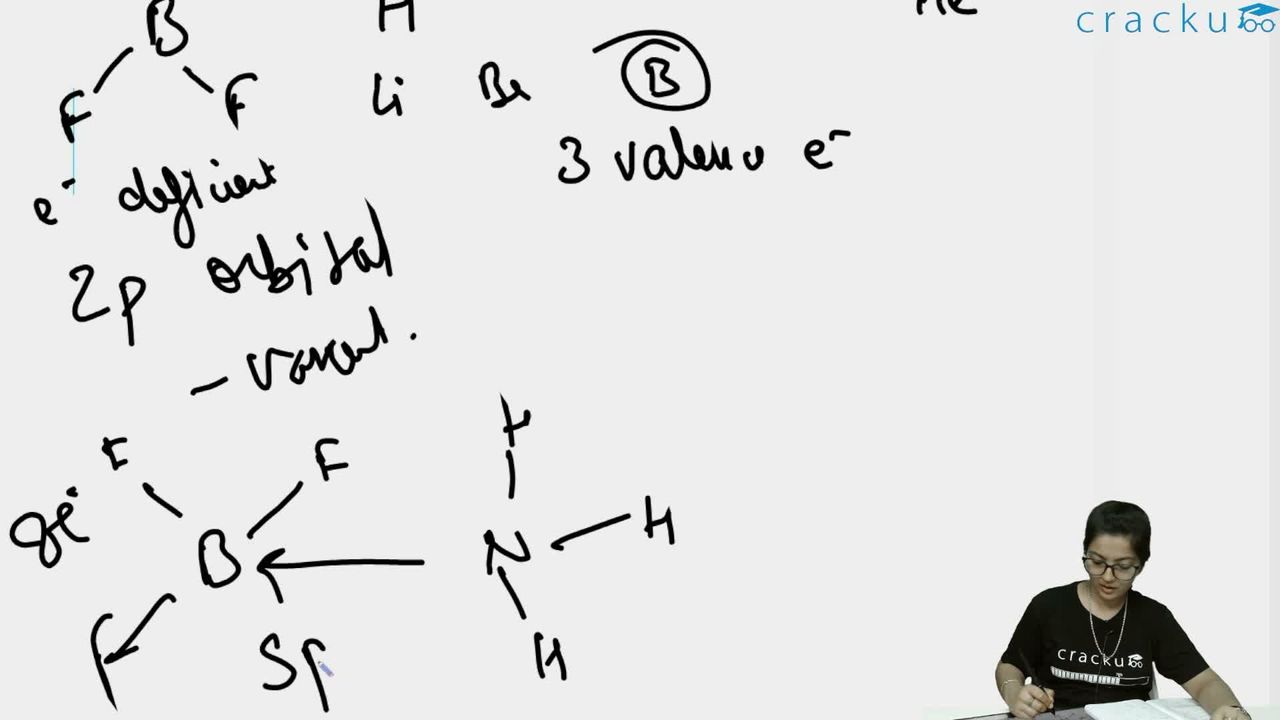
The formation of molecular complex $$\text{BF}_3 - \text{NH}_3$$ results in a change in hybridization of boron
In gaseous $$\text{BF}_3$$ the central atom B is surrounded by three electron-pair regions (three B-F $$\sigma$$ bonds and no lone pair).
For three regions the steric number is 3, giving trigonal-planar geometry and $$sp^2$$ hybridisation.
Ammonia, $$\text{NH}_3$$, possesses a lone pair on N. When $$\text{BF}_3$$ and $$\text{NH}_3$$ interact, this lone pair is donated to the vacant $$2p$$ orbital of boron, forming a coordinate bond:
$$\text{F}_3\text{B}\; \leftarrow \; \text{:NH}_3$$
After donation, boron is now surrounded by four electron-pair regions (three B-F bonds + one B←N bond).
For four regions the steric number is 4, giving tetrahedral geometry and $$sp^3$$ hybridisation.
Thus the hybridisation of boron changes
$$sp^2 \; \longrightarrow \; sp^3$$
Option B which is: from $$sp^2$$ to $$sp^3$$
Was this solution helpful?
Click on the Email ☝️ to Watch the Video Solution
Create a FREE account and get:
_1.webp)

Educational materials for JEE preparation

Ask our AI anything

AI can make mistakes. Please verify important information.
AI can make mistakes. Please verify important information.
