Join Our JEE Preparation Group
Prep with like-minded aspirants; Get access to free daily tests and study material.
Sign in
Please select an account to continue using cracku.in
↓ →
Join Our JEE Preparation Group
Prep with like-minded aspirants; Get access to free daily tests and study material.
Combustion of methane is an exothermic reaction: $$CH_4 + 2O_2 \rightarrow CO_2 + 2H_2O \;,\; \Delta H_c \approx -890\ \text{kJ mol}^{-1}$$. The large negative enthalpy means a considerable amount of heat is liberated.
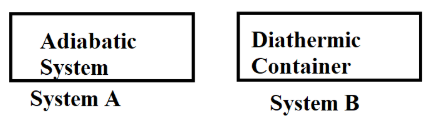
Case A: The reaction takes place in an adiabatic, rigid (no work other than $$P\,dV$$) vessel. Because the walls are adiabatic, $$q = 0$$ for the surroundings. The first-law statement for a closed, rigid system is $$\Delta U = q + w = 0 + 0 = 0$$; however, for a chemical reaction $$\Delta U = \Delta U_{\text{rxn}}$$ is negative (internal energy of products is lower). To keep $$\Delta U_{\text{total}} = 0$$, the temperature of the products must rise so that their sensible internal energy increases and offsets $$\Delta U_{\text{rxn}}$$. Thus the gas mixture inside heats up.
Case B: The reaction occurs in an open vessel that is very well stirred and is surrounded by a massive heat sink (an isothermal bath). Though the reaction is still exothermic, the heat released is immediately conducted away to the bath. Because the bath’s thermal capacity is so large, its temperature does not change perceptibly, and the system remains essentially isothermal. Therefore the temperature of the reacting gases stays the same.
Hence, in system A the temperature rises, whereas in system B the temperature remains unchanged.
Option A which is: System A - Temperature rises; System B - Temperature remains same
Was this solution helpful?
Create a FREE account and get:
_1.webp)

Educational materials for JEE preparation

Ask our AI anything

AI can make mistakes. Please verify important information.
AI can make mistakes. Please verify important information.