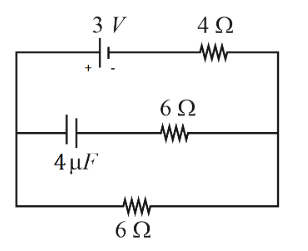
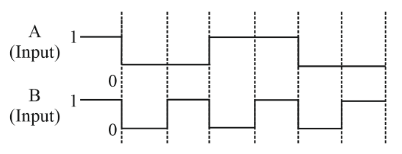
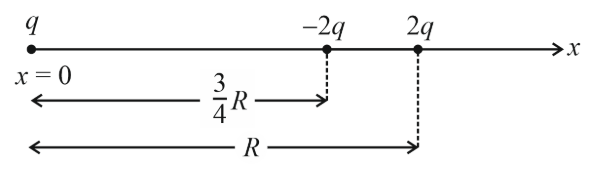
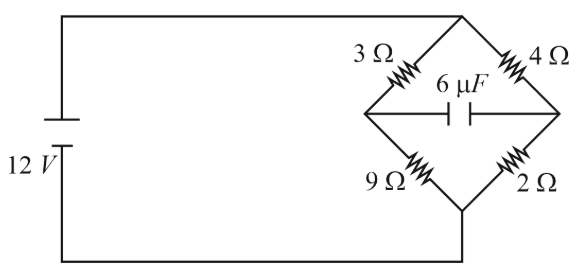
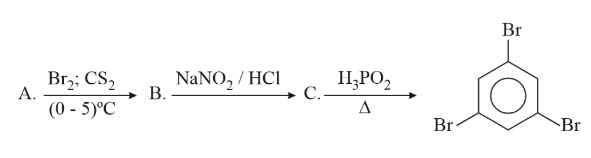
For the following questions answer them individually
In the equation $$X + \frac{a}{Y^2}\left[Y - b\right] = RT$$, $$X$$ is pressure, $$Y$$ is volume, $$R$$ is universal gas constant and $$T$$ is temperature. The physical quantity equivalent to the ratio $$\frac{a}{b}$$ is:
The distance travelled by an object in time $$t$$ is given by $$s = 2.5t^2$$. The instantaneous speed of the object at $$t = 5$$ s will be :
A passenger sitting in a train A moving at $$90$$ km h$$^{-1}$$ observes another train B moving in the opposite direction for $$8$$ s. If the velocity of the train B is $$54$$ km h$$^{-1}$$, then length of train B is:
A vehicle of mass $$200$$ kg is moving along a levelled curved road of radius $$70$$ m with angular velocity of $$0.2$$ rad s$$^{-1}$$. The centripetal force acting on the vehicle is:
Two planets A and B of radii $$R$$ and $$1.5R$$ have densities $$\rho$$ and $$\frac{\rho}{2}$$ respectively. The ratio of acceleration due to gravity at the surface of B to A is:
Given below are two statements:
Statement I : For a planet, if the ratio of mass of the planet to its radius increase, the escape velocity from the planet also increase.
Statement II : Escape velocity is independent of the radius of the planet.
In the light of above statements, choose the most appropriate answer from the options given below
Given below are two statements: one is labelled as Assertion A and the other is labelled as Reason R
Assertion A : A spherical body of radius $$(5 \pm 0.1)$$ mm having a particular density is falling through a liquid of constant density. The percentage error in the calculation of its terminal velocity is 4%.
Reason R : The terminal velocity of the spherical body falling through the liquid is inversely proportional to its radius. In the light of the above statements, choose the correct answer from the options given below
The initial pressure and volume of an ideal gas are $$P_0$$ and $$V_0$$. The final pressure of the gas when the gas is suddenly compressed to volume $$\frac{V_0}{4}$$ will be:
(Given $$\gamma$$ = ratio of specific heats at constant pressure and at constant volume.)
The mean free path of molecules of a certain gas at STP is $$1500d$$, where $$d$$ is the diameter of the gas molecules. While maintaining the standard pressure, the mean free path of the molecules at $$373$$ K is approximately:
A particle executes SHM of amplitude $$A$$. The distance from the mean position when its kinetic energy becomes equal to its potential energy is: