
Join Our JEE Preparation Group
Prep with like-minded aspirants; Get access to free daily tests and study material.
Sign in
Please select an account to continue using cracku.in
↓ →
Join Our JEE Preparation Group
Prep with like-minded aspirants; Get access to free daily tests and study material.
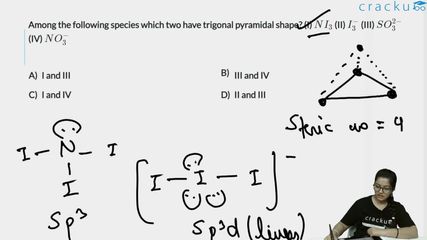
Among the following species which two have trigonal pyramidal shape? (I) $$NI_3$$ (II) $$I_3^-$$ (III) $$SO_3^{2-}$$ (IV) $$NO_3^-$$
A molecule or ion exhibits a trigonal pyramidal shape when its central atom is $$sp^3$$ hybridized with a steric number of 4, comprising exactly 3 bonding pairs and 1 lone pair ($$\text{AB}_3\text{E}$$ type).
(I) $$\text{NI}_3$$ (Nitrogen Triiodide)
(II) $$\text{I}_3^-$$ (Triiodide Ion)
(III) $$\text{SO}_3^{2-}$$ (Sulfite Ion)
(IV) $$\text{NO}_3^-$$ (Nitrate Ion)
Both $$\text{NI}_3$$ (I) and $$\text{SO}_3^{2-}$$ (III) have a steric number of 4 with 1 lone pair, giving them identical trigonal pyramidal geometries.
Answer: Option A — I and III
Was this solution helpful?
Click on the Email ☝️ to Watch the Video Solution
Create a FREE account and get:
_1.webp)

Educational materials for JEE preparation

Ask our AI anything

AI can make mistakes. Please verify important information.
AI can make mistakes. Please verify important information.


