Sign in
Please select an account to continue using cracku.in
↓ →
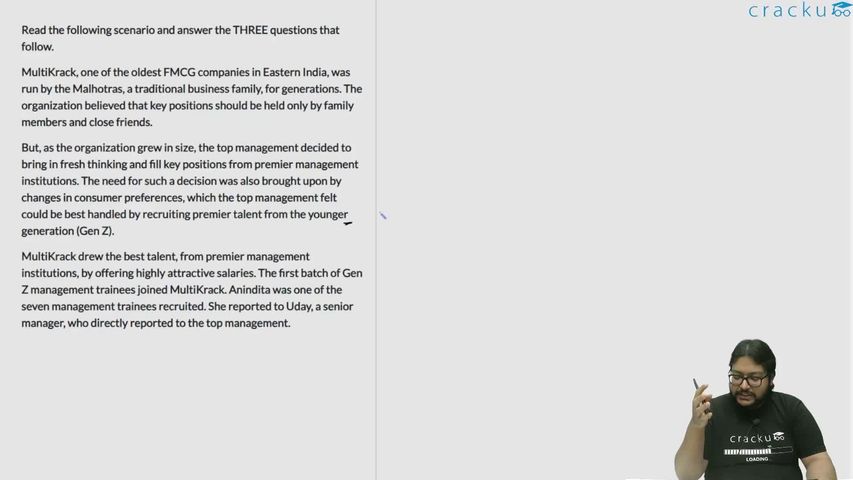
Read the following scenario and answer the THREE questions that follow.
MultiKrack, one of the oldest FMCG companies in Eastern India, was run by the Malhotras, a traditional business family, for generations. The organization believed that key positions should be held only by family members and close friends.
But, as the organization grew in size, the top management decided to bring in fresh thinking and fill key positions from premier management institutions. The need for such a decision was also brought upon by changes in consumer preferences, which the top management felt could be best handled by recruiting premier talent from the younger generation (Gen Z).
MultiKrack drew the best talent, from premier management institutions, by offering highly attractive salaries. The first batch of Gen Z management trainees joined MultiKrack. Anindita was one of the seven management trainees recruited. She reported to Uday, a senior manager, who directly reported to the top management.
A few months passed. Anindita was a valuable member of her team and the top management was impressed with her. However, the other management trainees left the organization. In their exit interviews, they shared the condescending behavior of senior management as the reason for their departure. Some even left MultiKrack to join organizations that paid lesser than what MultiKrack paid. The top management understood that the seniors belonged to a different generation; they found it difficult to appreciate the intergenerational differences. The top management felt it was high time to do something about the senior management’s behavior towards the juniors.
Which of the following actions, considered by the top management, will BEST enable change in the senior management's behavior?
The departure of the management trainees, despite the attractive salaries offered by MultiKrack, indicates that the problem lies in the organization’s work culture rather than compensation. Since the top management has recognised that the senior managers struggle to appreciate intergenerational differences, the most effective solution is to address the underlying attitudes and behaviours that contribute to this problem. Option D is the correct answer, as investing in diversity, equity and inclusion training can help senior managers understand generational differences, recognise their biases and develop more respectful ways of interacting with younger employees. Using the mass exodus as a turning point can also signal the organization’s commitment to creating a more inclusive workplace.
Option A would limit interactions between juniors and seniors without correcting the seniors’ behaviour. Option B may help identify problematic behaviour, but collecting ratings alone will not necessarily bring about lasting change. Option C risks creating further resentment by promoting younger employees without addressing the attitudes of the existing senior management. Option E may discourage overtly discriminatory behaviour through the threat of disciplinary action, but a warning alone is unlikely to change the underlying attitudes that cause seniors to dismiss or belittle their younger colleagues.
Was this solution helpful?
Click on the Email ☝️ to Watch the Video Solution
Create a FREE account and get:
Book Free CAT Mentorship
Get personalized CAT strategy from a 99%iler
500+ students mentored
OTP Verification
Enter the 6-digit code sent to your phone
Booking Summary
Enter OTP
Didn't receive the OTP?
Start your IIM journey with the right preparation and crack CAT 2026.

Educational materials for CAT preparation

Ask our AI anything

AI can make mistakes. Please verify important information.
AI can make mistakes. Please verify important information.
 91- 6303239042