Sign in
Please select an account to continue using cracku.in
↓ →
 CAT WhatsApp Group
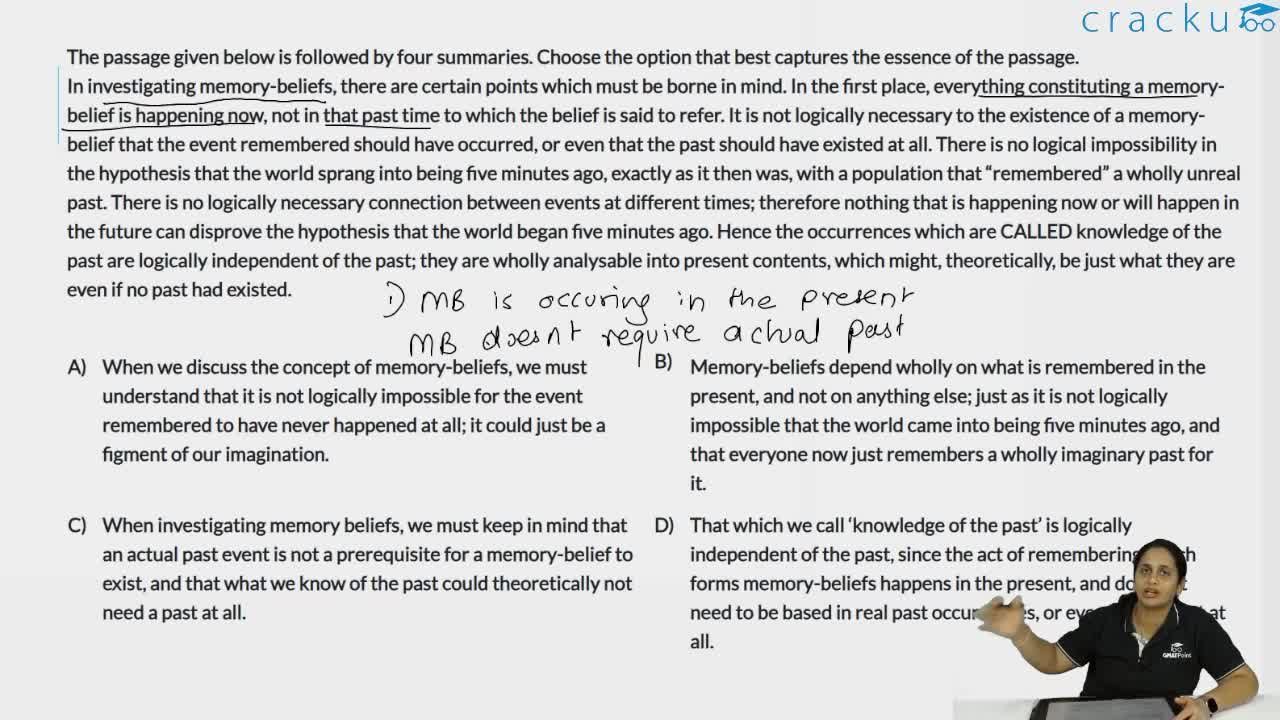
The passage given below is followed by four summaries. Choose the option that best captures the essence of the passage.
In investigating memory-beliefs, there are certain points which must be borne in mind. In the first place, everything constituting a memory-belief is happening now, not in that past time to which the belief is said to refer. It is not logically necessary to the existence of a memory-belief that the event remembered should have occurred, or even that the past should have existed at all. There is no logical impossibility in the hypothesis that the world sprang into being five minutes ago, exactly as it then was, with a population that “remembered” a wholly unreal past. There is no logically necessary connection between events at different times; therefore nothing that is happening now or will happen in the future can disprove the hypothesis that the world began five minutes ago. Hence the occurrences which are CALLED knowledge of the past are logically independent of the past; they are wholly analysable into present contents, which might, theoretically, be just what they are even if no past had existed.

The passage explains that memory-beliefs exist only in the present and do not require an actual past. It notes that remembering takes place now, and there is no logical reason the remembered event must have happened. The example of the world starting “five minutes ago” shows that our knowledge of the past cannot dismiss this idea. This means memory and knowledge of the past are logically separate from whether the past really happened. Option D addresses the entire argument. It states that knowledge of the past is logically separate from the past itself, links memory-beliefs to what happens in our minds now, and includes the idea that real past events, or even a past at all, are not logically necessary.
The other options do not fully capture the argument. Option A only discusses imagination and misses the logical independence of the past. Option B focuses too much on the five-minute example and leaves out the main point about memory-beliefs. Option C comes close, but it does not clearly state that our knowledge of the past is logically separate from the past itself.
Click on the Email ☝️ to Watch the Video Solution
Create a FREE account and get:
Book Free CAT Mentorship
Get personalized CAT strategy from a 99%iler
500+ students mentored
OTP Verification
Enter the 6-digit code sent to your phone
Booking Summary
Enter OTP
Didn't receive the OTP?

Educational materials for CAT preparation

Ask our AI anything

AI can make mistakes. Please verify important information.
AI can make mistakes. Please verify important information.
 91- 6303239042


