Sign in
Please select an account to continue using cracku.in
↓ →
 CAT WhatsApp Group
The passage below is accompanied by four questions. Based on the passage, choose the best answer for each question.
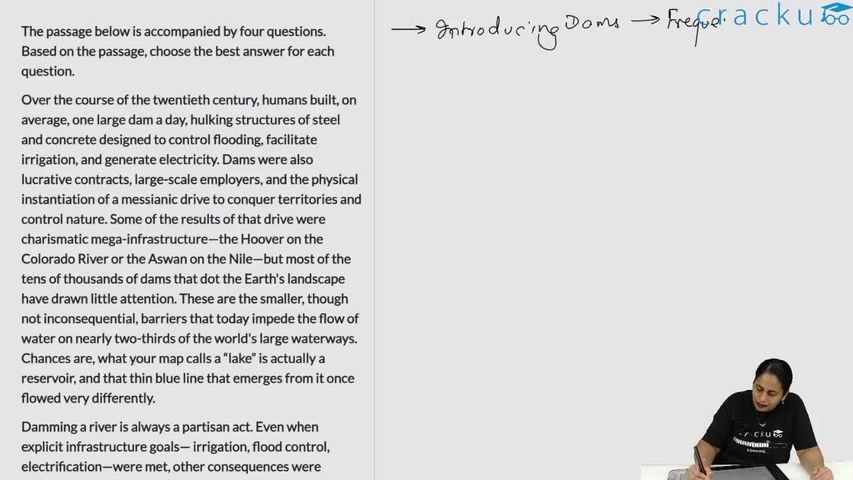
Over the course of the twentieth century, humans built, on average, one large dam a day, hulking structures of steel and concrete designed to control flooding, facilitate irrigation, and generate electricity. Dams were also lucrative contracts, large-scale employers, and the physical instantiation of a messianic drive to conquer territories and control nature. Some of the results of that drive were charismatic mega-infrastructure—the Hoover on the Colorado River or the Aswan on the Nile—but most of the tens of thousands of dams that dot the Earth's landscape have drawn little attention. These are the smaller, though not inconsequential, barriers that today impede the flow of water on nearly two-thirds of the world's large waterways. Chances are, what your map calls a “lake” is actually a reservoir, and that thin blue line that emerges from it once flowed very differently.
Damming a river is always a partisan act. Even when explicit infrastructure goals— irrigation, flood control, electrification—were met, other consequences were significant and often deleterious. Across the world, river control displaced millions of people, threatening livelihoods, foodways, and cultures. In the western United States, dams were often an instrument of colonialism, used to dispossess Indigenous people and subsidize settler agriculture. And as dams slowed the flow of water, inhibited the movement of nutrients, and increased the amount of toxic algae and other parasites, they snuffed out entire river ecologies. Declining fish populations are the most evident effect, but dams also threaten a host of other animals—from birds and reptiles to fungi and plants—with extinction. Every major dam, then, is also a sacrifice zone, a place where lives, livelihoods, and ways of life are eliminated so that new sorts of landscapes can support water-intensive agriculture and cities that sprout downstream of new reservoirs.
Such sacrifices have been justified as offerings at the temples of modernity. Justified by—and for—whom, though? Over the course of the twentieth century, rarely were the costs and benefits weighed thoughtfully and decided democratically. As Kader Asmal, chair of the landmark 2000 World Commission on Dams, concluded, “There have been precious few, if any, comprehensive, independent analyses as to why dams came about, how dams perform over time, and whether we are getting a fair return from our $2 trillion investment.” A quarter- century later, Asmal’s words ring ever truer. A litany of dams built in the mid- twentieth century are approaching the end of their expected lives, with worrying prospects for their durability. Droughts, magnified and multiplied by the effects of climate change, have forced more and more to run below capacity. If ever there were a time to rethink the mania for dams, it would be now.
There is some evidence that a combination of opposition, alternative energy sources, and a lack of viable projects has slowed the construction of major dams. But a wave of recent and ongoing construction, from India and China to Ethiopia and Canada, continues to tilt the global balance firmly in favor of water impoundment.
All of the following statements may be considered valid inferences from the passage EXCEPT that:

Let us evaluate each option one by one.
Option A can be inferred from the passage. The author notes that “a combination of opposition, alternative energy sources, and a lack of viable projects has slowed the construction of major dams,” but immediately adds that “a wave of recent and ongoing construction… continues to tilt the global balance firmly in favor of water impoundment.” This clearly supports the idea that dams continue to be built despite resistance and alternatives.
Option B cannot be inferred from the passage. While the author refers to “smaller, though not inconsequential, barriers,” this phrase is used to stress their cumulative impact on rivers, not their safety. There is no comparison anywhere in the passage suggesting that smaller dams are safer than large ones. The text discusses ecological damage and displacement caused by dams in general, without ranking them by safety.
Option C is supported by the passage. It explicitly states that “in the western United States, dams were often an instrument of colonialism, used to dispossess Indigenous people and subsidize settler agriculture.” This directly implies that dam-building was used to force people off their land.
Option D is also a valid inference. The passage quotes the World Commission on Dams questioning whether we are getting “a fair return from our $2 trillion investment,” and points out that many dams are ageing, running below capacity, and facing durability issues. Together, this supports the idea that dam-building has been extremely costly and may not be justifiable.
Since option B introduces a claim that the passage does not support, it is the correct answer.
Click on the Email ☝️ to Watch the Video Solution
Create a FREE account and get:
Book Free CAT Mentorship
Get personalized CAT strategy from a 99%iler
500+ students mentored
OTP Verification
Enter the 6-digit code sent to your phone
Booking Summary
Enter OTP
Didn't receive the OTP?

Educational materials for CAT preparation

Ask our AI anything

AI can make mistakes. Please verify important information.
AI can make mistakes. Please verify important information.
 91- 6303239042