Sign in
Please select an account to continue using cracku.in
↓ →

Join Our JEE Preparation Group
Prep with like-minded aspirants; Get access to free daily tests and study material.
Consider the following diagram with 102 vertices
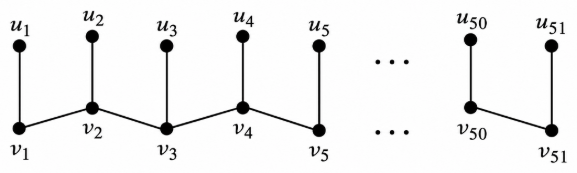
Show that one can assign the numbers $$1, 2, \ldots, 102$$ to the 102 vertices $$u_1, u_2, \ldots, u_{51}, v_1, v_2, \ldots, v_{51}$$ such that no two vertices have the same number, and the absolute differences of the numbers on adjacent vertices are a rearrangement of $$1, 2, \ldots, 101$$. (Two points are adjacent if they have a line segment joining them in the above diagram.)
Correct Answer: 0
The diagram has 101 edges, the 51 vertical edges $$u_i v_i$$ and the 50 edges $$v_i v_{i+1}$$ along the bottom path. For odd $$i$$ assign $$v_i = i$$ and $$u_i = 103 - i$$, and for even $$i$$ assign $$u_i = i$$ and $$v_i = 103 - i$$. The labels $$i$$ used are $$1, 2, \ldots, 51$$ and the labels $$103 - i$$ used are $$52, 53, \ldots, 102$$, so all 102 labels are distinct. Each vertical edge gives $$|u_i - v_i| = 103 - 2i$$, which runs through $$101, 99, \ldots, 1$$ for $$i = 1, \ldots, 51$$. Each bottom edge gives $$|v_i - v_{i+1}| = 102 - 2i$$ (for both parities of $$i$$), which runs through $$100, 98, \ldots, 2$$ for $$i = 1, \ldots, 50$$. Together the differences are exactly $$1, 2, \ldots, 101$$.
Was this solution helpful?
Book Free CAT Mentorship
Get personalized CAT strategy from a 99%iler
500+ students mentored
OTP Verification
Enter the 6-digit code sent to your phone
Booking Summary
Enter OTP
Didn't receive the OTP?


Predict your JEE Main percentile, rank & performance in seconds

Educational materials for JEE preparation

Ask our AI anything

AI can make mistakes. Please verify important information.
AI can make mistakes. Please verify important information.
 91- 6303239042

