
Join Our JEE Preparation Group
Prep with like-minded aspirants; Get access to free daily tests and study material.
Sign in
Please select an account to continue using cracku.in
↓ →
Join Our JEE Preparation Group
Prep with like-minded aspirants; Get access to free daily tests and study material.
In a triangle $$PQR$$, $$\angle R = \frac{\pi}{2}$$. If $$\tan\left(\frac{P}{2}\right)$$ and $$\tan\left(\frac{Q}{2}\right)$$ are the roots of $$ax^2 + bx + c = 0, a \neq 0$$ then
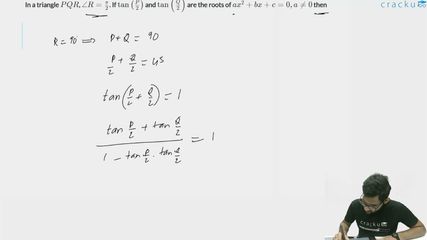
Let the three interior angles of the right-angled triangle be $$P, Q, R$$ with $$R=\frac{\pi}{2}$$. Hence
$$P+Q=\pi-\frac{\pi}{2}=\frac{\pi}{2}$$ $$\Longrightarrow$$ $$\frac{P}{2}+\frac{Q}{2}=\frac{\pi}{4}$$ $$-(1)$$
Denote $$\alpha=\dfrac{P}{2}$$ and $$\beta=\dfrac{Q}{2}$$. According to the question, the roots of the quadratic equation $$ax^{2}+bx+c=0$$ are $$\tan\alpha$$ and $$\tan\beta$$.
For a quadratic whose roots are $$r_{1}, r_{2}$$, we have
Sum of roots $$=r_{1}+r_{2}=-\dfrac{b}{a}$$, Product of roots $$=r_{1}r_{2}= \dfrac{c}{a}$$. $$-(2)$$
Using identity for tangent of a sum:
$$\tan(\alpha+\beta)=\dfrac{\tan\alpha+\tan\beta}{1-\tan\alpha\,\tan\beta}$$ $$-(3)$$
From $$-(1)$$, $$\alpha+\beta=\dfrac{\pi}{4}$$, so $$\tan(\alpha+\beta)=\tan\dfrac{\pi}{4}=1$$. Substituting this and the roots into $$-(3)$$ gives
$$1=\dfrac{\tan\alpha+\tan\beta}{\,1-\tan\alpha\,\tan\beta\,}$$ $$\Longrightarrow$$ $$\tan\alpha+\tan\beta = 1-\tan\alpha\,\tan\beta$$ $$-(4)$$
Introduce $$S=\tan\alpha+\tan\beta$$ and $$P=\tan\alpha\,\tan\beta$$. Equation $$-(4)$$ becomes $$S = 1 - P$$. Combine this with $$-(2)$$:
$$S = -\dfrac{b}{a}, \quad P = \dfrac{c}{a}$$
Therefore
$$-\dfrac{b}{a}=1-\dfrac{c}{a}$$ $$\Longrightarrow$$ $$-b = a-c$$ $$\Longrightarrow$$ $$c = a + b$$.
Hence the required relation among the coefficients is $$c = a + b$$.
Option B which is: $$c = a + b$$
Was this solution helpful?
Click on the Email ☝️ to Watch the Video Solution
Create a FREE account and get:
_1.webp)

Educational materials for JEE preparation

Ask our AI anything

AI can make mistakes. Please verify important information.
AI can make mistakes. Please verify important information.
