
Join Our JEE Preparation Group
Prep with like-minded aspirants; Get access to free daily tests and study material.
Sign in
Please select an account to continue using cracku.in
↓ →
Join Our JEE Preparation Group
Prep with like-minded aspirants; Get access to free daily tests and study material.
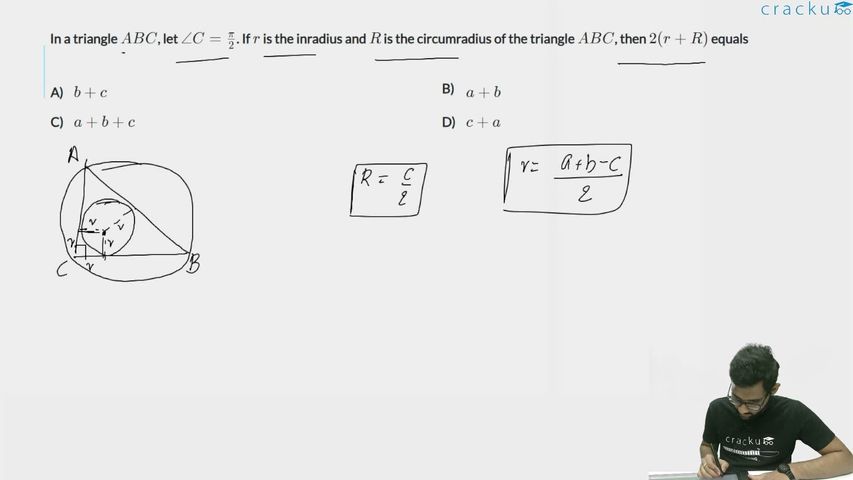
In a triangle $$ABC$$, let $$\angle C = \frac{\pi}{2}$$. If $$r$$ is the inradius and $$R$$ is the circumradius of the triangle $$ABC$$, then $$2(r + R)$$ equals
Let the sides opposite the angles $$A,B,C$$ be $$a, b, c$$ respectively. Given $$\angle C = \frac{\pi}{2}$$, the triangle is right-angled at $$C$$, so $$c$$ is the hypotenuse and $$a, b$$ are the two perpendicular sides.
Step 1: Circumradius $$R$$ for a right triangle
For any triangle, the extended law of sines gives $$\displaystyle R = \frac{c}{2\sin C}$$.
When $$C = \frac{\pi}{2}$$, we have $$\sin C = 1$$, hence
$$R = \frac{c}{2}$$.
Step 2: Inradius $$r$$ for a right triangle
The area of the triangle can be written in two ways:
(i) using legs: $$\text{Area} = \frac{1}{2}ab$$,
(ii) using inradius: $$\text{Area} = rs$$, where $$s$$ is the semi-perimeter $$s = \frac{a+b+c}{2}$$.
Equating the two areas,
$$rs = \frac{1}{2}ab \quad -(1)$$
$$\Rightarrow r = \frac{ab}{a + b + c}.$$
For a right triangle the Pythagorean theorem gives $$c = \sqrt{a^2 + b^2}$$, but a handier form for $$r$$ is obtained by the well-known identity
$$r = \frac{a + b - c}{2}.$$
(This follows directly from substituting $$s$$ into equation -(1) and simplifying.)
Step 3: Evaluate $$2(r + R)$$
Combine the expressions from Steps 1 and 2:
$$2(r + R) = 2\left(\frac{a + b - c}{2} + \frac{c}{2}\right)
= (a + b - c) + c
= a + b.$$
Thus $$2(r + R) = a + b$$, which corresponds to Option B.
Was this solution helpful?
Click on the Email ☝️ to Watch the Video Solution
Create a FREE account and get:
_1.webp)

Educational materials for JEE preparation

Ask our AI anything

AI can make mistakes. Please verify important information.
AI can make mistakes. Please verify important information.
