
Join Our JEE Preparation Group
Prep with like-minded aspirants; Get access to free daily tests and study material.
Sign in
Please select an account to continue using cracku.in
↓ →
Join Our JEE Preparation Group
Prep with like-minded aspirants; Get access to free daily tests and study material.
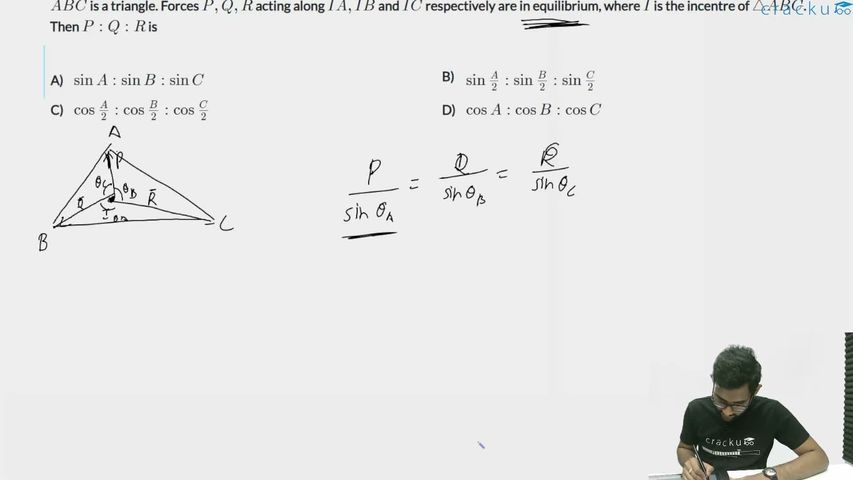
$$ABC$$ is a triangle. Forces $$\vec{P}, \vec{Q}, \vec{R}$$ acting along $$IA, IB$$ and $$IC$$ respectively are in equilibrium, where $$I$$ is the incentre of $$\triangle ABC$$. Then $$P : Q : R$$ is
For three coplanar forces to be in equilibrium, their vectors must form a closed triangle.
Equivalently, if the magnitudes are $$P,Q,R$$ and the angles between the directions of $$\vec Q,\vec R;\; \vec R,\vec P;\; \vec P,\vec Q$$ are $$\theta_A,\theta_B,\theta_C$$ respectively, then by the sine rule for the triangle of forces
$$\frac{P}{\sin\theta_A}= \frac{Q}{\sin\theta_B}= \frac{R}{\sin\theta_C}\;.\qquad -(1)$$
In this problem the forces act along the internal angle-bisectors $$IA,IB,IC$$ of $$\triangle ABC$$. Hence:
• the angle between $$IB$$ and $$IC$$ at the incentre $$I$$ equals $$\theta_A=90^\circ+\frac{A}{2}$$,
• the angle between $$IC$$ and $$IA$$ equals $$\theta_B=90^\circ+\frac{B}{2}$$,
• the angle between $$IA$$ and $$IB$$ equals $$\theta_C=90^\circ+\frac{C}{2}$$.
Using $$\sin(90^\circ+\phi)=\cos\phi$$, equation $$(1)$$ becomes
$$\frac{P}{\cos\frac{A}{2}}=\frac{Q}{\cos\frac{B}{2}}=\frac{R}{\cos\frac{C}{2}}.$$
Therefore
$$P:Q:R=\cos\frac{A}{2}:\cos\frac{B}{2}:\cos\frac{C}{2}.$$
Option C which is: $$\cos\frac{A}{2} : \cos\frac{B}{2} : \cos\frac{C}{2}$$
Was this solution helpful?
Click on the Email ☝️ to Watch the Video Solution
Create a FREE account and get:
_1.webp)

Educational materials for JEE preparation

Ask our AI anything

AI can make mistakes. Please verify important information.
AI can make mistakes. Please verify important information.
