
Join Our JEE Preparation Group
Prep with like-minded aspirants; Get access to free daily tests and study material.
Sign in
Please select an account to continue using cracku.in
↓ →
Join Our JEE Preparation Group
Prep with like-minded aspirants; Get access to free daily tests and study material.
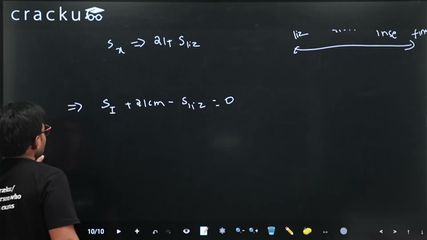
A lizard, at an initial distance of $$21$$ cm behind an insect, moves from rest with an acceleration of $$2$$ cm/s$$^2$$ and pursues the insect which is crawling uniformly along a straight line at a speed of $$20$$ cm/s. Then the lizard will catch the insect after
Let both the lizard and the insect start at $$t = 0$$.
Initial data
• Uniform speed of the insect: $$u = 20 \, \text{cm s}^{-1}$$
• Constant acceleration of the lizard (from rest): $$a = 2 \, \text{cm s}^{-2}$$
• Initial distance by which the lizard is behind the insect: $$s_0 = 21 \, \text{cm}$$
Step 1: Write individual displacements
Measured from their respective starting points, after time $$t$$ the displacements are
Insect: $$s_{\text{insect}} = u t = 20t$$
Lizard (starting from rest with uniform acceleration): $$s_{\text{lizard}} = \dfrac12 a t^{2} = \dfrac12 \times 2 \times t^{2} = t^{2}$$
Step 2: Express the shrinking gap
At time $$t$$, the separation between them equals the initial gap plus the distance covered by the insect minus the distance covered by the lizard:
$$\text{Gap}(t) = s_0 + s_{\text{insect}} - s_{\text{lizard}} = 21 + 20t - t^{2}$$
Step 3: Set the gap to zero for the instant of capture
The lizard catches the insect when $$\text{Gap}(t) = 0$$:
$$21 + 20t - t^{2} = 0$$
Re-arranging to the standard quadratic form:
$$t^{2} - 20t - 21 = 0$$
Step 4: Solve the quadratic equation
For $$at^{2} + bt + c = 0$$, the solutions are $$t = \dfrac{-b \pm \sqrt{b^{2} - 4ac}}{2a}$$. Here $$a = 1$$, $$b = -20$$, $$c = -21$$.
Discriminant:
$$\Delta = (-20)^{2} - 4(1)(-21) = 400 + 84 = 484$$
$$\sqrt{\Delta} = 22$$
Hence
$$t = \dfrac{20 \pm 22}{2}$$
Two roots appear:
$$t = \dfrac{20 + 22}{2} = 21 \, \text{s}$$
$$t = \dfrac{20 - 22}{2} = -1 \, \text{s}$$ (discarded because time cannot be negative).
Step 5: State the physical answer
The only physically meaningful time is $$t = 21 \, \text{s}$$.
Therefore, the lizard catches the insect after 21 seconds.
Option C which is: $$21$$ s
Was this solution helpful?
Click on the Email ☝️ to Watch the Video Solution
Create a FREE account and get:
_1.webp)

Educational materials for JEE preparation

Ask our AI anything

AI can make mistakes. Please verify important information.
AI can make mistakes. Please verify important information.
