
Join Our JEE Preparation Group
Prep with like-minded aspirants; Get access to free daily tests and study material.
Sign in
Please select an account to continue using cracku.in
↓ →
Join Our JEE Preparation Group
Prep with like-minded aspirants; Get access to free daily tests and study material.
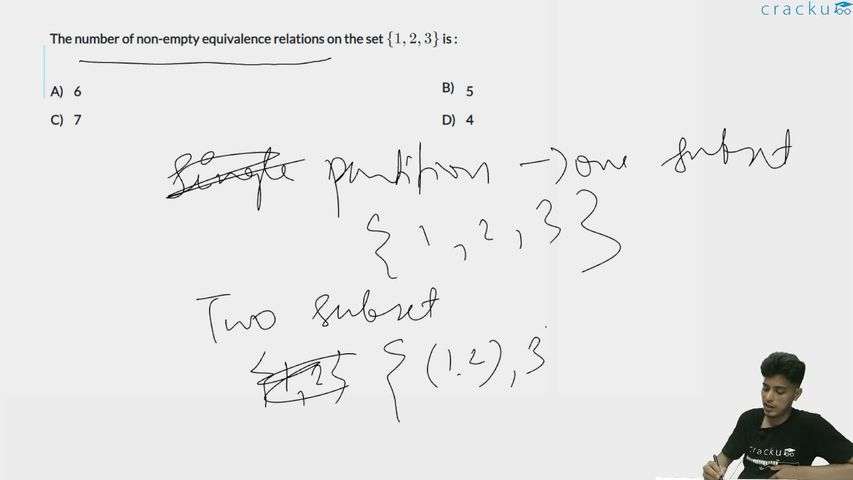
The number of non-empty equivalence relations on the set $$\left\{1, 2, 3\right\}$$ is :
An equivalence relation on a set must satisfy three properties: reflexivity, symmetry, and transitivity. The number of equivalence relations on a set is equal to the number of partitions of that set, as each partition defines an equivalence class.
For the set $$S = \{1, 2, 3\}$$, we need to find all possible partitions. A partition divides the set into non-empty, disjoint subsets whose union is the entire set.
The possible partitions are:
1. Partition with one subset:
- The entire set: $$\{\{1, 2, 3\}\}$$
This corresponds to one equivalence relation where all elements are related to each other.
2. Partitions with two subsets:
- Subset 1: $$\{1\}$$, Subset 2: $$\{2, 3\}$$
- Subset 1: $$\{2\}$$, Subset 2: $$\{1, 3\}$$
- Subset 1: $$\{3\}$$, Subset 2: $$\{1, 2\}$$
Each of these partitions corresponds to an equivalence relation where elements in the same subset are equivalent. There are three such partitions.
3. Partition with three subsets:
- Each element in its own subset: $$\{\{1\}, \{2\}, \{3\}\}$$
This corresponds to the equivalence relation where each element is only related to itself.
Total number of partitions = 1 (one subset) + 3 (two subsets) + 1 (three subsets) = 5.
Each partition defines a unique equivalence relation. Since reflexivity requires that every element is related to itself (i.e., pairs like (1,1), (2,2), (3,3) must be present), no equivalence relation can be empty. Therefore, all 5 equivalence relations are non-empty.
The number of non-empty equivalence relations is 5.
The correct option is B. 5.
Click on the Email ☝️ to Watch the Video Solution
Create a FREE account and get:
_1.webp)

Educational materials for JEE preparation

Ask our AI anything

AI can make mistakes. Please verify important information.
AI can make mistakes. Please verify important information.


