
Join Our JEE Preparation Group
Prep with like-minded aspirants; Get access to free daily tests and study material.
Sign in
Please select an account to continue using cracku.in
↓ →
Join Our JEE Preparation Group
Prep with like-minded aspirants; Get access to free daily tests and study material.
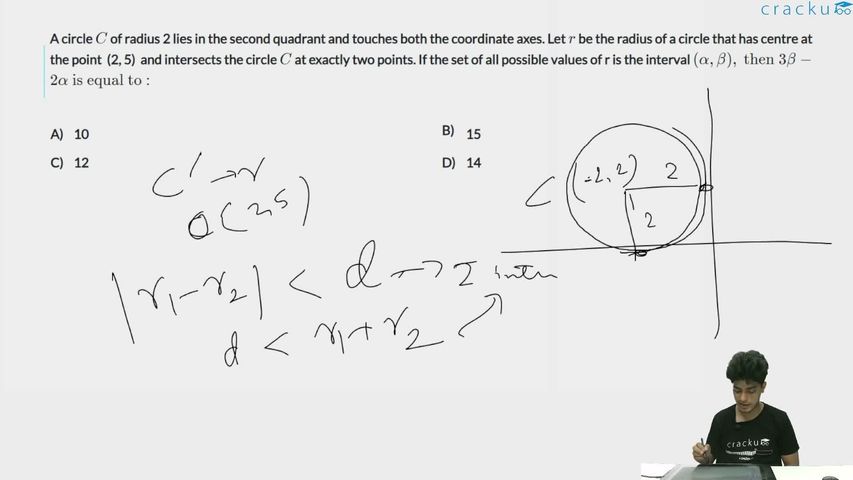
A circle $$C$$ of radius 2 lies in the second quadrant and touches both the coordinate axes. Let $$ r$$ be the radius of a circle that has centre at the point (2, 5) and intersects the circle $$ C $$ at exactly two points. If the set of all possible values of r is the interval $$(\alpha, \beta), \text{ then } 3\beta - 2\alpha \text{ is equal to :} $$
Centre $$C_1 = (-2, 2)$$
The second circle's centre is given as $$C_2 = (2, 5)$$. Use the standard distance formula:
$$d = \sqrt{(x_2 - x_1)^2 + (y_2 - y_1)^2} = \sqrt{(2 - (-2))^2 + (5 - 2)^2} = \sqrt{16 + 9} = 5$$
For two circles to intersect at exactly two distinct points, the distance between their centres must be strictly bound by the difference and sum of their radii:
$$|r_1 - r_2| < d < r_1 + r_2$$
$$|r - 2| < 5 < r + 2$$
1. $$r + 2 > 5 \implies r > 3$$
2. $$|r - 2| < 5 \implies -5 < r - 2 < 5 \implies -3 < r < 7$$
$$r \in (3, 7) \implies \alpha = 3, \ \beta = 7$$
$$3\beta - 2\alpha = 3(7) - 2(3) = 21 - 6 = 15$$
Was this solution helpful?
Click on the Email ☝️ to Watch the Video Solution
Create a FREE account and get:
_1.webp)

Educational materials for JEE preparation

Ask our AI anything

AI can make mistakes. Please verify important information.
AI can make mistakes. Please verify important information.
