
Join Our JEE Preparation Group
Prep with like-minded aspirants; Get access to free daily tests and study material.
Sign in
Please select an account to continue using cracku.in
↓ →
Join Our JEE Preparation Group
Prep with like-minded aspirants; Get access to free daily tests and study material.
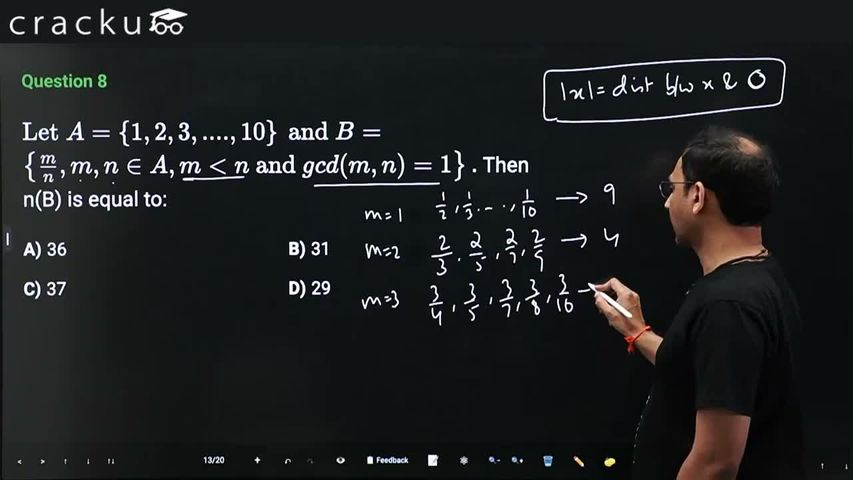
$$ \text{Let } A=\left\{1, 2, 3,....,10\right\} \text{ and }B=\left\{ \frac {m}{n},m,n \in A,m < n \text{ and }gcd(m,n)=1\right\}.$$ Then n(B) is equal to:
In the set B, the elements are fractions $$\dfrac{m}{n}$$ such that, $$n$$ can take the values from {1,2,...,10} and $$m$$ has to be less than $$n$$ and, $$m$$ and $$n$$ must be co-primes.
Euler's totient function represents the count of positive integers less than a given integer $$n$$ that are co-prime to $$n$$.
If $$n$$ is represented as,
$$n\ =\ p_1^a\ \times\ p_2^b\ \times\ p_3^c\ ...$$ where $$p_1,\ p_2,\ p_3..\ $$ are primes.
$$Φ\left(n\right)\ =\ n\left(1-\dfrac{1}{p_1}\right)\left(1-\dfrac{1}{p_2}\right)\left(1-\dfrac{1}{p_3}\right)...$$
When $$n$$ is prime, $$Φ(n)=n-1$$
$$n\left(B\right)=Φ\left(10\right)+\ Φ\left(9\right)\ +\ ...\ +\ Φ\left(2\right)$$
We are not including $$Φ(1)$$, as there are no integers less than 1 that are co-prime to 1.
$$Φ\left(10\right)$$: $$10=2\times5$$
$$Φ(10)=10\left(1-\dfrac{1}{2}\right)\left(1-\dfrac{1}{5}\right)\ =\ 10\left(\dfrac{1}{2}\right)\left(\dfrac{4}{5}\right)\ =\ 4$$
$$Φ\left(9\right)$$: $$9=3^2$$
$$Φ(9)=9\left(1-\dfrac{1}{3}\right)\ =\ 6$$
$$Φ\left(8\right)$$: $$8=2^3$$
$$Φ(8)=8\left(1-\dfrac{1}{2}\right)\ =\ 4$$
$$Φ\left(7\right)$$: $$7$$ is prime
$$Φ(7)=6$$
$$Φ\left(6\right)$$: $$6=2\times3$$
$$Φ(6)=6\left(1-\dfrac{1}{2}\right)\left(1-\dfrac{1}{3}\right)\ =\ 6\left(\dfrac{1}{2}\right)\left(\dfrac{2}{3}\right)\ =\ 2$$
$$Φ\left(5\right)$$: $$5$$ is prime
$$Φ(5)=4$$
$$Φ\left(4\right)$$: $$4=2^2$$
$$Φ(4)=4\left(1-\dfrac{1}{2}\right)\ =\ 2$$
$$Φ\left(3\right)$$: $$3$$ is prime
$$Φ(3)=2$$
$$Φ\left(2\right)$$: $$2$$ is prime
$$Φ(2)=1$$
$$n\left(B\right)=Φ\left(10\right)+\ Φ\left(9\right)\ +\ ...\ +\ Φ\left(2\right)=\ 4\ +\ 6\ +\ 4\ +\ 6\ +\ 2\ +\ 4\ +\ 2\ +\ 2\ +\ 1\ =\ 31$$
Hence, the correct answer is option B.
Was this solution helpful?
Click on the Email ☝️ to Watch the Video Solution
Create a FREE account and get:
_1.webp)

Educational materials for JEE preparation

Ask our AI anything

AI can make mistakes. Please verify important information.
AI can make mistakes. Please verify important information.
