
Join Our JEE Preparation Group
Prep with like-minded aspirants; Get access to free daily tests and study material.
Sign in
Please select an account to continue using cracku.in
↓ →
Join Our JEE Preparation Group
Prep with like-minded aspirants; Get access to free daily tests and study material.
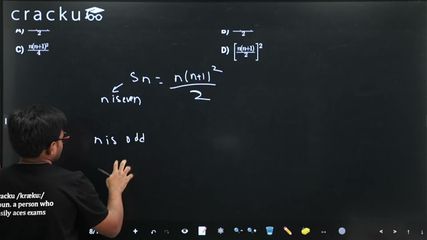
The sum of the first $$n$$ terms of the series $$1^2 + 2 \cdot 2^2 + 3^2 + 2 \cdot 4^2 + 5^2 + 2 \cdot 6^2 + \ldots$$ is $$\frac{n(n+1)^2}{2}$$ when $$n$$ is even. When $$n$$ is odd the sum is
The given series is:
$$ 1^2 + 2 \cdot 2^2 + 3^2 + 2 \cdot 4^2 + 5^2 + 2 \cdot 6^2 + \ldots $$
We are given that when n is even, the sum of the first n terms is:
$$ S_n = \frac{n(n+1)^2}{2} $$
Now, consider the case when n is odd. Let the number of terms be an odd number n.
An odd number of terms can be represented as taking the sum of the first even number of terms, which is $$ n - 1 $$ terms, and adding the final nth term:
$$ S_n = S_{n-1} + T_n $$
Since n is odd, the term preceding it, $$ n - 1 $$, must be an even number. Therefore, we can substitute $$ n - 1 $$ into the given formula for even numbers to find $$ S_{n-1} $$:
$$ S_{n-1} = \frac{(n-1)((n-1)+1)^2}{2} $$
$$ S_{n-1} = \frac{(n-1)n^2}{2} $$
Now determine the value of the nth term $$ T_n $$. Looking at the series pattern, the odd-positioned terms are simply the squares of the position index, such as $$ 1^2 $$, $$ 3^2 $$, and $$ 5^2 $$. Since n is an odd number, the nth term is:
$$ T_n = n^2 $$
Combine the expression for the sum of the first $$ n - 1 $$ terms and the nth term:
$$ S_n = \frac{(n-1)n^2}{2} + n^2 $$
Find a common denominator to add the two terms together:
$$ S_n = \frac{(n-1)n^2 + 2n^2}{2} $$
Factor out the common term $$ n^2 $$ from the numerator:
$$ S_n = \frac{n^2((n-1) + 2)}{2} $$
Simplify the expression inside the parentheses:
$$ S_n = \frac{n^2(n+1)}{2} $$
Final Answer:
When n is odd, the sum of the series is $$ \frac{n^2(n+1)}{2} $$.
Was this solution helpful?
Click on the Email ☝️ to Watch the Video Solution
Create a FREE account and get:
_1.webp)

Educational materials for JEE preparation

Ask our AI anything

AI can make mistakes. Please verify important information.
AI can make mistakes. Please verify important information.
