
Join Our JEE Preparation Group
Prep with like-minded aspirants; Get access to free daily tests and study material.
Sign in
Please select an account to continue using cracku.in
↓ →
Join Our JEE Preparation Group
Prep with like-minded aspirants; Get access to free daily tests and study material.
Let $$T_r$$ be the $$r$$th term of an A.P. whose first term is $$a$$ and common difference is $$d$$. If for some positive integers $$m, n, m \neq n, T_m = \frac{1}{n}$$ and $$T_n = \frac{1}{m}$$, then $$a - d$$ equals
The $$r$$-th term of an A.P. with first term $$a$$ and common difference $$d$$ is given by
$$T_r = a + (r-1)\,d$$
According to the question:
$$T_m = \frac{1}{n} \quad\text{and}\quad T_n = \frac{1}{m}$$
Write these two conditions using the general term:
$$a + (m-1)d = \frac{1}{n} \qquad -(1)$$
$$a + (n-1)d = \frac{1}{m} \qquad -(2)$$
Subtract equation $$-(2)$$ from $$-(1)$$ to eliminate $$a$$:
$$(m-1)d - (n-1)d = \frac{1}{n} - \frac{1}{m}$$
$$(m-n)d = \frac{m-n}{mn}$$
Because $$m \neq n$$, divide both sides by $$(m-n)$$ to obtain the common difference:
$$d = \frac{1}{mn}$$
Substitute this value of $$d$$ back into equation $$-(1)$$ to find $$a$$:
$$a + (m-1)\,\frac{1}{mn} = \frac{1}{n}$$
Multiply every term by $$n$$:
$$an + \frac{m-1}{m} = 1$$
Notice that $$\frac{m-1}{m} = 1 - \frac{1}{m}$$, so the left side becomes
$$an + 1 - \frac{1}{m} = 1$$
which simplifies to
$$an = \frac{1}{m}$$
Hence
$$a = \frac{1}{mn}$$
Finally, compute $$a - d$$:
$$a - d = \frac{1}{mn} - \frac{1}{mn} = 0$$
Therefore, $$a - d = 0$$, which corresponds to
Option A which is: $$0$$.
Was this solution helpful?
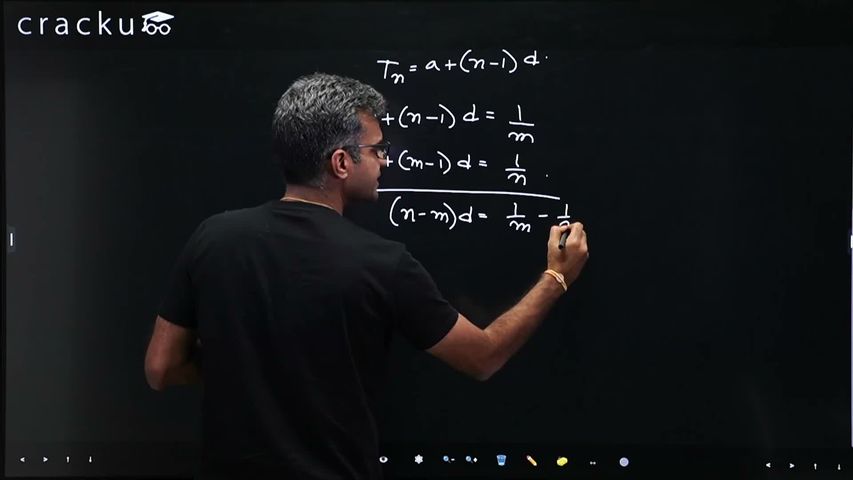
Click on the Email ☝️ to Watch the Video Solution
Create a FREE account and get:
_1.webp)

Educational materials for JEE preparation

Ask our AI anything

AI can make mistakes. Please verify important information.
AI can make mistakes. Please verify important information.
