
Join Our JEE Preparation Group
Prep with like-minded aspirants; Get access to free daily tests and study material.
Sign in
Please select an account to continue using cracku.in
↓ →
Join Our JEE Preparation Group
Prep with like-minded aspirants; Get access to free daily tests and study material.
The sum of series $$\frac{1}{2!} + \frac{1}{4!} + \frac{1}{6!} + \ldots$$ is
To find the sum of the series, we use the Maclaurin expansion of the exponential functions.
Recall the standard infinite series expansion for $$ e^x $$:
$$ e^x = 1 + \frac{x}{1!} + \frac{x^2}{2!} + \frac{x^3}{3!} + \frac{x^4}{4!} + \ldots $$
Substitute $$ x = 1 $$ into the expansion formula:
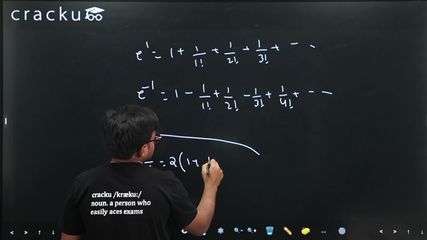
$$ e^1 = 1 + \frac{1}{1!} + \frac{1}{2!} + \frac{1}{3!} + \frac{1}{4!} + \ldots $$
Now substitute $$ x = -1 $$ into the expansion formula, which makes the signs alternate for odd powers:
$$ e^{-1} = 1 - \frac{1}{1!} + \frac{1}{2!} - \frac{1}{3!} + \frac{1}{4!} - \ldots $$
Add the two equations together to eliminate all the odd factorial denominator terms:
$$ e^1 + e^{-1} = \left(1 + \frac{1}{1!} + \frac{1}{2!} + \ldots\right) + \left(1 - \frac{1}{1!} + \frac{1}{2!} - \ldots\right) $$
Combine the remaining identical terms on the right side of the expression:
$$ e + e^{-1} = 2(1) + 2\left(\frac{1}{2!}\right) + 2\left(\frac{1}{4!}\right) + 2\left(\frac{1}{6!}\right) + \ldots $$
Factor out the common multiplier 2 from the entire right side:
$$ e + e^{-1} = 2 \left(1 + \frac{1}{2!} + \frac{1}{4!} + \frac{1}{6!} + \ldots\right) $$
Divide both sides by 2 to isolate the grouped series terms:
$$ \frac{e + e^{-1}}{2} = 1 + \frac{1}{2!} + \frac{1}{4!} + \frac{1}{6!} + \ldots $$
Subtract 1 from both sides to isolate the exact target series asked in the problem:
$$ \left(\frac{1}{2!} + \frac{1}{4!} + \frac{1}{6!} + \ldots\right) = \frac{e + e^{-1}}{2} - 1 $$
Find a common denominator on the right side to merge the terms:
$$ \frac{e + e^{-1}}{2} - \frac{2}{2} = \frac{e + e^{-1} - 2}{2} $$
Express the numerator fraction cleanly by converting the negative exponent term:
$$ \frac{e + \frac{1}{e} - 2}{2} = \frac{\frac{e^2 + 1 - 2e}{e}}{2} = \frac{e^2 - 2e + 1}{2e} $$
Recognize that the numerator forms a perfect square trinomial:
$$ e^2 - 2e + 1 = (e - 1)^2 $$
Substitute this back into the fraction to get the final simplified form:
$$ \frac{(e - 1)^2}{2e} $$
Final Answer:
The sum of the series is $$ \frac{(e - 1)^2}{2e} $$.
Was this solution helpful?
Click on the Email ☝️ to Watch the Video Solution
Create a FREE account and get:
_1.webp)

Educational materials for JEE preparation

Ask our AI anything

AI can make mistakes. Please verify important information.
AI can make mistakes. Please verify important information.
