Sign in
Please select an account to continue using cracku.in
↓ →

Join Our JEE Preparation Group
Prep with like-minded aspirants; Get access to free daily tests and study material.
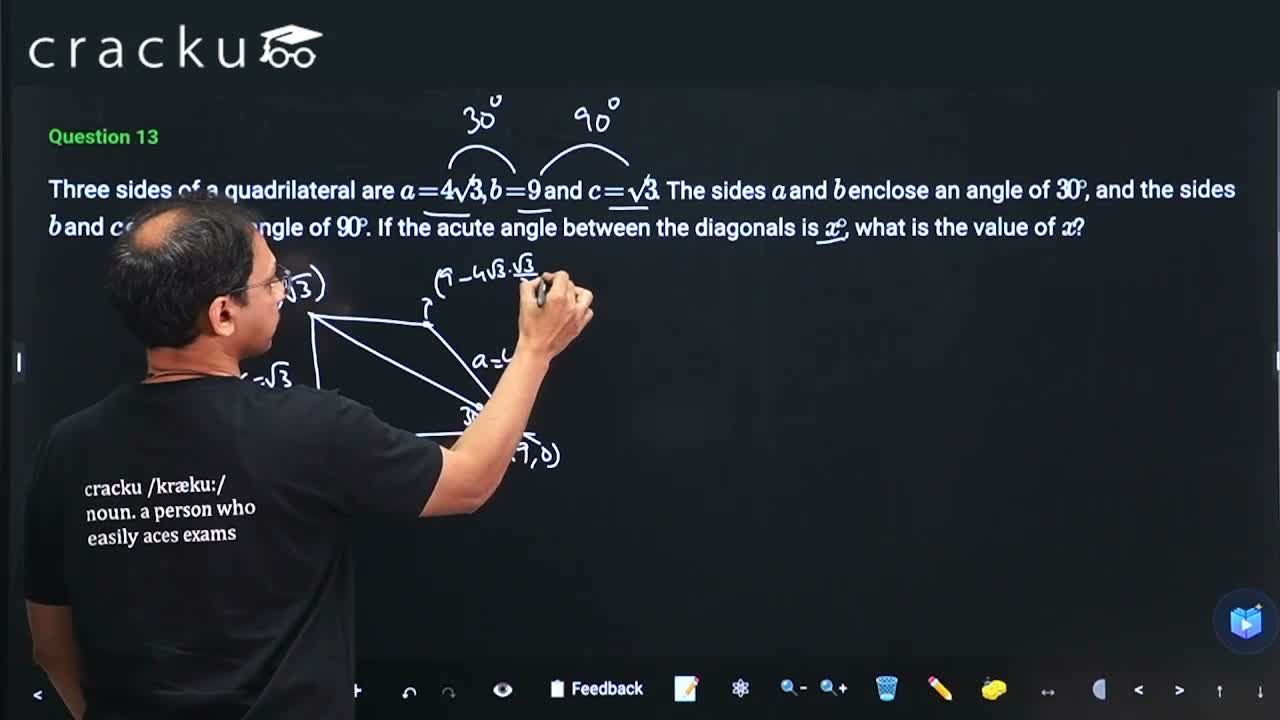
Three sides of a quadrilateral are $$a = 4\sqrt{3}, b = 9$$ and $$c =\sqrt{3}$$. The sides $$𝑎$$ and $$𝑏$$ enclose an angle of $$30^{\circ}$$, and the sides $$𝑏$$ and $$𝑐$$ enclose an angle of $$90^{\circ}$$. If the acute angle between the diagonals is $$x^{\circ}$$, what is the value of $$𝑥$$?
Correct Answer: 60
Let the quadrilateral be $$ABCD$$ in that order with the given consecutive sides
$$AB = a = 4\sqrt{3},\;\;BC = b = 9,\;\;CD = c = \sqrt{3}$$
and with the interior angles
$$\angle ABC = 30^{\circ},\;\;\angle BCD = 90^{\circ}.$$
We place the figure on the Cartesian plane by the following convenient choices.
Step 1: Assign vectors for the sides
Take vertex $$B$$ at the origin and draw $$\overrightarrow{BA}$$ along the positive $$x$$-axis.
$$\overrightarrow{BA}= (4\sqrt{3},\,0).$$
The side $$BC$$ makes an angle of $$30^{\circ}$$ with $$BA$$, so
$$\overrightarrow{BC}= \bigl(9\cos 30^{\circ},\,9\sin 30^{\circ}\bigr) =\left(\frac{9\sqrt3}{2},\,\frac{9}{2}\right).$$
Step 2: Draw $$CD$$ perpendicular to $$BC$$
Because $$\angle BCD = 90^{\circ},\;\overrightarrow{CD}$$ is perpendicular to $$\overrightarrow{BC}$$.
The clockwise unit vector perpendicular to $$BC$$ is
$$\bigl(\sin 30^{\circ},-\cos 30^{\circ}\bigr)=\left(\frac12,\,-\frac{\sqrt3}{2}\right).$$
Multiplying by $$|CD|=c=\sqrt3$$ gives
$$\overrightarrow{CD}= \left(\frac{\sqrt3}{2},\,-\frac{3}{2}\right).$$
(The anticlockwise direction would give a mirror image of the same convex quadrilateral; the acute angle between the diagonals is the same.)
Step 3: Express the two diagonals as vectors
Diagonal $$BD$$: $$\overrightarrow{BD}= \overrightarrow{BC}+\overrightarrow{CD} =\left(\frac{9\sqrt3}{2}+\frac{\sqrt3}{2},\,\frac92-\frac32\right) =\left(5\sqrt3,\,3\right).$$
Diagonal $$AC$$: $$\overrightarrow{AC}= \overrightarrow{AB}+\overrightarrow{BC} -\overrightarrow{BA} =\overrightarrow{BC}-\overrightarrow{BA} =\left(\frac{9\sqrt3}{2}-4\sqrt3,\,\frac{9}{2}-0\right) =\left(\frac{\sqrt3}{2},\,\frac{9}{2}\right).$$
Step 4: Use the dot-product to find the angle $$x$$ between the diagonals
Dot product $$\overrightarrow{BD}\,\cdot\,\overrightarrow{AC} = (5\sqrt3)\left(\frac{\sqrt3}{2}\right)+3\left(\frac{9}{2}\right) =\frac{15}{2}+\frac{27}{2}=21.$$
Magnitudes $$|\overrightarrow{BD}|=\sqrt{(5\sqrt3)^2+3^2} =\sqrt{75+9}=\sqrt{84}=2\sqrt{21},$$ $$|\overrightarrow{AC}|=\sqrt{\left(\frac{\sqrt3}{2}\right)^2+\left(\frac92\right)^2} =\sqrt{\frac34+\frac{81}{4}} =\sqrt{\frac{84}{4}}=\sqrt{21}.$$
Hence $$\cos x =\frac{\overrightarrow{BD}\cdot\overrightarrow{AC}} {|\overrightarrow{BD}|\;|\overrightarrow{AC}|} =\frac{21}{\bigl(2\sqrt{21}\bigr)\bigl(\sqrt{21}\bigr)} =\frac{21}{42}=\frac12.$$
Therefore $$x = \arccos\!\left(\frac12\right)=60^{\circ}.$$
The acute angle between the diagonals is $$\boxed{60}$$.
Was this solution helpful?
Click on the Email ☝️ to Watch the Video Solution
Book Free CAT Mentorship
Get personalized CAT strategy from a 99%iler
500+ students mentored
OTP Verification
Enter the 6-digit code sent to your phone
Booking Summary
Enter OTP
Didn't receive the OTP?
_1.webp)

Predict your JEE Main percentile, rank & performance in seconds

Educational materials for JEE preparation

Ask our AI anything

AI can make mistakes. Please verify important information.
AI can make mistakes. Please verify important information.
 91- 6303239042

