Sign in
Please select an account to continue using cracku.in
↓ →

Join Our JEE Preparation Group
Prep with like-minded aspirants; Get access to free daily tests and study material.
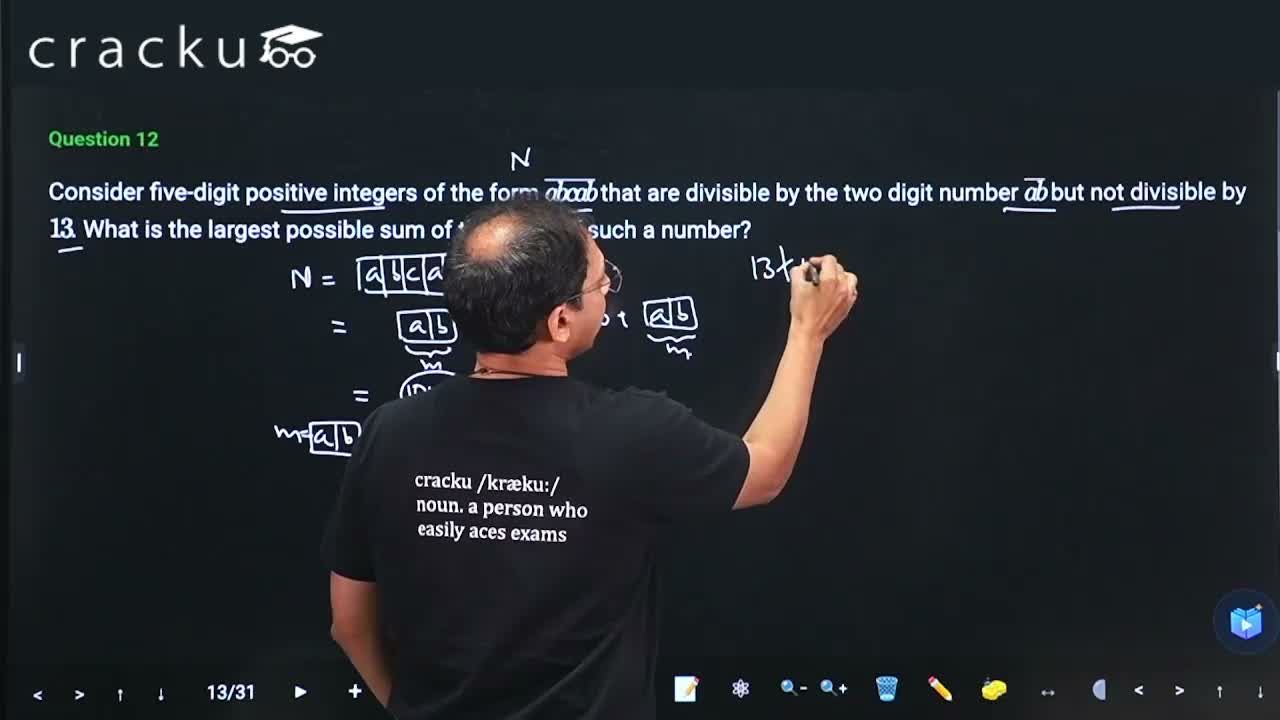
Consider five-digit positive integers of the form $$\overline{abcab}$$ that are divisible by the two digit number $$\overline{ab}$$ but not divisible by $$13$$. What is the largest possible sum of the digits of such a number?
Correct Answer: 33
Let the two-digit number be $$\overline{ab}=10a+b=N\;(\;10\le N\le 99,\;a\neq 0\;).$$
The five-digit number is $$\overline{abcab}=10000a+1000b+100c+10a+b.$$
Simplify it in terms of $$N$$ and $$c$$.
$$\begin{aligned} \overline{abcab}&=10000a+1000b+100c+10a+b\\ &=100(100a+10b+c)+\bigl(10a+b\bigr)\\ &=100\bigl(10N+c\bigr)+N\\ &=1000N+100c+N\\ &=1001N+100c\;.\tag{1} \end{aligned}$$
Condition for divisibility by $$N$$:
From (1), $$\overline{abcab}=1001N+100c$$ is divisible by $$N$$ ⇔ $$N$$ divides $$100c$$ (because $$N$$ always divides $$1001N$$).
Thus we must have $$N\;|\;100c.\tag{2}$$
Prime factors available in $$100c$$:
$$100=2^{2}\,5^{2},\qquad c\in\{1,2,\ldots ,9\}\implies c$$ contributes only the primes $$2,3,5,7.$$
So $$N$$ can contain no prime other than $$2,3,5,7.$$
(We must also remember that the final number must not be divisible by $$13$$.)
Our goal is to maximise the digit-sum
$$S= a+b+c= \tfrac12\bigl(2a+2b\bigr)+c = 2(a+b)+c.\tag{3}$$
Check each value of $$c$$ (only two-digit divisors of $$100c$$ are listed).
Case 1: $$c=9\;(100c=900)$$Two-digit divisors of 900: $$10,12,15,18,20,25,30,36,45,50,60,75,90.$$ For each divisor compute $$S=2(a+b)+9.$$
The largest digit sum occurs for $$N=75\;(a=7,\;b=5):$$
$$S=2(7+5)+9=24+9=33.\tag{4}$$
Verify the number:
$$\overline{abcab}=75975.$$
Divisibility:
$$75975\div 75=1013\;(\text{integer}),\qquad
75975\div 13=5844\text{ remainder }3\;(\text{not divisible}).$$
For $$c=8$$ the best divisor is $$64\;(a=6,b=4)\Rightarrow S=28\lt 33.$$br/> For $$c=7$$ the best divisor is $$35\;(a=3,b=5)\Rightarrow S=23\lt 33.$$br/> For $$c=6$$ the best divisor is $$75\;(a=7,b=5)\Rightarrow S=30\lt 33.$br/> For $$c=1,2,3,4,5$$ the maximum $$S$$ is even smaller.
Special note on $$c=0$$If $$c=0$$, then (1) becomes $$$$\overline{ab0ab}$$=1001N.$$ Since $$1001=7$$\cdot$$ 11$$\cdot$$ 13,$$ every such number is automatically divisible by $$13,$$ so all $$c=0$$ cases are rejected.
Hence the maximal attainable digit-sum is the value in (4), namely $$33.$$
Answer: 33
Was this solution helpful?
Click on the Email ☝️ to Watch the Video Solution
Book Free CAT Mentorship
Get personalized CAT strategy from a 99%iler
500+ students mentored
OTP Verification
Enter the 6-digit code sent to your phone
Booking Summary
Enter OTP
Didn't receive the OTP?
_1.webp)

Predict your JEE Main percentile, rank & performance in seconds

Educational materials for JEE preparation

Ask our AI anything

AI can make mistakes. Please verify important information.
AI can make mistakes. Please verify important information.
 91- 6303239042

