Sign in
Please select an account to continue using cracku.in
↓ →

Join Our JEE Preparation Group
Prep with like-minded aspirants; Get access to free daily tests and study material.
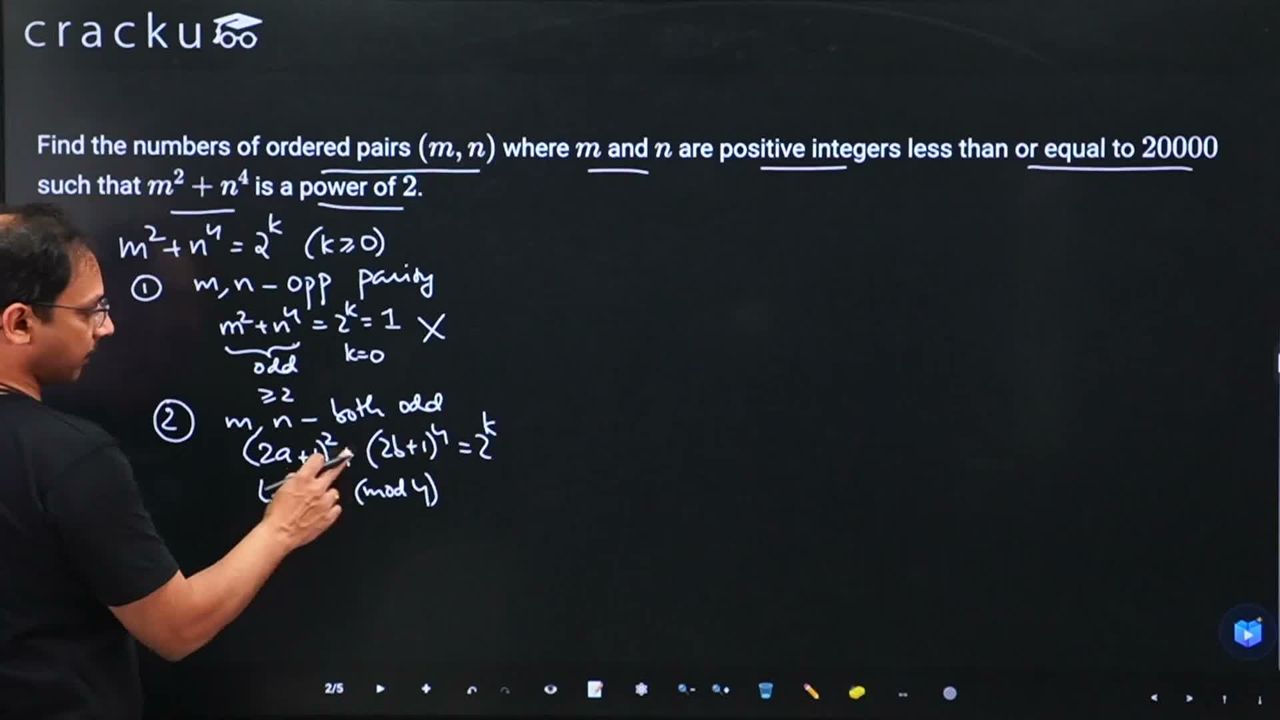
Find the number of ordered pairs $$(𝑚, 𝑛)$$ where $$𝑚$$ and $$𝑛$$ are positive integers less than or equal to $$20000$$ such that $$m^{2} + n^{4}$$ is a power of $$2$$.
Correct Answer: 08
Let $$m,n \in \mathbb{Z}^{+},\; m,n \le 20000$$ and suppose
$$m^{2}+n^{4}=2^{k}\qquad (k\in \mathbb{Z}_{\ge 0}).$$
Denote the highest power of $$2$$ dividing an integer $$x$$ by $$v_{2}(x)$$. Write
$$m = 2^{u}\,m_{1},\qquad n = 2^{v}\,n_{1},\quad\text{where } m_{1},n_{1}\text{ are odd},\; u,v\ge 0.$$
Then
$$m^{2}=2^{\,2u}\,m_{1}^{2},\qquad n^{4}=2^{\,4v}\,n_{1}^{4}.$$
Factor the common power of $$2$$ out of the sum:
$$m^{2}+n^{4}=2^{t}\Bigl(m_{1}^{2}\,2^{\,2u-t}+n_{1}^{4}\,2^{\,4v-t}\Bigr),$$
where $$t=\min \{2u,\,4v\}=v_{2}(m^{2}+n^{4})$$. For the bracketed term to be an integer, one of the exponents $$2u-t,\;4v-t$$ is zero.
Case 1: $$2u\lt 4v\;(\,t=2u\,).$$ The bracket equals $$m_{1}^{2}+n_{1}^{4}\,2^{\,4v-2u}$$, which is **odd + even = odd**. A positive odd power of $$2$$ can only be $$1$$, but the bracket is at least $$1+2=3$$ (because $$4v-2u\ge 2$$). Impossible. Case 2: $$4v\lt 2u\;(\,t=4v\,).$$ Now the bracket is **even + odd = odd**, again impossible by the same argument. Case 3: $$2u=4v\;(\,\Rightarrow u=2v,\; t=2u=4v\,).$$ Then$$m^{2}+n^{4}=2^{\,4v}\bigl(m_{1}^{2}+n_{1}^{4}\bigr)=2^{k}.$$
Hence $$m_{1}^{2}+n_{1}^{4}=2^{\,k-4v}.$$
Since both $$m_{1},n_{1}$$ are odd, $$m_{1}^{2}\equiv n_{1}^{4}\equiv 1 \pmod{8}$$, so their sum is $$\equiv 2 \pmod{8}$$. A power of $$2$$ that is $$2 \pmod{8}$$ is exactly $$2^{1}=2$$. Therefore
$$m_{1}^{2}+n_{1}^{4}=2,\qquad\Rightarrow\qquad m_{1}=1,\; n_{1}=1.$$
Combining with $$u=2v$$ gives
$$n = 2^{v},\qquad m = 2^{\,2v},\qquad v\in \mathbb{Z}_{\ge 0}.$$
Now apply the upper bound $$m,n \le 20000$$:
$$2^{v}\le 20000,\quad 2^{\,2v}\le 20000.$$
The second inequality is stricter. Compute successive powers:
$$\begin{aligned} v=0:&\;2^{0}=1,\;2^{0}=1 \\ v=1:&\;2^{1}=2,\;2^{2}=4 \\ v=2:&\;2^{2}=4,\;2^{4}=16 \\ v=3:&\;2^{3}=8,\;2^{6}=64 \\ v=4:&\;2^{4}=16,\;2^{8}=256 \\ v=5:&\;2^{5}=32,\;2^{10}=1024 \\ v=6:&\;2^{6}=64,\;2^{12}=4096 \\ v=7:&\;2^{7}=128,\;2^{14}=16384 \\ v=8:&\;2^{8}=256,\;2^{16}=65536\;(\gt 20000) \\ \end{aligned}$$
Thus admissible values are $$v=0,1,2,3,4,5,6,7$$ — eight choices in all.
Each $$v$$ gives the pair $$\bigl(m,n\bigr)=\bigl(2^{\,2v},\,2^{v}\bigr).$$
Therefore the required number of ordered pairs is 08.
Was this solution helpful?
Click on the Email ☝️ to Watch the Video Solution
Book Free CAT Mentorship
Get personalized CAT strategy from a 99%iler
500+ students mentored
OTP Verification
Enter the 6-digit code sent to your phone
Booking Summary
Enter OTP
Didn't receive the OTP?
_1.webp)

Predict your JEE Main percentile, rank & performance in seconds

Educational materials for JEE preparation

Ask our AI anything

AI can make mistakes. Please verify important information.
AI can make mistakes. Please verify important information.
 91- 6303239042

