Sign in
Please select an account to continue using cracku.in
↓ →

Join Our JEE Preparation Group
Prep with like-minded aspirants; Get access to free daily tests and study material.
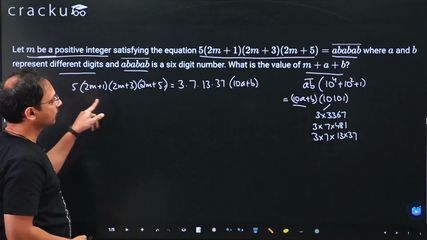
Let $$𝑚$$ be a positive integer satisfying the equation $$5(2m + 1)(2m + 3)(2m + 5) = \overline{ababab}$$ where $$𝑎$$ and $$𝑏$$ represent different digits and $$\overline{ababab}$$ is a six digit number. What is the value of $$𝑚 + 𝑎 + 𝑏$$?
Correct Answer: 24
The number with the repeated pattern $$\overline{ababab}$$ can be written algebraically.
Hundred-thousands, thousands and tens places contain the digit $$a$$, while ten-thousands, hundreds and units places contain $$b$$:
$$\overline{ababab}=a\,(100000+1000+10)+b\,(10000+100+1)=10101(10a+b).$$
Hence the given equation becomes
$$5(2m+1)(2m+3)(2m+5)=10101(10a+b).$$
1. The right side must be divisible by $$5$$, so the last digit of $$\overline{ababab}$$ equals $$b\in\{0,5\}$$.
2. The left side is $$5\times(\text{odd})$$, therefore its last digit is $$5$$ (never $$0$$).
⇒ $$b=5$$.
Thus $$10a+b=10a+5=5(2a+1)$$ and
$$\overline{ababab}=10101\bigl(5(2a+1)\bigr)=50505(2a+1).$$
Divide the original equation by $$5$$:
$$\bigl(2m+1\bigr)\bigl(2m+3\bigr)\bigl(2m+5\bigr)=10101(2a+1). \quad -(1)$$
Let $$n=2m+3$$ (the middle odd number). Then $$n$$ is odd and
Left side $$=(n-2)\,n\,(n+2)=n(n^2-4)=n^3-4n. \quad -(2)$$
Rewrite (1) with this notation:
$$n^3-4n=10101(2a+1). \quad -(3)$$
Because $$a$$ is a non-zero digit different from $$5$$, the possible values of $$2a+1$$ are
$$3,5,7,9,13,15,17,19. \quad -(4)$$
Compute $$10101(2a+1)$$ for each case (use mental multiplication or short work):
$$\begin{aligned} 2a+1=3 &\Rightarrow 30303\\ 2a+1=5 &\Rightarrow 50505\\ 2a+1=7 &\Rightarrow 70707\\ 2a+1=9 &\Rightarrow 90909\\ 2a+1=13&\Rightarrow 131313\\ 2a+1=15&\Rightarrow 151515\\ 2a+1=17&\Rightarrow 171717\\ 2a+1=19&\Rightarrow 191919 \end{aligned}$$
Now solve $$n^3-4n=R$$ for each right-hand value $$R$$ above. Because $$n^3$$ dominates, take the integer cube root of $$R$$ as a first guess:
Case 2a+1 = 5: R = 50505$$\sqrt[3]{50505}\approx37.$$ Test $$n=37$$ in (2): $$37^3-4(37)=50653-148=50505,$$ which matches $$R$$ exactly.
Therefore $$n=37=2m+3\;\Longrightarrow\;2m=34\;\Longrightarrow\;m=17.$
Since $$2a+1=5\;\Longrightarrow\;a=2$$ and we already had $$b=5$$, the triple $$(m,a,b)=(17,2,5)$$ satisfies every condition.
Checking the other values of $$R$$ shows no integer $$n$$ solves $$n^3-4n=R$$ (the two nearest cubes always differ from $$R$$). Thus the solution found is unique.
Finally, the required sum is
$$m+a+b = 17+2+5 = 24.$$
Answer: 24
Was this solution helpful?
Click on the Email ☝️ to Watch the Video Solution
Book Free CAT Mentorship
Get personalized CAT strategy from a 99%iler
500+ students mentored
OTP Verification
Enter the 6-digit code sent to your phone
Booking Summary
Enter OTP
Didn't receive the OTP?
_1.webp)

Predict your JEE Main percentile, rank & performance in seconds

Educational materials for JEE preparation

Ask our AI anything

AI can make mistakes. Please verify important information.
AI can make mistakes. Please verify important information.
 91- 6303239042

