
Join Our JEE Preparation Group
Prep with like-minded aspirants; Get access to free daily tests and study material.
Sign in
Please select an account to continue using cracku.in
↓ →
Join Our JEE Preparation Group
Prep with like-minded aspirants; Get access to free daily tests and study material.
Three capacitors $$C_1 = 2 \mu$$F, $$C_2 = 6 \mu$$F and $$C_3 = 12 \mu$$F are connected as shown in the figure. Find the ratio of the charges on capacitors $$C_1$$, $$C_2$$ and $$C_3$$ respectively.
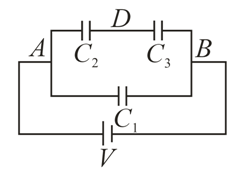
We need to find the ratio of the charges on the capacitors $$C_1$$, $$C_2$$, and $$C_3$$ arranged in the given circuit configuration.
Let's look closely at the nodes and connections across the network :
The values of the three capacitors are given as:
$$C_1 = 2\ \mu\text{F},\quad C_2 = 6\ \mu\text{F},\quad C_3 = 12\ \mu\text{F}$$
Since the voltage across $$C_1$$ is the full voltage $$V$$:
$$Q_1 = C_1 \times V = 2V$$
Because $$C_2$$ and $$C_3$$ are connected together in series within their branch, the same amount of electric charge flows through both of them ($$Q_2 = Q_3$$). This shared charge is determined by the equivalent capacitance ($$C_{\text{eq, top}}$$) of that branch multiplied by the potential difference $$V$$:
$$\frac{1}{C_{\text{eq, top}}} = \frac{1}{C_2} + \frac{1}{C_3} = \frac{1}{6} + \frac{1}{12}$$
$$\frac{1}{C_{\text{eq, top}}} = \frac{2 + 1}{12} = \frac{3}{12} = \frac{1}{4} \implies C_{\text{eq, top}} = 4\ \mu\text{F}$$
Now, calculate the charge on this series branch:
$$Q_2 = Q_3 = C_{\text{eq, top}} \times V = 4V$$
We can now construct the required ratio of the charges on $$C_1$$, $$C_2$$, and $$C_3$$ respectively:
$$Q_1 : Q_2 : Q_3 = 2V : 4V : 4V$$
Dividing throughout by the common factor $$2V$$ gives:
$$Q_1 : Q_2 : Q_3 = 1 : 2 : 2$$
Final Answer: 1 : 2 : 2 (Option D)
Create a FREE account and get:
_1.webp)

Educational materials for JEE preparation

Ask our AI anything

AI can make mistakes. Please verify important information.
AI can make mistakes. Please verify important information.


