
Join Our JEE Preparation Group
Prep with like-minded aspirants; Get access to free daily tests and study material.
Sign in
Please select an account to continue using cracku.in
↓ →
Join Our JEE Preparation Group
Prep with like-minded aspirants; Get access to free daily tests and study material.
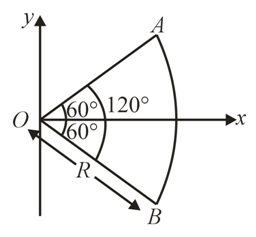
Figure shows a rod $$AB$$, which is bent in a 120° circular arc of radius $$R$$. A charge $$(-Q)$$ is uniformly distributed over rod AB. What is the electric field $$\vec{E}$$ at the centre of curvature O?
We need to find the maximum mass $$m_{\text{pan}}$$ that can be placed in the pan without breaking either of the two wires, $$W_1$$ or $$W_2$$.
Both wires are made of the same material, meaning they share the same breaking stress limit:
The maximum tension ($$T_{\text{max}}$$) a wire can sustain before breaking is given by the formula:
$$T_{\text{max}} = \sigma_{\text{max}} \times A$$
$$T_{1,\text{max}} = (1.25 \times 10^9) \times (8 \times 10^{-7}) = 10 \times 10^2 = 1000\text{ N}$$
$$T_{2,\text{max}} = (1.25 \times 10^9) \times (4 \times 10^{-7}) = 5 \times 10^2 = 500\text{ N}$$
Let $$m$$ be the maximum mass added to the pan. The tensions experienced by the two wires under static equilibrium are determined by the hanging loads beneath them:
$$T_2 = (10 + m)g = (10 + m) \times 10 = 100 + 10m$$
$$T_1 = (20 + 10 + m)g = (30 + m) \times 10 = 300 + 10m$$
To avoid breaking, the actual tension in each wire must not exceed its maximum capacity:
$$T_1 \le T_{1,\text{max}}$$
$$300 + 10m \le 1000 \implies 10m \le 700 \implies m \le 70\text{ kg}$$
$$T_2 \le T_{2,\text{max}}$$
$$100 + 10m \le 500 \implies 10m \le 400 \implies m \le 40\text{ kg}$$
To ensure neither wire breaks, we must choose the smaller value of the two mass constraints. If the mass exceeds $$40\text{ kg}$$, wire $$W_2$$ will snap first.
Therefore, the maximum safe mass that can be added to the pan is exactly $$40\text{ kg}$$.
Final Answer: 40
Create a FREE account and get:
_1.webp)

Educational materials for JEE preparation

Ask our AI anything

AI can make mistakes. Please verify important information.
AI can make mistakes. Please verify important information.


