
Join Our JEE Preparation Group
Prep with like-minded aspirants; Get access to free daily tests and study material.
Sign in
Please select an account to continue using cracku.in
↓ →
Join Our JEE Preparation Group
Prep with like-minded aspirants; Get access to free daily tests and study material.
If the R.M.S. speed of oxygen molecules at 0°C is 160 m s$$^{-1}$$. Find the R.M.S. speed of hydrogen molecules at 0°C.
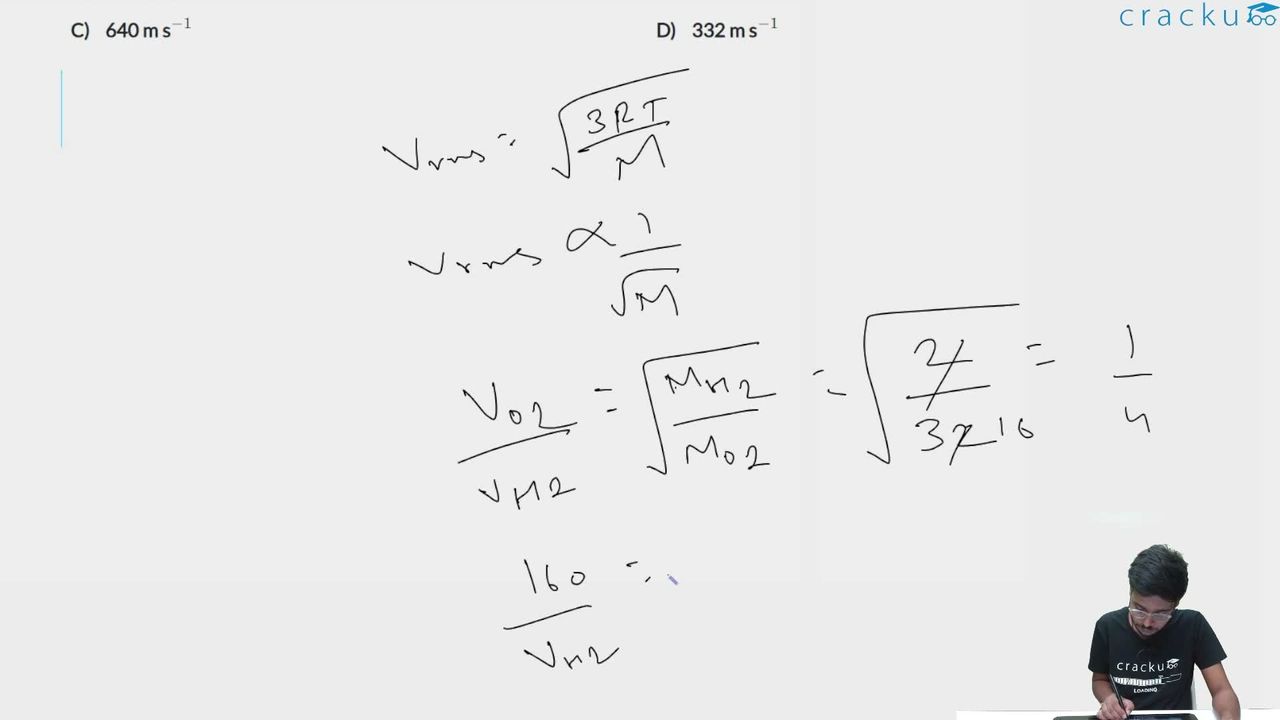
We recall the ideal-gas expression for root-mean-square (R.M.S.) speed: $$v_{\text{rms}}=\sqrt{\dfrac{3RT}{M}},$$ where $$R$$ is the universal gas constant, $$T$$ is the absolute temperature and $$M$$ is the molar mass of the gas in kilogram per mole.
Because both gases are at the same temperature $$T=0^{\circ}\text{C}=273\ \text{K},$$ the factor $$3RT$$ will be common. Hence, for two gases 1 and 2 we may write the ratio
$$\dfrac{v_{\text{rms,1}}}{v_{\text{rms,2}}} =\sqrt{\dfrac{M_2}{M_1}}.$$
Here, gas 1 is hydrogen $$(\mathrm{H_2})$$ and gas 2 is oxygen $$(\mathrm{O_2}).$$ Therefore we have
$$v_{\text{rms}(\text{H}_2)}=v_{\text{rms}(\text{O}_2)}\sqrt{\dfrac{M_{\mathrm{O_2}}}{M_{\mathrm{H_2}}}}.$$
Now we substitute the given value $$v_{\text{rms}(\text{O}_2)}=160\ \text{m s}^{-1}$$ and the molar masses $$M_{\mathrm{O_2}}=32\ \text{g mol}^{-1}$$, $$M_{\mathrm{H_2}}=2\ \text{g mol}^{-1}$$:
$$v_{\text{rms}(\text{H}_2)} = 160 \times \sqrt{\dfrac{32}{2}}.$$
Inside the square root we simplify first: $$\dfrac{32}{2}=16.$$ Taking the square root gives $$\sqrt{16}=4.$$
So we obtain
$$v_{\text{rms}(\text{H}_2)} = 160 \times 4 = 640\ \text{m s}^{-1}.$$
Hence, the correct answer is Option C.
Click on the Email ☝️ to Watch the Video Solution
Create a FREE account and get:
_1.webp)

Educational materials for JEE preparation

Ask our AI anything

AI can make mistakes. Please verify important information.
AI can make mistakes. Please verify important information.


