Sign in
Please select an account to continue using cracku.in
↓ →
In this question, three statements are given, followed by three conclusions numbered I, II and Ill. Assuming the statements to be true, even if they seem to be at variance with commonly known facts, decide which of the conclusions logically follows/follow from the statements.
Statements:
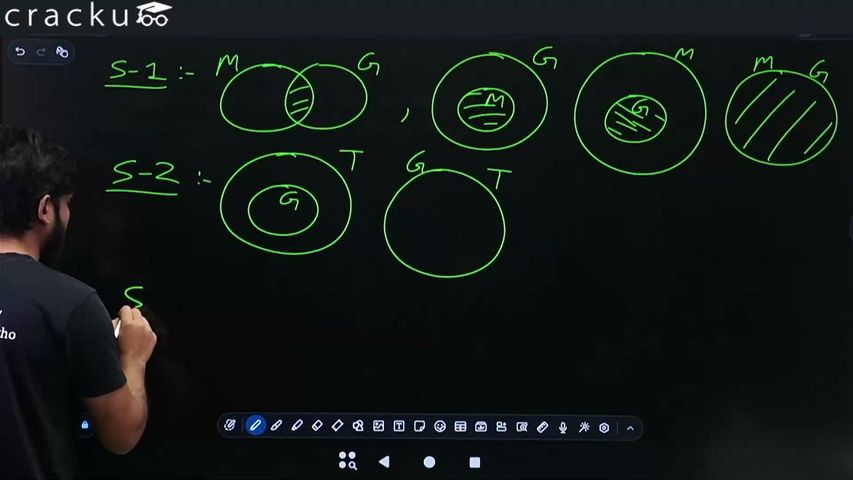
Some mirrors are glass.
All glass are taps.
Some taps are pens.
Conclusions:
I. Some glass are mirrors.
II. All taps are glass.
III. Some pens are taps.
Write the three statements in standard form keeping subject → predicate order consistent:
$$S_1:$$ Some mirrors are glass.
$$S_2:$$ All glass are taps.
$$S_3:$$ Some taps are pens.
We now test each conclusion against these statements using the two basic rules of categorical logic that are always valid:
Rule 1 (Conversion for “Some A are B”): From “Some A are B” we can interchange subject and predicate to get “Some B are A.”
Rule 2 (Immediate statement acceptance): A conclusion that restates a given premise is always valid.
Testing Conclusion I: “Some glass are mirrors.”
Statement $$S_1$$ is “Some mirrors are glass.” By Rule 1 we may convert it to “Some glass are mirrors.” Therefore Conclusion I logically follows.
Testing Conclusion II: “All taps are glass.”
Statement $$S_2$$ says “All glass are taps,” which is a one-way inclusion. The converse “All taps are glass” is not guaranteed by the original statement, so Conclusion II does not follow.
Testing Conclusion III: “Some pens are taps.”
Statement $$S_3$$ itself is “Some taps are pens.” Converting by Rule 1 would give “Some pens are taps,” exactly our conclusion. Hence Conclusion III follows.
Therefore only Conclusions I and III follow.
Option D which is: Only conclusions I and III follow.
Was this solution helpful?
Click on the Email ☝️ to Watch the Video Solution
Create a FREE account and get:
Start your IIM journey with the right preparation and crack CAT 2026.

Educational materials for CAT preparation

Ask our AI anything

AI can make mistakes. Please verify important information.
AI can make mistakes. Please verify important information.
 91- 6303239042

