
Join Our JEE Preparation Group
Prep with like-minded aspirants; Get access to free daily tests and study material.
Sign in
Please select an account to continue using cracku.in
↓ →
Join Our JEE Preparation Group
Prep with like-minded aspirants; Get access to free daily tests and study material.
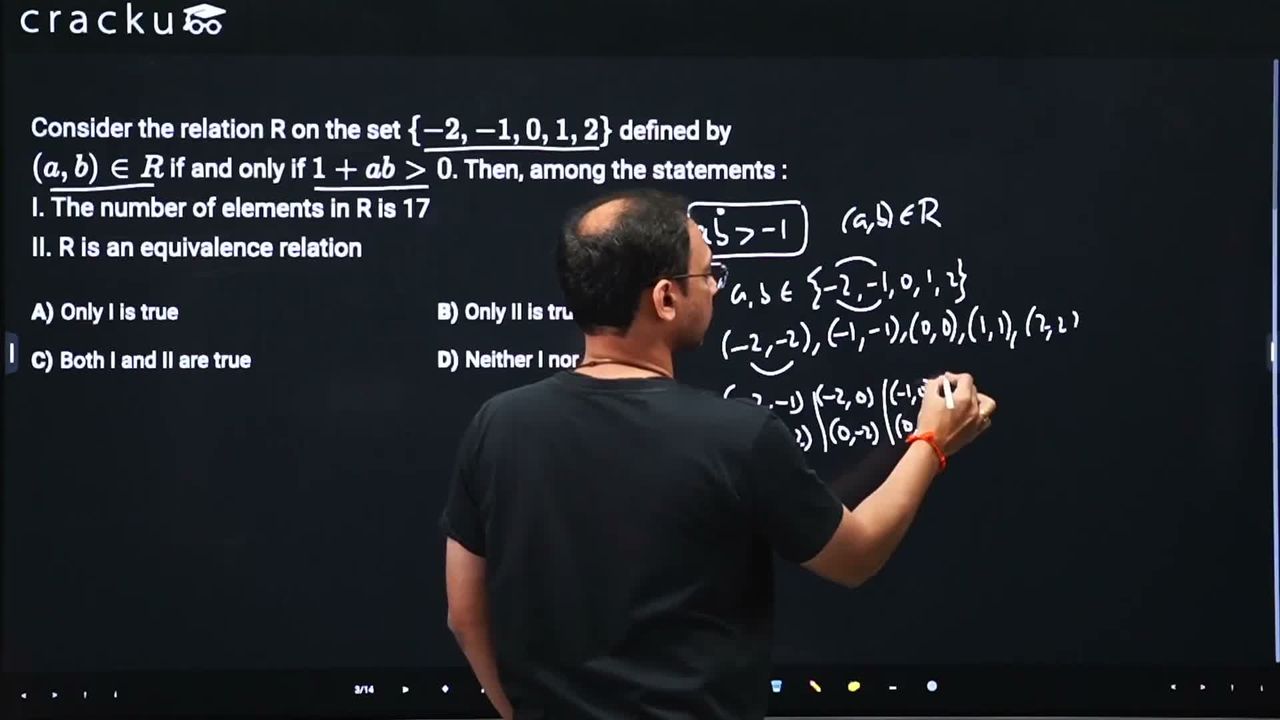
Consider the relation R on the set $$\{-2, -1, 0, 1, 2\}$$ defined by $$(a, b) \in R$$ if and only if $$1 + ab > 0$$. Then, among the statements :
I. The number of elements in R is 17
II. R is an equivalence relation
Pairs for $$1 + ab > 0$$ (or $$ab > -1$$):
$$(-2, -2), (-2, -1), (-2, 0)$$ [3 pairs]
$$(-1, -2), (-1, -1), (-1, 0)$$ [3 pairs]
$$(0, -2), (0, -1), (0, 0), (0, 1), (0, 2)$$ [5 pairs]
$$(1, 0), (1, 1), (1, 2)$$ [3 pairs]
$$(2, 0), (2, 1), (2, 2)$$ [3 pairs]
$$\text{Total elements} = 3 + 3 + 5 + 3 + 3 = 17$$
Therefore, Statement I is true.
We know that $$(-2, 0) \in R$$ because $$1 + (-2)(0) = 1 > 0$$. We also know that $$(0, 2) \in R$$ because $$1 + (0)(2) = 1 > 0$$.
For $$R$$ to be transitive, the pair $$(-2, 2)$$ must also belong to $$R$$.
$$1 + (-2)(2) = 1 - 4 = -3 \ngtr 0$$
Since $$(-2, 0) \in R$$ and $$(0, 2) \in R$$, but $$(-2, 2) \notin R$$, the relation is not transitive. Therefore, it cannot be an equivalence relation.
Hence, Statement II is false.
Was this solution helpful?
Click on the Email ☝️ to Watch the Video Solution
Create a FREE account and get:
_1.webp)

Educational materials for JEE preparation

Ask our AI anything

AI can make mistakes. Please verify important information.
AI can make mistakes. Please verify important information.
