
Join Our JEE Preparation Group
Prep with like-minded aspirants; Get access to free daily tests and study material.
Sign in
Please select an account to continue using cracku.in
↓ →
Join Our JEE Preparation Group
Prep with like-minded aspirants; Get access to free daily tests and study material.
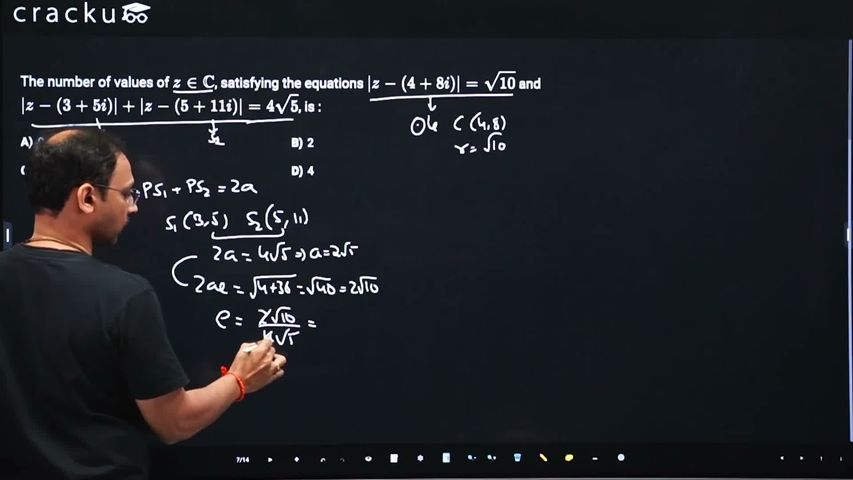
The number of values of $$z \in \mathbb{C}$$, satisfying the equations $$|z - (4 + 8i)| = \sqrt{10}$$ and $$|z - (3 + 5i)| + |z - (5 + 11i)| = 4\sqrt{5}$$, is :
This is a great geometry-based complex numbers problem. To find the number of values of $$z$$, we need to identify the geometric shapes represented by these two equations and see how many times they intersect.
Step 1: Identify the First Shape
The equation $$|z - (4 + 8i)| = \sqrt{10}$$ represents a circle.
Step 2: Identify the Second Shape
The equation $$|z - (3 + 5i)| + |z - (5 + 11i)| = 4\sqrt{5}$$ represents an ellipse, provided that the constant ($$4\sqrt{5}$$) is greater than the distance between the two fixed points (foci).
$$\sqrt{(5-3)^2 + (11-5)^2} = \sqrt{2^2 + 6^2} = \sqrt{4 + 36} = \sqrt{40} = 2\sqrt{10}$$
Since $$\sqrt{80} > \sqrt{40}$$ (i.e., $$2a > 2ae$$), this is a valid ellipse.
Step 3: Check the Relationship
Interestingly, let's find the midpoint of the foci of the ellipse:
Notice: The center of the circle is exactly the same as the center of the ellipse! Both are centered at $$(4, 8)$$.
Step 4: Determine Intersection
To see if they intersect, let's compare the radius of the circle to the semi-minor and semi-major axes of the ellipse.
$$b^2 = 20 - 10 = 10 \implies b = \sqrt{10}$$
Conclusion:
The radius of the circle ($$r = \sqrt{10}$$) is exactly equal to the semi-minor axis of the ellipse ($$b = \sqrt{10}$$).
Because the circle is centered at the same point as the ellipse and its radius falls between the length of the semi-minor and semi-major axes (specifically, it equals the semi-minor axis), the circle will be tangent to the ellipse at the two co-vertices.
Therefore, there are 2 points of intersection.
Correct Option: B (2)
Was this solution helpful?
Click on the Email ☝️ to Watch the Video Solution
Create a FREE account and get:
_1.webp)

Educational materials for JEE preparation

Ask our AI anything

AI can make mistakes. Please verify important information.
AI can make mistakes. Please verify important information.
