Two buses travel between Jamshedpur and Kolkata in the opposite directions, on the same road. On that road, the maximum allowed speeds are different (but constant) for the opposite directions. Usually, both buses travel at the respective maximum allowed speeds to their respective destinations: the bus from Jamshedpur to Kolkata takes 4 hours, while the bus from Kolkata to Jamshedpur takes 3 hours.
One day, the two buses start at the same time. However, one hour after starting, the bus from Jamshedpur to Kolkata reduces its speed to half of its maximum allowed speed due to congestion on the road.
If both buses do not stop anywhere in between, how many hours after starting do they meet?
XAT Time, Speed and Distance Questions
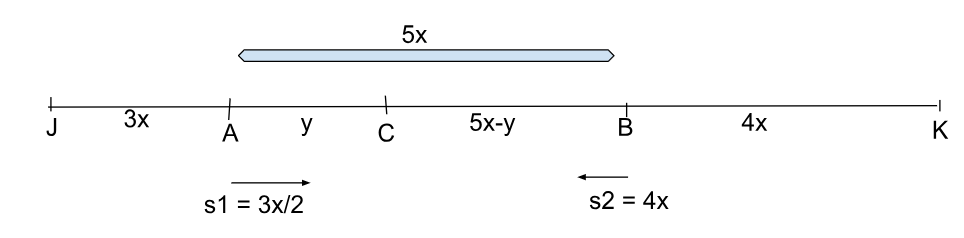
Let the maximum allowed speed from Jamshedpur to Kolkata be s1 kmph and the maximum allowed speed from Kolkata to Jamshedpur be s2 kmph. Since the bus is moving at the maximum allowed speed then we can say that the speed of the bus moving from Jamshedpur to Kolkata (Bus 1) is s1 kmph and the speed of the bus moving from Kolkata to Jamshedpur (Bus 2) is s2 kmph.
Time taken by Bus 1 to travel from Jamshedpur to Kolkata = 4 hrs
Distance travelled by Bus 1 = 4 $$\times\ $$s1
Time taken by Bus 2 to travel from Kolkata to Jamshedpur = 3 hrs
Distance travelled by Bus 1 = 3 $$\times\ $$s2
Since both the bus is travelling on the same road, the distance travelled by both the buses will be same.
4 $$\times\ $$s1 = 3 $$\times\ $$s2
$$\ \frac{\ s1}{s2}=\ \frac{\ 3}{4}$$
The ratio of speed of Bus 1 to the speed of Bus 2 is 3:4.
Hence, let the speed of Bus 1 be 3x kmph and the speed of Bus 2 be 4x kmph.
Total distance travelled by the buses = $$4\times\ 3x\ =3\times\ 4x=12x$$
Now, both the buses started at the same time and travelled at the maximum allowed speed for 1 hr.
Distance travelled by Bus 1= JA = $$3x\times\ 1=3x$$
Distance travelled by Bus 2= KB = $$4x\times\ 1=4x$$
Distance left to be travelled= AB = $$12x-\left(3x+4x\right)=5x$$
Now, the speed of Bus 1 is reduced to half due to congestion.
New speed of Bus 1 = $$\ \frac{\ 3x}{2}$$
After the reduction of speed, let the two buses meet at point C and the time taken by both the buses to reach C is the same.
Let the distance travelled by Bus 1 from A to C be y km.
BC = 5x-y km
Hence, $$\ \frac{\ y}{\ \frac{\ 3x}{2}}=\ \frac{\ 5x-y}{4x}$$
y = $$\ \frac{\ 15x}{11}$$
Time required = $$\ \frac{\ \ \frac{\ 15x}{11}}{\ \frac{\ 3x}{2}}=\ \frac{\ 10}{11}$$ hrs
Total time required for both the buses to meet = $$\frac{\ 10}{11}+1=\ \frac{\ 21}{11}$$ hrs
Hence, both the buses will meet after $$\frac{\ 21}{11}$$ hrs from starting.
$$\therefore\ $$ The required answer is D.
The swimming pool in an exclusive club is a circular strip. A water flow is artificially maintained in the strip, along a clockwise direction, at a constant speed of 3km/h (kilometers/hour). One morning, Ayub and Rana start swimming at the same time from two diametrically opposite points on the strip. Ayub swims in a counterclockwise direction, while Rana swims in a clockwise direction. They swim at constant, but different, speeds. When they meet for the first time, Ayub has covered 60m (meters). They meet again after Rana has covered 180m from the first meeting point.
If Rana swims at the speed of 3 km/h in still water, how long does Ayub take to complete one round of the circular strip, if he swims in the clockwise direction?
Let us denote Ayub and Rana as A and R respectively for simplicity.
Let the speed of A and B in still water be Sa and Sr respectively and the speed of river be r.
r = 3 kmph = 50 $$\ \frac{\ m}{\min}$$ (clockwise)
Sr = 3 kmph = 50 $$\ \frac{\ m}{\min}$$ (clockwise)
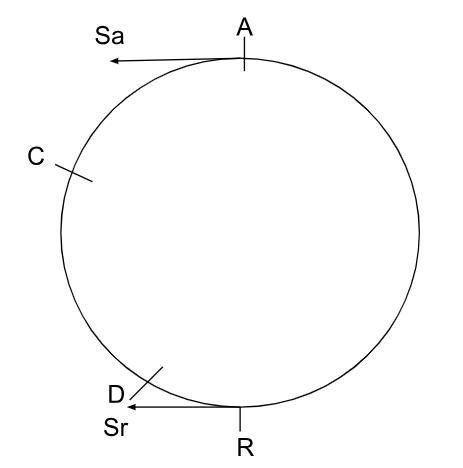
Since A is swimming in counter clockwise direction and R is swimming in clockwise direction, let C be the point where they meet for the first time.
Distance travelled by A = AC = 60m
Speed of A = (Sa-50) $$\ \frac{\ m}{\min}$$ (as he is travelling in counter clockwise direction which is upstream)
Time taken by A to reach C = $$\ \frac{\ 60}{Sa-50}\min$$
Speed of R = (Sr+50) $$\ \frac{\ m}{\min}$$ (as he is travelling in clockwise direction which is downstream)
= 100 $$\ \frac{\ m}{\min}$$
Since, the time taken by R to reach C is the same as the time taken by A to reach C (as they started swimming at the same time), distance travelled by R = RC = $$\ \frac{\ 100\times\ 60}{Sa-50}m$$
Total distance travelled by both A and R = AC + RC = $$\ \frac{\ 6000}{Sa-50}+60\ m$$
As A and R travelled in opposite directions from exactly diametrical ends, the distance A to R will be half of the circumference of the circle.
$$\pi\ r$$ = $$\ \frac{\ 6000}{Sa-50}+60\ m$$ $$\longrightarrow\ i$$
Now, let's assume that they meet again at D after R travelled for 180m,
Time taken for them to meet again = $$\ \frac{\ 180}{100}\min$$
Distance travelled by A = CD (in counter clockwise direction) = $$\ \frac{\ \left(Sa-50\right)\times\ 180}{100}m$$
Distance travelled by R = CD (in clockwise direction) = 180m
Total distance travelled = $$\ \frac{\ \left(Sa-50\right)\times\ 180}{100}m$$ + 180 m
This distance will be equal to the circumference of the circle.
Hence, $$2\pi\ r$$ = $$\ \frac{\ \left(Sa-50\right)\times\ 180}{100}m$$ + 180 m $$\longrightarrow\ ii$$
Take the value of $$\pi\ r$$ from equation i and substitute it in equation ii.
$$\ \frac{\ 12000}{Sa-50}+120=\ \frac{\ 180\left(Sa-50\right)}{100}+180$$
Let the value of Sa-50 be t.
$$\ \frac{\ 12000}{t}+120=\ \frac{\ 180\left(t\right)}{100}+180$$
$$\ 3t^2+100t-20000=0$$
t = $$\ \frac{\ 200}{3}$$, -100 (Not possible as the speed can't be negative)
Sa-50 = $$\ \frac{\ 200}{3}$$
Sa = $$\ \frac{\ 350}{3}\ \frac{\ m}{\min}$$
Use this value in equation ii to get, $$2\pi\ r$$ = 300m
Speed of A when he is swimming in clockwise direction = $$\ \frac{\ 350}{3}+50$$
= $$\ \frac{\ 500}{3}\ \frac{\ m}{\min}$$
Time taken by A to complete one round of the circular strip = $$\ \frac{300}{\ \frac{\ 500}{3}\ }\min$$
= $$\ \frac{\ 9}{5}\min$$ = 1 min 48 sec
Hence, the time taken by A to complete one round of the circular strip is 1 min 48 sec.
$$\therefore\ $$ The answer is D.
There are five dustbins along a circular path at different places. Ramesh takes multiple rounds of the path every morning, always at the same speed. He noticed that it took him a different number of steps to walk between any two consecutive dustbins. Ramesh also noticed that starting from any of the dustbins, it took a minimum 800 steps to reach every second dustbin. On the other hand, starting from any of the dustbins, it took a maximum 1260 steps to reach every third dustbin.
If Ramesh’s one step is 0.77 metre, and the width of the path is negligible, which the following can be the radius of the circular path?
Let's assume that all the dustbins are at equal distances and the distance between two dustbin's be l.
We are told that a minimum 800 steps to reach every second dustbin.
800$$\le$$2l $$\Rightarrow$$ 400 $$\le$$ l
Similarly, we are also told that a maximum 1260 steps to reach every third dustbin.
So, 3l$$\le$$1260
400$$\le$$l$$\le$$420
The circumference will be 5l.
2000$$\le$$ 5l $$\le$$ 2100
2000 and 2100 are both in steps of Ramesh.
We are told that each of his step is 0.77m.
So, 2000 steps = 2000*0.77= 1540m
2100 steps = 2100*0.77 = 1617
So, the circumference will lie between 1540 and 1617.
1540 $$\le 2\pi r \le$$ 1617.
$$\frac{1540}{2\pi}\le r\le\frac{1617}{2\pi}$$
$$245.22\le r\le\ 257.48$$
So, 250m is the correct option.
A flight, traveling to a destination 11,200 kms away, was supposed to take off at 6:30 AM. Due to bad weather, the departure of the flight got delayed by three hours. The pilot increased the average speed of the airplane by 100 km/hr from the initially planned average speed, to reduce the overall delay to one hour.
Had the pilot increased the average speed by 350 km/hr from the initially planned average speed, when would have the flight reached its destination?
Let's assume the initial speed of the flight is F. And the time taken is t.
Given the distance to be travelled, 11200.
We know distance = speed *time.
So, 11200=Ft-->1
Due to bad weather, the flight started with a three-hour delay. Given that the flight speed increased by 100kmph, the delay would be reduced to one hour. So, it is nothing but the travel time is reduced by 2 hours.
In that case, the equation will become 11200=(F+100)*(t-2)-->2
Equation 1 can be re-written as t=$$\frac{11200}{F}$$-->3
Now Equation 2: $$\frac{11200}{F+100}$$=t-2
$$\Rightarrow$$ = $$\frac{11200}{F+100}$$+2=t
$$\frac{11200+2\left(F+100\right)}{F+100}=t$$
$$t=\frac{11400+2F}{F+100}$$-->4
Divide equation 3 by equation 4:'
$$\frac{t}{t}=\frac{\frac{11200}{F}}{\frac{11400+2F}{F+100}}$$
$$\Rightarrow$$ $$\frac{\left(11400+2F\right)}{F+100}=\frac{11200}{F}$$
$$\left(11400+2F\right)\cdot F=\left(F+100\right)\cdot11200$$
$$\left(11400F+2F^2\right)=\left(11200F+1120000\right)$$
$$\ 2F^2+200F-1120000=0\ \Rightarrow\ F^2+100F-560000=0$$
So, F=700 or -800. Speed can't be negative. So, the speed is 700km/hr.
Now, if the speed is increased by 350, the new speed will be 1050.
Hence, the time taken will be $$\frac{11200}{1050}=\frac{32}{3}=10\ \frac{2}{3\ }hrs=10hrs\ 40\min$$
The flight has to start at 6:30 am, but it is delayed by 3 hrs. So, the actual time is 9:30 am.
10hrs: 40mins from that will be 8:10 pm
Kim’s wristwatch always shows the correct time, including ‘am’ and ‘pm’. Jim’s watch is identical to Kim’s watch in all aspects except its pace, which is slower than the pace of Kim’s watch. At 12 noon on January 1st, Jim sets his watch to the correct time, but an hour later, it shows 12:57 pm. At 12 noon on the next June 1st, Jim resets his watch to the correct time.
On how many instances between, and including 12 noon on the two dates mentioned, do Jim’s and Kim’s watches show the exact same time, including the ‘am’ and the ‘pm’?
The pace of Jim's watch is slower by 3 minutes in comparison with Kim's watch for every one hour. The difference increases as the hours pass by.
The time and "am" and "pm" of the watch coincide when the difference between the two clocks reduces to 24 hours. The two clocks display the same time including am and pm.
For a difference of 24 hours, the clock needs to lag by 1440 minutes.
For every one hour, the clock lags by 3 minutes. Hence in order to have a difference of 1440 minutes, it takes $$\frac{1440}{3}=\ 480\ hours$$. This is equivalent to 20 days of time.
Hence for every twenty days, they display the same time.
In the period of Jan 1 and June 1, there are 150 days which includes 7, 20-day intervals. Along with the 7 times once on Jan 1st and once on June 1st, they display the same time.
A total of 9 times.
On the bank of the pristine Tunga river, a deer and a tiger are joyfully playing with each other. The deer notices that it is 40 steps away from the tiger and starts running towards it. At the same time, the tiger starts running away from the deer. Both run on the same straight line. For every five steps the deer takes, the tiger takes six. However, the deer takes only two steps to cover the distance that the tiger covers in three. In how many steps can the deer catch the tiger?
Let speed of deer = 5steps/second and speed of tiger = 6 steps/sec
Let deer cover 1 m in a step => tiger covers 2/3 m in a step
Hence speed of deer = 5m/s and spped of tiger = 6 x 2/3 m/s = 4m/s
Hence time taken by a deer to catch tiger = 40 seconds
Distance travelled by deer in 40 seconds = 5 x 40 =200 steps
Four friends, Ashish, Brian, Chaitra, and Dorothy, decide to jog for 30 minutes inside a stadium with a circular running track that is 200 metres long. The friends run at different speeds. Ashish completes a lap exactly every 60 seconds. Likewise, Brian, Chaitra and Dorothy complete a lap exactly every 1 minute 30 seconds, 40 seconds and 1 minute 20 seconds respectively. The friends begin together at the start line exactly at 4 p.m. What is the total of the numbers of laps the friends would have completed when they next cross the start line together ?
All the four friends will meet at the starting point after LCM(60,90,40,80) = 720 seconds.
Number of laps by A in 720 seconds = 12
Number of laps by B in 720 seconds = 8
Number of laps by C in 720 seconds = 18
Number of laps by D in 720 seconds = 9
Together they complete = 47 laps
At any point of time, let x be the smaller of the two angles made by the hour hand with the minute hand on an analogue clock (in degrees). During the time interval from 2:30 p.m. to 3:00 p.m., what is the minimum possible value of x?
The difference between the hour and minute hand of a clock is given by $$\left|30H-5.5m\right|$$. Here H is the current hour and m represents the number of completed minutes in the current hour.
In the given time frame of 2: 30 to 3: 00 pm.
At 2 : 30 pm the angle = $$\left|30\cdot2-5.5\cdot30\right|\ =\ 105\ \deg rees$$
At 3: 00 pm the angle = $$\left|30\cdot3-5.5\cdot0\right|\ =\ 90\ \deg rees$$
The function of $$\left|30\cdot H-5.5\cdot m\right|\ =\ $$ constantly increases as the value of m increases from 31, 32................ 59.
Because of the modulus function, the net value of the function remains positive
Between 2: 30 to 2: 59 the angle is constantly increasing. The minimum value is 2: 30 which is equal to 105 degrees which is greater than the 90 degrees when the time is 3: 00.
Hence 90 degrees is the minimum angle.
Swati can row a boat on still water at a speed of 5 km/hr. However, on a given river, it takes her 1 hour more to row the boat 12 km upstream than downstream. One day, Swati rows the boat on this river from X to Y, which is N km upstream from X. Then she rows back to X immediately. If she takes at least 2 hours to complete this round trip, what is the minimum possible value of N?
Let the speed of the stream be x
$$\frac{12}{5-x}=\frac{12}{5+x}+1$$
The value of x satisfying the above equation is 1
Now,
$$\frac{N}{5+1}+\frac{N}{5-1}\ge2$$
$$\frac{2N+3N}{12}\ge2$$
=> $$N\ge4.8$$
Two friends, Ram and Shyam, start at the same point, at the same time. Ram travels straight north at a speed of 10km/hr, while Shyam travels straight east at twice the speed of Ram. After 15 minutes, Shyam messages Ram that he is just passing by a large telephone tower and after another 15 minutes Ram messages Shyam that he is just passing by an old banyan tree. After some more time has elapsed, Ram and Shyam stop. They stop at the same point of time. If the straight-line distance between Ram and Shyam now is 50 km, how far is Shyam from the banyan tree (in km)? (Assume that Ram and Shyam travel on a flat surface.)
2500=$$\left(5+10t\right)^2+\left(10+20t\right)^2$$ => $$\left(1+2t\right)^2=20$$
$$AB^2=25+100\left(1+2t\right)^2$$ => AB= 45km.
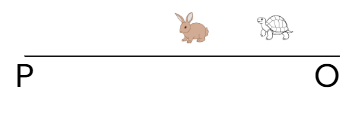
A hare and a tortoise run between points O and P located exactly 6 km from each other on a straight line. They start together at O, go straight to P and then return to O along the same line. They run at constant speeds of 12 km/hr and 1 km/hr respectively. Since the tortoise is slower than the hare, the hare shuttles between O and P until the tortoise goes once to P and returns to O. During the run, how many times are the hare and the tortoise separated by an exact distance of 1 km from each other?
The total distance to be travelled is 6+6 = 12km
We know the speeds of the hare and the tortoise.
Time taken by the Tortoise to finish one round = $$\frac{12}{1}=12hr$$.
We know the speed of the Hare is 12 km/h. Let's find the distance travelled by the hare in 12 hrs. = $$12\cdot12=144km$$
This is nothing but $$\frac{144}{12}=12\ \text{rounds}\ $$. So, Hare will make 12 rounds of OP.
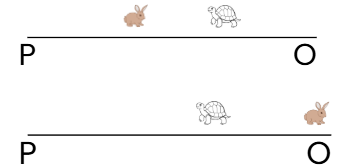
In the first round, both have started from point O. After some time, the distance between them will be 1 km.

After some more time, when the hare is returning from P to O, before and after crossing the tortoise, the hare will be two more times 1km apart from the tortoise. So, in the first round, there are three such occurrences.
In the second round, when the hare starts from point O, while going and returning, there will be four occurrences when, before and after crossing the tortoise, the hare will be exactly 1 km apart. But the first occurrence of round 2 is already counted in round 1. So, in second round as well, there will be total 3 occurrences.
In the third, fourth and fifth rounds, there will be 4 such occurrences.
In the sixth round, because the tortoise will be at point P, there will be only 2 cases.
Now, till around 6, there are 20 such occurrences. And from round 7 to 12, it will be exactly the same but in reverse order of 2, 4, 4, 4, 3, 3. Hence, total such occurrences = 20 * 2 = 40.
Every day a person walks at a constant speed, $$V_1$$ for 30 minutes. On a particular day, after walking for 10 minutes at $$V_1$$, he rested for 5 minutes. He finished the remaining distance of his regular walk at a constant speed, $$V_2$$, in another 30 minutes. On that day, find the ratio of $$V_2$$ and his average speed (i.e., total distance covered /total time taken including resting time).
The man walks with a speed of V1 for 30 minutes.
=> Distance covered = 30*V1.
On a particular day, he walks for 10 minutes at V1, takes a rest of 5 minutes, and then covers the distance by walking at V2 for 30 minutes.
=> 10*V1 + 30*V2 = 30*V1
20*V1 = 30*V2
V1 = 1.5V2---------(1)
=> Total distance = 30*1.5*V2 = 45V2.
Now, we know that the person took 10 + 5 + 30 = 45 minutes to cover the entire distance.
=> Average speed = 45V2/45 = V2.
Ratio of V2 and the average speed = 1:1.
Therefore, option A is the right answer.
A boat, stationed at the North of a lighthouse, is making an angle of 30° with the top of the lighthouse. Simultaneously, another boat, stationed at the East of the same lighthouse, is making an angle of 45° with the top of the lighthouse. What will be the shortest distance between these two boats? The height of the lighthouse is 300 feet. Assume both the boats are of negligible dimensions.
One boat is stationed to the North of the light house and the other boat is stationed to the East of the light house.
The boat stationed to the East subtends an angle of 45 degrees and the boat stationed to the North subtends an angle of 30 degrees.
Now, distance between the boat stationed to the East and the light house,d1 = tan 45
$$300/d1 = 1$$
=> $$d1 = 300$$ feet
Distance between the boat stationed to the North and the light house,d2 = tan 30
$$300/d2 = 1/\sqrt{3}$$
=> $$d2=300\sqrt{3}$$
Shortest distance between the 2 boats = $$\sqrt{300^2+(300\sqrt{3})^2}$$
= $$300*\sqrt{4}$$
= $$600$$ feet.
Therefore, option C is the right answer.
A girl travels along a straight line, from point A to B at a constant speed, $$V_1$$ meters/sec for T seconds. Next, she travels from point B to C along a straight line, at a constant speed of $$V_2$$ meters/sec for another T seconds. BC makes an angle 105° with AB. If CA makes an angle 30° with BC, how much time will she take to travel back from point C to A at a constant speed of $$V_2$$ meters/sec, if she travels along a straight line from C to A?
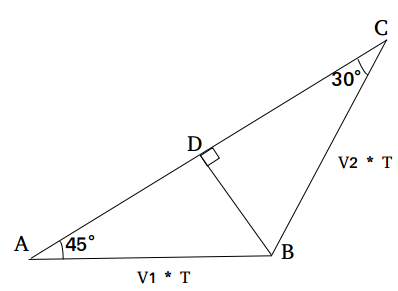
We draw BD perpendiculat to AC.
In right angled triangle BDC, BD / BC = sin 30°
or, BD = (V2 * T)/2 ......(i)
In right angled triangle BDA, BD / BA = sin 45°
Or, BD = (V1 * T)/$$\sqrt{2}$$ ......(ii)
From (i) and (ii), we get
V2 / V1 = $$\sqrt{2}$$
Total distance to be travelled from C to A = CD + DA = $$\sqrt{3}$$BD + BD
= BD($$1 + \sqrt{3}$$)
Replacing BD = (V2 * T)/2 in the avove equation,
CA = $$\dfrac{\text{(V2 * T)}}{2} (1 + \sqrt{3}$$)
Time taken at speed V2 = $$0.5(\sqrt{3}+1)$$T
Hence, option C is the correct answer.
Arup and Swarup leave point A at 8 AM to point B. To reach B, they have to walk the first 2 km, then travel 4 km by boat and complete the final 20 km by car. Arup and Swarup walk at a constant speed of 4 km/hr and 5 km/hr respectively. Each rows his boat for 30 minutes. Arup drives his car at a constant speed of 50 km/hr while Swarup drives at 40 km/hr. If no time is wasted in transit, when will they meet again?
Both of them row the boat for the same time. Therefore, we can ignore the time taken to row the boat and add it to the final answer.
Arup will walk 2 km in 2/4 = 30 minutes.
Swarup will walk 2 km in 2/5 = 24 minutes.
Therefore, Swarup will start driving 30-24 = 6 minutes earlier than Arup.
In 6 minutes, Swarup will gain a lead of 6*40/60 = 4 km.
Arup drives at 50 kmph (i.e, 10 kmph faster than Swarup). Therefore, Arup will cover the 4 km advantage that Swarup has in 4/10*60 = 24 minutes.
Therefore, the time after which both of them will meet is 30 (to walk) + 30 (to row the boat) + 24 = 1 hour 24 minutes after Arup starts.
Since both of them start at 8 AM, they will meet again at 9:24 AM.
Therefore, option D is the right answer.
Study the figure below and answer the question:
Four persons walk from Point A to Point D following different routes. The one following ABCD takes 70 minutes. Another person takes 45 minutes following ABD. The third person takes 30 minutes following route ACD. The last person takes 65 minutes following route ACBD. IF all were to walk at the same speed, how long will it take to go from point B to point C?
AB + BC + CD = 70 ------------(i)
AB + BD = 45 ------------------(ii)
AC + CD = 30 ------------------(iii)
AC + CB + BD = 65 ------------(iv)
Adding (i) & (iv)
=> AB + BC + CD + AC + CB + BD = 70 + 65
(AB + BD) + 2 BC + (AC + CD) = 135
From (ii) & (iii)
=> 45 + 2 BC + 30 = 135
=> 2 BC = 135 - 75 = 60
=> BC = $$\frac{60}{2} = 30$$ min
Each day on Planet M is 10 hours, each hour 60 minutes and each minute 40 seconds. The inhabitants of Planet M use 10 hour analog clock with an hour hand, a minute hand and a second hand. If one such clock shows 3 hours 42 minutes and 20 seconds in a mirror what will be the time in Planet M exactly after 5 minutes?
10 hour analog clock is used.
Time in mirror = 3 hours 42 minutes and 20 seconds
=> Actual time = 10 - (3 hrs 42 min 20 sec)
= 6 hrs 17 min 20 sec
$$\therefore$$ Time after 5 minutes = 6 hrs 22 min 20 sec
Pradeep could either walk or drive to office. The time taken to walk to the office is 8 times the driving time. One day, his wife took the car making him walk to office. After walking 1km, he reached a temple when his wife called to say that he can now take the car. Pradeep figure that continuing to walk to the office will take as long as walking back home and then driving to the office. Calculate the distance between the temple and the office.
Let walking speed = $$a$$
=> Driving speed = $$8a$$
Let the distance between temple and office = x
Acc. to ques,
=> $$\frac{x}{a} = \frac{1}{a} + \frac{x + 1}{8 a}$$
=> $$8x = 8 + x + 1$$
=> $$x = \frac{9}{7}$$
Devanand’s house is 50 km West of Pradeep’s house. On Sunday morning, at 10 a.m., they leave their respective houses.
Under which of the following scenarios, the minimum distance between the two would be 40 km?
Scenario I: Devanand walks East at a constant speed of 3 km per hour and Pradeep walks South at a constant speed of 4 km per hour.
Scenario II: Devanand walks South at a constant speed of 3 km per hour and Pradeep walks East at a constant speed of 4 km per hour.
Scenario III: Devanand walks West at a constant speed of 4 km per hour and Pradeep walks East at a constant speed of 3 km per hour.
Scenario I : Devanand's position after $$t$$ hours is $$(50 - 3t)$$ km west of Pradeep's house, while Pradeep's position is $$4t$$ km south of his own house.
If $$d$$ is the distance between them, then
=> $$d^2 = (50 - 3t)^2 + (4t)^2$$
=> $$d^2 = 2500 - 300t + 25t^2$$
=> $$d^2 = 25 (t^2 - 12t + 36) + 1600$$
=> $$d^2 = 25 (t - 6)^2 + 1600$$
Thus, minimum distance is 40 km after 6 hours.
Thus, scenario I is possible
Scenario II & III are not possible as minimum distance in that case would be 50 km as after that distance will keep on increasing between the two.
Prof. Mandal walks to the market and comes back in an auto. It takes him 90 minutes to make the round trip. If he takes an auto both ways it takes him 30 minutes. On a Sunday, he decides to walk both ways. How long would it take him?
As it took Prof. Mandal 30 minutes for round trip to the market by auto, we can infer that the auto takes 15 minutes for one way trip.
When he walks one way and return by auto, it took him 90 minutes.
We know the auto would have taken 15 minutes while returning.
So, the professor takes (90 - 15) = 75 minutes one way while walking to the market.
So, for a round trip by walking, he will take 2 * 75 minutes = 150 minutes.
Hence, option D is the correct.
The taxis plying in Wasseypur have the following fare structure: Rs 20 for the first two kilometers, Rs 5 for every km in excess of 2 km and up to 10 km, and Rs 8 for every km in excess of 10 km. Bullock carts on the other hand charge Rs 2 per km. Sardar Khan takes a taxi from the Wasseypur railway station to his home. On the way, at a distance of 14 km from the railway station, he meets Faizal Khan, and gets down from the taxi to talk to him. Later he takes a bullock cart to reach his home. He spends a total of Rs 102 to reach his home from the railway station. How far is his home from the railway station (in kilometers)?
For the first 2 km, fare = Rs. 20
For the next 8 km, fare = Rs. 5 * 8 = Rs. 40
For the next 4 km, fare = Rs. 8 * 4 = Rs. 32
Total fare up to 14 km = Rs. 20 + Rs. 40 + Rs. 32 = Rs. 92
Total fare paid by Sardar Khan = Rs. 102
Money spent on bullock cart = Rs. 102 - Rs. 92 = Rs. 10
Charge for bullock cart = Rs. 2/km
Distance travelled by bullock cart = 5 km
Total distance travelled by Sardar Khan = (14 + 5) km = 19 km
Hence, option C is the correct answer.
Ram, Shyam and Hari went out for a 100 km journey. Ram and Hari started the journey in Ram's car at the rate of 25 kmph, while Shyam walked at 5 kmph. After sometime, Hari got off and started walking at the rate of 5kmph and Ram went back to pick up Shyam. All three reached the destination simultaneously. The number of hours required for the trip was:
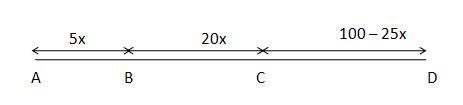
Let 'A' be the point from where all started and D is the destination. At 'x' hours both Ram and Hari reached point C, Hari got off and Ram turned back to pick up Shyam. At the same instant, Shyam was at point B.
Let 'T' is the total amount of time taken by all three to reach point D.
For Hari,
T = $$x+\dfrac{100-25x}{5}$$ ... (1)
For Ram,
T = $$x+\dfrac{20x*5/6}{25}$$ + $$\dfrac{20x*5/6+100-25x}{25}$$ ... (2)
By equating (1) and (2),
$$x+\dfrac{100-25x}{5}$$ = $$x+\dfrac{20x*5/6}{25}$$ + $$\dfrac{20x*5/6+100-25x}{25}$$
$$\Rightarrow$$ $$x = 3$$ hours.
Therefore, time taken by all to reach destination = $$x+\dfrac{100-25x}{5}$$
$$\Rightarrow$$ 3 + $$\dfrac{100-25*3}{5}$$
$$\Rightarrow$$ 3 + 5
$$\Rightarrow$$ 8 hours
Hence, we can say that option A is the correct answer.
City Bus Corporation runs two buses from terminus A to terminus B,one from each of the terminuses such that each bus makes 5 round trips in a day. There are no stops in between. These buses ply back and forth on the same route at different but uniform speeds. Each morning the buses start at 7 AM from the respective terminuses. They meet for the first time at a distance of 7 km from terminus A. Their next meeting is at a distance of 4 km from terminus B, while travelling in opposite directions. Assuming that the time taken by the buses at the terminuses is negligibly small, and the cost of running a bus is 20 per km, find the daily cost of running the buses (in )
Let the distance between two termini = $$P$$ km
Let the speed of the bus started from Terminus A be x and that of the bus started from terminus B be y.
The two buses met at a distance of 7km from Terminus A
Since the time of travel for both buses is the same.
$$\frac{7}{x}$$=$$\frac{P-7}{y}$$
$$\frac{x}{y}$$=$$\frac{7}{P-7}$$ ----------- Eq (1)
They met again at a distance of 4 km from terminus B.
Distance travelled by bus which started from Terminus A = P+4
Distance travelled by bus which started from Terminus A = 2P-4
So $$\frac{x}{y}$$ = $$\frac{P+4}{2P-4}$$ --Eg (2)
On solving Eq 1& 2, we get P=17 km
Each bus covers a distance of 17*2=34 km on a round trip.
Each bus makes 5 round trips in a day =34*5=170 km
Cost of running one bus = $$170 \times 20 = 3400$$
$$\therefore$$ Cost of running both buses = $$3400 \times 2 = Rs. 6,800$$
Shyam, a fertilizer salesman, sells directly to farmers. He visits two villages A and B. Shyam starts from A, and travels 50 meters to the East, then 50 meters North-East at exactly 45° to his earlier direction, and then another 50 meters East to reach village B. If the shortest distance between villages A and B is in the form of $$a\sqrt{b+\sqrt{c}}$$ meters, Find the value of a+b+c.
Shortest distance between A and B = $d = \sqrt{(AM)^2 + (BM)^2}$ ----------Eqn(1)
In $$\triangle$$ OPN
=> $$sin 45 = \frac{PN}{PO}$$
=> $$\frac{1}{\sqrt{2}} = \frac{PN}{50}$$
=> $$PN = \frac{50}{\sqrt{2}} = 25 \sqrt{2}$$
=> $$BM = PN = 25 \sqrt{2}$$
Again, $$tan 45 = \frac{PN}{ON}$$
=> $$ON = 25 \sqrt{2}$$
=> $$AM=AO\ +\ ON\ +\ NM\ =\ 50\ +\ 25\sqrt{2}\ +\ 50\ =\ 100\ +\ 25\sqrt{2}$$
Using eqn(I), we get :
=> $$d^2 = (100 + 25 \sqrt{2})^2 + (25 \sqrt{2})^2$$
=> $$d^2 = 10000 + 5000 \sqrt{2} + 1250 + 1250 $$ = $$12500 + 5000 \sqrt{2}$$
=> $$d^2 = 2500 (5 + 2 \sqrt{2}) = 2500 (5 + \sqrt{8})$$ -----------Eqn(II)
Also, it is given that : $$d = a\sqrt{b+\sqrt{c}}$$
=> $$d^2 = a^2 (b + \sqrt{c})$$ -----------Eqn(III)
Comparing, eqn(II) & (III), we get :
=> $$a^2 (b + \sqrt{c}) = 2500 (5 + \sqrt{8})$$
=> $$a = 50 , b = 5 , c = 8$$
$$\therefore a + b + c = 50 + 5 + 8 = 63$$
Answer question based on the following information.
Ramya, based in Shanpur, took her car for a 400 km trip to Rampur. She maintained a log of the odometer readings and the amount of petrol she purchased at different petrol pumps at different prices (given below). Her car already had 10 litres of petrol at the start of the journey, and she first purchased petrol at the start of the journey, as given in table below, and she had 5 litres remaining at the end of the journey.

What has been the mileage (in kilometers per litre) of her car over the entire trip?
At the start, Ramya has 10 litres petrol. She purchased 20 litres, 15 litres and 10 litres.
At the end, she has left 5 litres of petrol.
Petrol used = $$(10 + 20 + 15 + 10 - 5) = 50$$ litres
Distance travelled = $$800 - 400 = 400$$ km
$$\therefore$$ Mileage of Ramya's car = $$\frac{400}{50} = 8$$ km/litre
Answer question based on the following information.
Ramya, based in Shanpur, took her car for a 400 km trip to Rampur. She maintained a log of the odometer readings and the amount of petrol she purchased at different petrol pumps at different prices (given below). Her car already had 10 litres of petrol at the start of the journey, and she first purchased petrol at the start of the journey, as given in table below, and she had 5 litres remaining at the end of the journey.

Her car’s tank-capacity is 35 litres. Petrol costs 45/- litre in Rampur. What is the minimum
amount of money she would need for purchasing petrol for the return trip from Rampur to Shanpur, using the same route? Assume that the mileage of the car remains unchanged throughout the route, and she did not use her car to travel around in Rampur.
Ramya's car has 5 litres in the tank. She can fill a maximum of 30 litres more as tank capacity is 35 litres.
The cost of petrol in Rampur is Rs. 45/litre. As the cost of petrol is lower at all the succeeding petrol pumps and hence to minimise the cost, she will fill enough petrol to reach first petrol pump i.e. 150 km.
Initially she can travel = $$8 \times 5 = 40$$ km using 5 litres of petrol
Hence to travel 110 km, she will need = $$\frac{110}{8} = 13.75$$ litre at the rate of Rs. 45/litre
On reaching the first petrol pump in the reverse journey, she will fill up enough petrol to reach the second petrol pump as the cost of petrol in the second pump is less than the cost of first pump and the distance is 50 km.
=> She needs = $$\frac{50}{8} = 6.25$$ litres at the rate of Rs. 40/litre
For the rest of the journey (200 km), she will need = $$\frac{200}{8} = 25$$ litres at the rate of Rs. 35/litre
$$\therefore$$ Total cost = $$(13.75 \times 45) + (6.25 \times 40) + (25 \times 35)$$
= $$618.75 + 250 + 875 = 1743.75 \approx Rs. 1744$$
Amarendra and Dharmendra are brothers. One day they start at the same time from their home for Tatanagar railway station in their respective cars. Amarendra took 25 minutes to reach the station. After reaching the station Amarendra found that Dharmendra is 2500 m away from the station. The distance of Tatanagar Station from their home is 15 km. Next day Dharmendra decided to start 7 minutes early.
If they drive at the speed same as the previous day then Amarendra will reach the station
Amarendra took 25 minutes to cover 15 km. In the same time Dharmendra travel 2500m less, i,e, 12.5 km
=> Speed of Amarendra = $$\frac{15}{25} = 0.6$$ km/min
Speed of Dharmendra = $$\frac{12.5}{25} = 0.5$$ km/min
=> Time taken by Dharmendra to reach the station = $$\frac{15}{0.5} = 30$$ minutes
Next day, Dharmendra started 7 minutes early, so he will reach the station = 30 - 25 - 7 = -2 minutes
=> 2 minutes or 120 seconds before Amarendra.
In a clock having a circular scale of twelve hours, when time changes from 7:45 A.M. to 7:47 A.M.,
by how many degrees the angle formed by the hour hand and minute hand changes?
Angle covered by the hour hand in 12 hours = 360°
In 1 hour = $$\frac{360}{12} = 30^{\circ}$$
and in 1 minute = $$\frac{30}{60} = \frac{1}{2}^{\circ}$$
Similarly, angle covered by minute hand in 1 hour = 360°
In 1 minute = $$\frac{360}{60} = 6^{\circ}$$
=> Every minute, the angle between the two hands changes by = $$6 - \frac{1}{2} = \frac{11}{2}^{\circ}$$
$$\therefore$$ From 7:45 A.M. to 7:47 A.M.,i.e. in 2 minutes the angle between the two hands will change by
= $$2 \times \frac{11}{2} = 11^{\circ}$$
Frequently Asked Questions
Yes, Time, Speed and Distance is one of the most important arithmetic topics in XAT Quantitative Ability. Questions from this topic frequently test a candidate's ability to apply formulas and concepts.
XAT may include questions on average speed, relative speed, trains, boats and streams, races, circular tracks, and journey-based problems involving time, speed, and distance relationships.
Start by mastering the fundamental relationship between time, speed, and distance. Learn key formulas, practice topic-wise questions, and solve previous year papers to improve calculation speed and accuracy.
Most Time, Speed and Distance questions are moderate in difficulty. While some are formula-based, others require logical interpretation and multiple-step calculations.
Cracku's XAT Time, Speed and Distance Questions are designed according to the latest XAT exam pattern and difficulty level. They provide topic-wise practice, detailed solutions, shortcut techniques, and performance analysis to help aspirants strengthen concepts and solve questions more efficiently.