In a multiple-choice examination, there are 20 questions. Each correct answer is worth 4 marks, while 2 marks are to be deducted for every wrong answer. Further, 1 mark is to be deducted for every unattempted question. One student receives a total of 46 marks in the examination. However, before releasing the marks, the professor realizes that she has, by mistake, deducted 2 marks for every unattempted question and 1 mark for every wrong answer.
After correction, how many marks will the student get?
XAT Linear Equations Questions
Let the number of correct and wrong questions be x and y respectively.
Number of unattempted questions = 20 - (x+y) $$\longrightarrow\ i$$
4 marks are awarded for every correct questions and 2 and 1 marks are deducted for every wrong and unattempted questions respectively.
Total original marks scored = 4x-2y-((20-(x+y)) = 5x-y-20 $$\longrightarrow\ ii$$
But the teacher deducted 1 and 2 marks for every wrong and unattempted questions respectively by mistake.
Total marks = 4x-y-2(20-x-y) = 6x+y-40
Total marks = 46 (given)
6x+y-40 = 46
6x+y = 86
The possible pairs of (x,y) are (14,2), (13,8), (12,14), ........ , (1,80), (0,86).
x+y = 16, 21, 26, ........ , 81,86
Only one case will be possible as (x+y) $$\le\ $$ 20 (as equation i $$\ge\ 0$$)
Hence, Number of correct questions = x = 14
Number of wrong questions = y = 2
Number of unattempted questions = 20 - (14+2) = 4
Hence, final marks = $$\left(5\times\ 14\right)-2-20$$ = 48 (from equation ii)
$$\therefore\ $$ The required answer is C.
Consider the system of two linear equations as follows: $$3x + 21y + p = 0$$; and $$qx + ry - 7 = 0$$, where p, q, and r are real numbers.
Which of the following statements DEFINITELY CONTRADICTS the fact that the lines represented by the two equations are coinciding?
In order for the line two be coincident, the ratio of the coefficients of the variables and the constants from both the equations must be the same.
That is, $$\frac{3}{q}=\frac{21}{r}=\frac{p}{-7}$$
Let's consider each option individually.
Checking through the easier options first.
Option A: p and q must have opposite signs
In order for $$\frac{3}{q}=\frac{p}{-7}$$ to be true, p and q must be of opposite signs as pq = -21
Hence, this option does not contradict the lines coinciding.
Option D: r and q must have the same signs
Similar to option A, for $$\frac{3}{q}=\frac{21}{r}$$ to hold true, q and r must be of the same signs.
Hence, this option too does not contradict the lines coinciding.
Option E: p cannot be zero
In order for q and r to have real values, the fractions $$\frac{3}{q}=\frac{21}{r}=\frac{p}{-7}$$ must not be zero.
Putting p=0 would give the value of p/(-7) as 0, which would then not give real values of q and r
Hence, p can never be zero. This statement, too, does not contradict the two lines being coincident.
Now that A, D, and E are not our answers, we need to consider the more complex options.
Option B: r is the smallest amongst p, q, r
We would want $$\frac{3}{q}=\frac{21}{r}$$ to hold true.
If we take q and r to be positive, we must take p to be negative, in that case p would be negative and the smallest. So, in order to consider the possibility of r being the smallest, we must take q and r as negative values.
Now, with q and r negative, a smaller number would have a bigger magnitude or a bigger absolute value.
We can try putting in values at this point to see if this would contradict the lines coinciding.
taking r as -21 and q as -3, we can take p as 7
These values would make the lines coincident, with r being the smallest value.
Hence, this options too does not necessarily contradcit the lines coinciding.
Option C: q is the largest amongst p, q, r
Follwoing the same logic as Optoin B, we cannot take q and r to be negative, as that would make p positive, making p the largest value.
Therefore, in order to consider the possibility of q being the largest, we must take positive values of q and r
Now, comparing $$\frac{3}{q}=\frac{21}{r}$$, if q is larger than r, then the numerator of the first term would be smaller than the numerator of the second term, and the denominator of the first term would be larger than the denominator of the second term
Making the fraction $$\frac{3}{q}$$ strictly smaller than $$\frac{21}{r}$$
If this option is true, the lines can never coincide, as the ratios of the coefficient can never be equal.
Therefore, Option C would be the correct answer.
The cost of running a movie theatre is Rs. 10,000 per day, plus additional Rs. 5000 per show. The theatre has 200 seats. A new movie released on Friday. There were three shows, where the ticket price was Rs. 250 each for the first two shows and Rs. 200 for the late-night show.
For all shows together, total occupancy was 80%. What was the maximum amount of profit possible?
The cost of running all three shows a day is 10,000+3*5,000=25,000.
The has to be 80% occupancy of total seats. In total there are 200*3 shows=600 seats.
Out of that 80% is $$\frac{80}{100}\cdot600=480$$
Since we need to maximize the profit. We shall take the vacant 120 seat in show 3 which cost less.
The income from first show 200 * 250= 50,000
The income from second show 200 * 250= 50,000
The income form third show 80*200= 16,000
The total income is 1,16,000-25,000=91,000
Read the following scenario and answer the TWO questions that follow.
Aman has come to the market with Rs. 100. If he buys 5 kilograms of cabbage and 4 kilograms of potato, he will have Rs. 20 left; or else, if he buys 4 kilograms of cabbage and 5 kilograms of onion, he will have Rs. 7 left. The per kilogram prices of cabbage, onion and potato are positive integers (in rupees), and any type of these vegetables can only be purchased in positive integer kilogram, or none at all.
Aman decides to buy only onion, in whatever maximum quantity possible (in positive integer kilogram), with the money he has come to the market with. How much money will he be left with after the purchase?
Let the price of one kg of potato be P, one kg of cabbage be C, and one kg of onion be O.
we are given the equations,
$$5C+4P=80$$ (i)
$$4C+5O=93$$ (ii)
In equation (ii), we get 3 as the unit digit on the right-hand side. This is only possible with 8 + 5 on the left-hand side.
So, the unit place value of C must be 2, which means that C can have values 2, 12, 22, 32, and so on. The value of O must be an odd number.
Using this information in equation (i), we can see that the value of 5C will always have 0 as its unit digit. Meaning that the value of 4P must also have its unit digit as zero.
This would tell that P is a multiple of 5.
4P can then only be 20, 40 or 60 for C to also have a positive integer value.
If P is 5, C would be 12, giving the value of O to be 9
If P is 10, C would be 8, and this is consistent with our criteria that the unit digit of C must be 2
If P is 15, C would be 4, which is again not consistent with the same criteria.
Therefore, the price of one kg of potato would be Rs. 5, one of of cabbage would be Rs. 12 and one kg of onion would be Rs. 9
Aman can buy a maximum of 11 kg of onions for Rs. 99, leaving him with Rs. 1
Therefore, Option E is the correct answer.
The Guava club has won 40% of their football matches in the Apple Cup that they have played so far. If they play another n matches and win all of them, their winning percentage will improve to 50. Further, if they play 15 more matches and win all of them, their winning percentage will improve from 50 to 60. How many matches has the Guava club played in the Apple Cup so far? In the Apple Cup matches, there are only two possible outcomes, win or loss; draw is not possible.
Let 'm' be the number of matches Guava played till now. They won '0.4m' matches.
After playing another 'n' matches and wining all of them, their winning percentage will improve to 50.
i.e,
$$\ \frac{\ 0.4m+n}{m+n}=0.5$$
$$m=5n$$
Playing 15 more matches and wining all of them, their winning percentage will improve from 50 to 60.
i.e $$\ \frac{\ 0.4m+n+15}{m+n+15}=0.6$$
Solving, we get $$6+0.4n\ =\ 0.2m$$
Substituting $$m=5n$$,
we get $$6+0.4n\ =\ n$$
$$n=10\ \&\ m\ =50$$
Hence, Guava club played 50 matches so far.
The answer is option A.
Let x and y be two positive integers and p be a prime number. If x (x - p) - y (y + p) = 7p, what will be the minimum value of x - y?
The given equation is,
x (x - p) - y (y + p) = 7p
$$x^2-px-y^2-py=7p$$
$$x^2-y^2-px-py=7p$$
$$\left(x+y\right)\left(x-y\right)-p\left(x+y\right)=7p$$
$$\left(x-y-p\right)\left(x+y\right)=7p$$
As '7' & 'p' both are prime numbers
$$\left(x-y-p\right)\left(x+y\right)$$ can be expressed as $$\left(7\times\ p\right)\ or\ \left(7p\times\ 1\right)$$
Case (i) - $$\left(x+y\right)\ \times\ \left(x-y-p\right)=7\times\ p$$
$$x+y+x-y-p=7+ p$$
$$2x-p=7+p$$
$$x=\frac{7}{2}+p$$
But it's given that 'x' is a positive integer. This case is not possible.
Case (ii) - $$\left(x+y\right)\ \times\ \left(x-y-p\right)=7p\times\ 1$$
$$x+y+x-y-p=7p+1$$
$$2x-p=7p+1$$
$$x=\frac{1}{2}+4p$$
But it's given that 'x' is a positive integer. This case is not possible.
The given equation is not possible with given conditions.
Option (E) is correct.
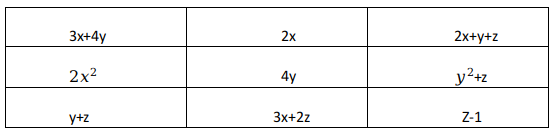
Rahul has just made a $$3 \times 3$$ magic square, in which, the sum of the cells along any row, column or diagonal, is the same number N. The entries in the cells are given as expressions in x, y, and Z. Find N?
Sum of 3rd row = sum of 2nd column
=> 2x+4y = y+2z-1
=> 2x+3y-2z= -1 ------- (A)
Sum of diagonals are also equal
=> 3x+4y+z-1 = y+z+2x+y+z
=> x+2y-z=1 -----(B)
Solving A and B we get y= 3
Putting it in A, we get x-z = -5 ----- (C)
Sum of 1st row = sum of 2nd column
5x+5y+z = 3x+4y+2z
=> 2x +y - z =0
Since y=3, 2x-z = -3 ------ (D)
Solving C and D we get x=2 and z=7
Hence N = 36
A shop sells bags in three sizes: small, medium and large. A large bag costs Rs.1000, a medium bag costs Rs.200, and a small bag costs Rs.50. Three buyers, Ashish, Banti and Chintu, independently buy some numbers of these types of bags. The respective amounts spent by Ashish, Banti and Chintu are equal. Put together, the shop sells 1 large bag, 15 small bags and some medium bags to these three buyers. What is the minimum number of medium bags that the shop sells to them?
Let the amount spent by Ashish is 'a', Banti is 'b' and Chintu is 'c'. Given, a = b = c.
One of them has bought a large bag. So, he must have spent at least 1000 rupees. It means, everyone has spent at least a thousand rupees. Or, a +b + c ≥ 3000.
Revenue from small bags = 50*15 = 750.
Revenue from large bag = 1000*1 = 1000. Total revenue excluding from medium bag = 750 + 1000 = 1750.
If 4 medium bags are sold, total revenue = 200*4 + 1750 = 2550, which is less than 3000. Hence, not the right answer.
If 5 medium bags are sold, total revenue = 200*5 + 1750 = 2750, which is less than 3000. Hence, not the right answer.
If 7 medium bags are sold, total revenue = 200*7 + 1750 = 3150, which is more than 3000. Hence, 7 is the correct answer.
The sum of the possible values of X in the equation |X + 7| + |X - 8| = 16 is:
Expression : $$|x + 7| + |x - 8| = 16$$
Case 1 : $$x < -7$$
=> $$-(x + 7) - (x - 8) = 16$$
=> $$-2x + 1 = 16$$
=> $$x = \frac{-15}{2} = - 7.5$$
Case 2 : $$-7 \leq x < 8$$
=> $$(x + 7) - (x - 8) = 16$$
=> $$15 = 16$$, which is not possible.
Case 3 : $$x \geq 8$$
=> $$(x + 7) + (x - 8) = 16$$
=> $$2x - 1 = 16$$
=> $$x = \frac{17}{2} = 8.5$$
$$\therefore$$ Sum of all possible values of $$x = 8.5 - 7.5 = 1$$
Three truck drivers, Amar, Akbar and Anthony stop at a road side eating joint. Amar orders 10
rotis, 4 plates of tadka, and a cup of tea. Akbar orders 7 rotis, 3 plates of tadka, and a cup of tea. Amar pays 80 for the meal and Akbar pays 60. Meanwhile, Anthony orders 5 rotis, 5 plates of tadka and 5 cups of tea. How much (in ) will Anthony pay?
Let cost of 1 roti, 1 tadka and 1 tea be Rs. $$x, y, z$$ respectively.
Acc to ques,
=> $$10x + 4y + z = 80$$ <-- Equation 1
and $$7x + 3y + z = 60$$ <-- Equation 2
We have three equations and two unknowns. So let us try to find the value of $$x$$ and $$y$$ in terms of $$z$$.
Multiplying Equation 1 with 3 and subtracting 4 times (Equation 2) from it gives,
$$3*(10x+4y+z)-4*(7x+3y+z)=3*80-4*60$$
Or, $$2x-z =0$$
=> $$x = \frac{z}{2}$$
Substituting it in Equation 1, we get $$6z+4y=80$$ or $$y = 20 - \frac{3}{2} z$$
To find : $$5x + 5y + 5z = ?$$
= $$5 [\frac{z}{2} + (20 - \frac{3 z}{2}) + z]$$
= $$5 \times 20 = 100$$
A chocolate dealer has to send chocolates of three brands to a shopkeeper. All the brands are packed in boxes of same size. The number of boxes to be sent is 96 of brand A, 240 of brand B and 336 of brand C. These boxes are to be packed in cartons of same size containing equal number of boxes. Each carton should contain boxes of same brand of chocolates. What could be the minimum number of cartons that the dealer has to send?
Since each carton should contain boxes of the same brand of chocolates and all boxes being of equal size, to get the minimum number of cartons, we should have the maximum number of boxes in each carton.
Thus, the number of boxes in each carton = H.C.F (96,240,336)
= 48
So, we will get minimum number of cartons if there are 48 boxes in each carton.
$$\therefore$$ Number of cartons = $$\frac{96}{48} + \frac{240}{48} + \frac{336}{48}$$
= $$2 + 5 + 7 = 14$$
Frequently Asked Questions
Yes, Linear Equations are one of the fundamental topics in the Algebra section of XAT Quantitative Ability. They form the basis for solving a variety of algebraic and word-based problems.
XAT may include questions involving single-variable equations, simultaneous linear equations, systems of equations, and application-based problems that require forming and solving equations.
Candidates should focus on understanding equation formation, substitution, elimination, and cross-multiplication methods. Regular practice of topic-wise questions and previous year papers can improve problem-solving speed and accuracy.
Most Linear Equations questions are easy to moderate in difficulty. However, some application-based problems may require logical interpretation and algebraic manipulation.
Cracku's XAT Linear Equations Questions are designed according to the latest XAT exam pattern and difficulty level. They provide topic-wise practice, detailed solutions, shortcut methods, and performance analysis to help aspirants strengthen algebra fundamentals and improve accuracy in solving equations.
You can practice XAT Linear Equations questions through topic-wise question banks, previous year papers, sectional tests, and mock tests that offer detailed explanations and multiple solving approaches.