 91- 6303239042
ISSUE
Sign in
Please select an account to continue using cracku.in
↓ →
In each of the question, the underlined word is used in four different ways. Choose the option in which the usage of the word is incorrect or inappropriate.
ISSUE
An issue can mean the following:
Legal term for children- He died without an issue- died without children. Hence, D is the correct usage.
The issue also means publication in print, the August issue of the magazine. Hence, option A is the correct usage.
Issue can also mean formal release of something. The government issued a stamp is also correct.
The problem came to a successful issue. This is indicating resolution and issue in none of its contexts means resolution, so this is the incorrect usage.
SAVE
Option A: "He is saving his strength for the heavy work he will have to do this afternoon" is a correct and common usage of the verb "save". It means to reserve or conserve energy for later use.
Option B: Malati saved the little boy from drowning. This is the correct use of 'save,' referring to protection.
Option C: This is correct, formal usage of "save" meaning "except" or "but". It indicates that the only piece of information known about Vijay is the exception clause that follows.
Option D: "I have saved myself of the truth of the report" is not correct standard English usage. The verb "save" requires a different preposition (usually "from" or "for") to describe being spared from something, such as "I saved myself from the truth".
MASTER
Option A: "She could not master the courage to tell her friend" about her loss. It refers to the fact that she could not gather enough courage, so muster is the correct word to be used here, not master.
Mastered means to have gained expertise in something, so all other uses are correct.

OVER
The thief over witted the police and got away with the loot. This is incorrect usage of over.
The correct usage is "out-witted" which means to defeat or bypass. Over-witted is incorrect usage.
Read the following passage and answer the questions given after it.
Nearly two thousand years have passed since a census decreed by Caesar Augustus became part of the greatest story ever told. Many things have changed in the intervening years. The hotel industry worries more about overbuilding than overcrowding, and if they had to meet an unexpected influx, few inns would have a manager to accommodate the weary guests. Now it is the census taker that does the travelling in the fond hope that a highly mobile population will Stay put long enough to get a good sampling. Methods of gathering, recording and evaluating information have presumably been improved a great deal. And where then is the modest purpose of Rometo obtain a simple head count as an adequate basis for levying taxes, now batteries of complicatedstatistical series furnished by govenmental agencies and private organizations are eagerly scanned and interpreted by sages and seers to get a clue to future events. The Bible does not tell us how the Roman census takers made out, and as regards our more immediate concern, the reliability of present day economic forecasting, there are considerable differences of opinion. They are aimed at the celebration of the 125th anniversary of the American Statistical Assocation. There was the thought that business forecasting might well be on its way from an art to a science, and some speakers talked about newfangled computers and high-falution mathematical systems in terms of excitement and endearment which we, at least in our younger years when these things mattered, would have associated more readily with the description of fair maiden. But others pointed to the deplorable regord of the highly esteemed forecasts and forecasters with a batting average below that of the Mets, and the President-elect of the Association cautioned that “high powered statistical methods are usually in order where the facts are crude and inadequate, the exact contrary of what crude and inadequate statisticians assume.” Weleft his birthday party somewhere between hope and despair and with the conviction, not really newly acquired, that properstatistical methods applied to ascertainable facts have their merits in economic forecasting as long as neither forecaster nor public is deluded into mistaking the delineation of probabilities and trends for a prediction of certainties of mathematical exactitude.
The passage would Be na likely to appear in
According to the passage, taxation in Roman times was based on

The author refers to the Romans primarily in order to
The author refers to the Mets primarily in order to
On the basis of the passage it can be inferred that the author would agree with which of the following statements ?

The author’s tone can best be described as
In each of the following sentences four words or phrases have been underlined. One underlined part in each sentence is not acceptable in standard English. Pick up that part and mark its number.
In order to(1) conserve valuable petrol, motorists had aught(2) check their speedometers while(3) driving along(4) the highway.
There have been(1) little(2) change in the patient’s condition since(3) he was moved(4) to the intensive care unit.

He told the members(1) of his staff that(2) each one should carry out(3) his task oneself.(4)
The new managing committee arranged(1) everything expect(2) that the weekly meetings(3) were discontinued.(4)
Expect refers to regarding something as likely to happen
Except means to exclude something
In this sentence, the intent is to convey that the managing committee arranged for everything but excluded/ omitted the weekly meetings.
So here, except is the valid choice, and expect does not fit, as there is no likelihood or expectation for the meetings.
He laid(1) for an hour(2) in an unconscious state until(3) a policeman picked him up.(4)
The corrected sentence is: "He lay for an hour in an unconscious state until a policeman picked him up." This correction is needed because "lay" is the past tense of the intransitive verb "to lie" (rest/recline), whereas "laid" is the past tense of the transitive verb "to lay" (put down).
The word lay and its form are incorrect usage here because it refers to placing something or putting something down. Hence, an inanimate object or direct obejct is laid down, since lay is a transitive verb.
Example- Raman laid the book down.

In each of the following questions, a pair of words is followed by four pairs of words. Select the pair which best expresses the same relationship as the original pair.
STARE : GLANCE ::
To figure out a similar pair, we first need to understand the pair already present.
Stare: Glance- stare refers to intensely looking at someone or something, and glance refers to a quick, short look.
So the relationship is one of a high-intensity word and a low-intensity word describing the same action.
Gulp and sip are the best pair, as gulp refers to taking in a substantial amount of liquid in one go, and sip refers to taking in short amounts of liquid at once.
STOREY: BUILDING::
To figure out a similar pair, we first need to understand the pair already present.
A storey is a single unit or floor of the building; multiple storeys stacked on top of each other would make a building. So, the relationship is that of a part to a whole.
Similarly, a rung is the horizontal slab/ support that, when stacked on top of another, forms a ladder. So, rung: ladder is a similar pair.
Option A: A plot is the general sequence of events that make up a story, and an outline is the structured roadmap detailing the story's key moments. Plot or outline is not the unit of either, and hence is not a similar pair.
Option C: A cable is a mode of transportation connecting two ends of a mountainous region with a rope; an elevator is a mode of transportation moving up and down.
Option D: Every skyscraper will have a foundation, but there will only be a single foundation. Foundations will not be in multiples stacked or arranged to form a skyscraper. Hence, it is not a similar pair.
SCALES : JUSTICE ::
To figure out a similar pair, we first need to understand the pair already present.
Scales are a symbol of justice. Reference: measuring scales in law and court symbols.
Similarly, a torch symbolises the concept of liberty. Reference: Statue of Liberty holding a torch. Hence, torch is a similar pair.
Other options do not represent symbols of a concept.
BOLT : FABRIC ::
To figure out a similar pair, we first need to understand the pair already present.
A bolt of fabric is a long, continuous length of cloth wound around a flat, tube-like, or rectangular cardboard/plastic core for storage, shipping, and display. Therefore, a bolt is an object that is made up of a fabric completely and is a representative of one particular fabric.
Similarly, a roll is an object that is completely made up of one particular film. Hence, this is a similar relation.
Lock key and needle thread are different objects that are used as complements.
The book and paper are not correct because paper is an individual unit that makes up a book and does not represent the entire book on its own.
MOISTEN : DRENCH ::
To figure out a similar pair, we first need to understand the pair already present.
Moisten: Drench refers to the action of wetting with varying intensity, moisten is very low intensity, and drenching is very high intensity.
So the relationship is one of a high-intensity word and a low-intensity word describing the same action. A prick is a light, shallow or small puncture, whereas a stab is a deep, forceful and violent thrust.
Prick and stab are the best pair; both refer to piercing a surface with a sharp object.
In the following questions choose the alternative which best expresses the meaning of the given word.
BEHEST
Behest (noun) means an authoritative order, command, or urgent request, often used in the phrase "at the behest of". It implies doing something because someone in authority instructed or requested it.
Hence, command is the appropriate synonym.
COLOSSUS
A colossus is an exceptionally large statue, or figuratively, a person or entity of immense size, power, or importance.
Colossus is used to represent something of immense size.
It derives from the Greek kolossos (large statue) and is commonly used for figures such as the Colossus of Rhodes or influential historical figures.
Hence, huge is the appropriate synonym.
DEFER
Defer means to delay or postpone something to a later time.
Hence, postpone is the correct synonym.
EXASPERATION
Exasperation means the feeling of anger or irritation caused by someone or something.
Hence, irritation is the correct synonym.
FRAGMENT
Fragment refers to a part of something.
Hence, portion would be the correct synonym since it also means a part of something.
In the following questions, fill in the blanks with the appropriate phrase or idiom.
He was not called for the interview as his application had been..............
This photo clearly .......... the difference between the two brothers.
The correct phrase is "brings out." The complete sentence is: "This photo clearly brings out the difference between the two brothers." The phrasal verb "bring out" means to highlight, reveal, or make a particular quality or feature noticeable, which fits the context of showing distinctions
Why not others:
We were ................... decorating the living room, when our guests from Chicago arrived, a week early.
We were in the thick of decorating the living room when our guests from Chicago arrived, a week early.
The phrase "in the thick of" means to be in the middle of an intense or busy activity, and is hence the correct choice.
Why not others:
Have you heard the latest ? The increase in Car prices is .............
This is strictly ........... but you are going to be transferred.
In the following questions choose the alternative which is opposite in meaning to the given word.
LUSCIOUS
Luscious means richly pleasing to the senses; intensely sweet, flavorful, or sensually appealing. Think of ripe fruit or rich food.
Insipid means lacking flavour, interest, or vitality; bland, dull, and utterly unremarkable.
Hence, they make a good antonym pair.
Why not others:
MERCILESS
Merciless refers to the lack or absence of mercy, as apparent by the presence of the 'less' suffix.
The correct antonym for the same is kind, which means being merciful and of a giving nature.
MAR
Mar means to destroy, damage, disfigure or spoil something.
Example: A scar marred his face.
'make' can be the most appropriate antonym among all the options present, as the antonym of destroy should be to create or make something.
OPAQUE
Opaque means something that cannot be seen through; light does not pass through it. Figuratively, it also means difficult to understand, obscure, or unclear.
Transparent means something that can be seen through completely; light passes through it freely. Figuratively, it means open, obvious, and easy to understand, with nothing hidden.
Why not clear: Though clear seems like a close contender, it is not the right choice because clear can mean a broader number of things; it can mean something that can be seen through clearly, but it can also mean something free from cloudiness, darkness or dirt.
Because, we have a more precise and exact option present we choose transparent.
MAGNANIMITY
Magnanimity means generous nobility of spirit; being big-hearted, forgiving, and generous, especially toward a rival or someone you have power over.
Meanness means petty, small-minded stinginess, not just with money but with spirit, generosity, and kindness.
They are good opposites because they sit at opposite ends of the same scale of human generosity and character.
Why not others:
Each question has a sentence with twoblanks. From the alternatives select the pair which best completes the sentence.
State hospitality extended to a visiting foreign dignitary is often used symbolically to convey .............. messages and very often pomp and ceremony serve to ............. sharp differences.
If you carry this .......... attitude to the conference, you will .......... vany alipportens you may have at this moment.
The special purpose vehicle for infrastructural projects has been proposed to impart a ......... to such core sector projects as also to ensure the completion of such projects which remained .......... on account of. paucity of funds.
A number of journalists and cameramen WEIS sasic by the police when they went to cover the ......... drive of the state government.
India and Pakistan should abandon the practice of arresting fishermen who ............... cross into their territorial waters and instead ........... a mechanism for the informal repatriation of these innocents.
A survey of film-watching habits of people living in five cities A, B, C, D and E is summarised in a table given below. Column I in the table gives percentage of film watchers in each city who watch only one film a week while column II gives the total number of film - watchers who watch two or more films per week. Read the table and answer Questions.

How many film watchers in City B see only one film a week ?
30% of people watch more than 1 movie in city A which is equal to 57,000 people
=> Total population in city A = $$\frac{57000}{30}\times100=1,90,000$$
Similarly, for other cities :

There are 19500 film watchers in City B who see only one film a week.
=> Ans - (B)
A city with the highest numberof film watchers is
30% of people watch more than 1 movie in city A which is equal to 57,000 people
=> Total population in city A = $$\frac{57000}{30}\times100=1,90,000$$
Similarly, for other cities :
City D has the highest number of film watchers (2,88,000)
=> Ans - (C)
Which city has, the lowest number of film-watchers who see only one film is a week ?
30% of people watch more than 1 movie in city A which is equal to 57,000 people
=> Total population in city A = $$\frac{57000}{30}\times100=1,90,000$$
Similarly, for other cities :
Clearly, city B has the lowest number of film-watchers who see only one film is a week (19,500).
=> Ans - (B)
How many cities have the number of film watchers above the average number of all film watchers in the cities above taken together ?
30% of people watch more than 1 movie in city A which is equal to 57,000 people
=> Total population in city A = $$\frac{57000}{30}\times100=1,90,000$$
Similarly, for other cities :
Average of film watchers in all cities (in '000) = $$\frac{190+50+250+288+181.8}{5}=\frac{959.8}{5}=191.96$$ = $$191960$$
$$\therefore$$ In 2 cities, C and D, the number of film watchers are above the average number of all film watchers in the cities above taken together.
=> Ans - (B)
The ratio of the numberof film watchers who see only one film a weekin cities B and is
30% of people watch more than 1 movie in city A which is equal to 57,000 people
=> Total population in city A = $$\frac{57000}{30}\times100=1,90,000$$
Similarly, for other cities :
=> Ratio of the number of film watchers who see only one film a week in cities B and C = $$\frac{19500}{195000}=1:10$$
=> Ans - (A)
The following graph shows the actual and target production (in lakh tonnes) of a company over the years. Study the graph and answer Questions.

The actual production in 2004 is what percent of target production in 2005 ?
Actual production in 2004 = 45
Target production in 2005 = 60
=> Required % = $$\frac{45}{60}\times100=75\%$$
=> Ans - (C)
Number of years, in which actual production is above the average target production over the years, is
Total target production over the years = 15+30+30+35+60+40+60 = 270
=> Required average target production = $$\frac{270}{7}\approx38.5$$
$$\therefore$$ In 4 years, i.e. 2004,2005,2006 and 2007 actual production is above the average target production over the years.
=> Ans - (A)
The target production in 2002, 2004 and 2007 together is what percent of the actual production in 2001 and 2003
The target production in 2002, 2004 and 2007 together = 30+35+60 = 125
Actual production in 2001 and 2003 = 20+30 = 50
=> Required % = $$\frac{125}{50}\times100=250\%$$
=> Ans - (D)
The ratio of total actual production to the total target production over the years above is
Total actual production over the years = 20+25+30+45+40+45+45 = 250
Total target production over the years = 15+30+30+35+60+40+60 = 270
=> Required ratio = $$\frac{250}{270}=25:27$$
=> Ans - (B)
Number of years in which target production is less than or equal to the actual production is
Number of years in which target production is less than or equal to the actual production is 4 times, in 2001, 2003, 2004 and 2006
=> Ans - (D)
The value of
$$\left(\sqrt[6]{27} - \sqrt{6\frac{3}{4}}\right)^2 + \frac{2(\sqrt{2} + \sqrt{6})}{3\sqrt{2} + \sqrt{3}}$$ is
Expression : $$\left(\sqrt[6]{27} - \sqrt{6\frac{3}{4}}\right)^2 + \frac{2(\sqrt{2} + \sqrt{6})}{3\sqrt{2} + \sqrt{3}}$$
= $$[(3)^{\frac{3}{6}}-(\frac{3\sqrt3}{2})]^2$$ $$+\frac{2(\sqrt{2} + \sqrt{6})}{3\sqrt{2} + \sqrt{3}}$$
= $$(\sqrt3-\frac{3\sqrt3}{2})^2+$$ $$\frac{2(\sqrt{2} + \sqrt{6})}{3\sqrt{2} + \sqrt{3}}$$
= $$(\frac{-\sqrt3}{2})^2+$$ $$\frac{2(\sqrt{2} + \sqrt{6})}{3\sqrt{2} + \sqrt{3}}$$
= $$\frac{3}{4}+$$ $$\frac{2(\sqrt{2} + \sqrt{6})}{3\sqrt{2} + \sqrt{3}}$$
= $$\frac{9\sqrt2+3\sqrt3+8\sqrt2+8\sqrt6}{4(3\sqrt2+\sqrt3)}$$
= $$\frac{3\sqrt3(\sqrt6+1)+8\sqrt2(\sqrt3+1)}{4\sqrt3(\sqrt6+1)}$$
The product
$$\left(1 - \frac{1}{2^2}\right)\left(1 - \frac{1}{3^2}\right)\left(1 - \frac{1}{4^2}\right).....\left(1 - \frac{1}{11^2}\right)\left(1 - \frac{1}{12^2}\right)$$ is equal to
Expression : $$\left(1 - \frac{1}{2^2}\right)\left(1 - \frac{1}{3^2}\right)\left(1 - \frac{1}{4^2}\right).....\left(1 - \frac{1}{11^2}\right)\left(1 - \frac{1}{12^2}\right)$$
= $$\left(1^2 - \frac{1}{2^2}\right)\left(1^2 - \frac{1}{3^2}\right)\left(1^2 - \frac{1}{4^2}\right).....\left(1^2 - \frac{1}{11^2}\right)\left(1^2 - \frac{1}{12^2}\right)$$
= $$\left(1 - \frac{1}{2}\right)(1+\frac{1}{2})\left(1 - \frac{1}{3}\right)(1+\frac{1}{3})\left(1 - \frac{1}{4}\right)(1+\frac{1}{4}).....\left(1 - \frac{1}{11}\right)(1+\frac{1}{11})\left(1 - \frac{1}{12}\right)(1+\frac{1}{12})$$
= $$(\frac{1}{2})(\frac{3}{2})\times(\frac{2}{3})(\frac{4}{3})\times(\frac{3}{4})(\frac{5}{4})\times(\frac{4}{5})(\frac{6}{5})\times.................\times(\frac{10}{11})(\frac{12}{11})\times(\frac{11}{12})(\frac{13}{12})$$
= $$\frac{1}{2}\times\frac{13}{12}=\frac{13}{24}$$
=> Ans - (D)
Smallest positive number amongst the numbers
(a) $$10 - 3\sqrt{11}$$ (b) $$3\sqrt{11} - 10$$ (c) $$18 - 5\sqrt{13}$$ (d) $$51 - 10\sqrt{26}$$ is
Option D has to be the smallest, since $$\sqrt{\ 26}$$ is nearly 5.1, which when multiplied with 10 shall get almost totally cancel out the positive number 51.
From among $$2^{\frac{1}{2}}, 3^{\frac{1}{3}}, 8^{\frac{1}{8}}$$ and $$9^{\frac{1}{9}}$$, the greatest is
Terms : $$2^{\frac{1}{2}}, 3^{\frac{1}{3}}, 8^{\frac{1}{8}}$$ and $$9^{\frac{1}{9}}$$
L.C.M. (2,3,8,9) = 72
Multiplying the exponents by 72, we get :
= $$2^{\frac{72}{2}}, 3^{\frac{72}{3}}, 8^{\frac{72}{8}}$$ and $$9^{\frac{72}{9}}$$
= $$(2)^{36},(3)^{24},(8)^9,(9)^8$$
Now, clearly, $$(2)^{36}>(8)^9$$ and $$(3)^{24}>(9)^8$$
Now, among $$(2)^{36}$$ and $$(3)^{24}$$
these can be written as : $$(8)^{12}$$ $$<$$ $$(9)^{12}$$
Thus, greatest among these are : $$3^{\frac{1}{3}}$$
=> Ans - (B)
The unit’s digit of $$3^{1001} \times 7^{1002} \times 13^{1003}$$ is
Expression : $$3^{1001} \times 7^{1002} \times 13^{1003}$$
= $$3^{4k+1} \times 7^{4k+2} \times 13^{4k+3}$$
Unit's digit will be same as unit digit of $$(3)^1\times(7)^2\times(3)^3$$
Only unit digit considered = $$3\times9\times7=9$$
=> Ans - (D)
$$\frac{1}{1 - \sqrt{2} + \sqrt{3}} + \frac{1}{1 - \sqrt{2} - \sqrt{3}} - \frac{2}{1 + \sqrt{2} - \sqrt{3}} + \frac{3}{\sqrt{2}}$$ equals
Expression : $$\frac{1}{1 - \sqrt{2} + \sqrt{3}} + \frac{1}{1 - \sqrt{2} - \sqrt{3}} - \frac{2}{1 + \sqrt{2} - \sqrt{3}} + \frac{3}{\sqrt{2}}$$
= $$[\frac{1}{1-\sqrt2+\sqrt3}\times\frac{(1-\sqrt2)-\sqrt3}{(1-\sqrt2)-\sqrt3}]+[\frac{1}{1-\sqrt2-\sqrt3}\times\frac{(1-\sqrt2)+\sqrt3}{(1-\sqrt2)+\sqrt3}]-2[\frac{1}{1+\sqrt2-\sqrt3}\times\frac{(1+\sqrt2)+\sqrt3}{(1+\sqrt2)+\sqrt3}]+[\frac{3}{\sqrt2}]$$
= $$[\frac{1-\sqrt2-\sqrt3}{(1-\sqrt2)^2-(\sqrt3)^2}]+[\frac{1-\sqrt2+\sqrt3}{(1-\sqrt2)^2-(\sqrt3)^2}]-2[\frac{1+\sqrt2+\sqrt3}{(1+\sqrt2)^2-(\sqrt3)^2}]+[\frac{3}{\sqrt2}]$$
= $$[\frac{1-\sqrt2-\sqrt3}{1-2\sqrt2+2-3}]+[\frac{1-\sqrt2+\sqrt3}{1-2\sqrt2+2-3}]-2[\frac{1+\sqrt2+\sqrt3}{1+2\sqrt2+2-3}]+[\frac{3}{\sqrt2}]$$
= $$[\frac{1-\sqrt2-\sqrt3}{-2\sqrt2}]+[\frac{1-\sqrt2+\sqrt3}{-2\sqrt2}]-2[\frac{1+\sqrt2+\sqrt3}{2\sqrt2}]+[\frac{6}{2\sqrt2}]$$
= $$[\frac{-1+\sqrt2+\sqrt3}{2\sqrt2}]+[\frac{-1+\sqrt2-\sqrt3}{2\sqrt2}]+[\frac{-2-2\sqrt2-2\sqrt3}{2\sqrt2}]+[\frac{6}{2\sqrt2}]$$
= $$\frac{1}{2\sqrt2}[(-1-1-2+6)+(\sqrt2+\sqrt2-2\sqrt2)+(\sqrt3-\sqrt3-2\sqrt3)]$$
= $$\frac{1}{2\sqrt2}(2-2\sqrt3)$$
= $$\frac{1-\sqrt3}{\sqrt2}$$
= $$\frac{1}{2}(\sqrt2-\sqrt6)$$
=> Ans - (D)
x, y and z are distinct positive integers in which x and y are odd and z is even. Which of the following can not be true ?
Let $$x=5,z=4,y=3$$
(A) : $$(x-z)^2y =1\times3=3$$ is odd
(B) : $$(x-z)^2y^2=1\times9=9$$ is odd
(C) : $$(x-z)y=1\times3=3$$ is odd
(D) : $$(x-y)^2z=4\times4=16$$ is even
=> Ans - (A)
For natural numbers, when p is divided by d, the quotient is q and the remainder is r. When q is divided by d’, the quotient is q’ and the remainder is r’. Then if p is divided by dd’, the remainder is
We are given that p on being divided by d given that quotient q and remainder r, giving us the equation
p = qd + r
From the second relation, we can get the second equation to be q = d'q' + r'
Substituting the value of q from the second equation into the first equation, we get p to be (q'd' + r')d + r
p = q'd'd + r'd + r
Dividing this by dd', the first term will not give any remainder as it is a multiple of dd', and the second and third terms are not multiples of dd', giving the remainder to be r'd +r
Therefore, Option A is the correct answer.
The sum of digits of the number $$N = \sqrt{25^{64} \times 64^{25}}$$ is
Expression : $$N = \sqrt{25^{64} \times 64^{25}}$$
= $$\sqrt{(5)^{128}\times(2)^{150}}$$
= $$(5)^{64}\times(2)^{75}$$
= $$(2)^{11}\times(10)^{64}$$
= $$2048\times(10)^{64}$$
Thus, there are 68 digits in the numbers and sum of digits = $$2+0+4+8=14$$
=> Ans - (C)
Let p and q be inversely proportional and positive. If p increases by 20%, then q decreases by
Let $$p=\frac{1}{q}$$
If $$p$$ increases by 20%, => $$p'=\frac{6p}{5}=\frac{6}{5q}$$
Now, $$p'=\frac{1}{q'}$$
=> $$q'=\frac{1}{p'}$$
=> $$q'=\frac{5q}{6}$$
$$\therefore$$ Percentage decrease in $$q=\frac{1}{6}\times100=16\frac{2}{3}\%$$
=> Ans - (D)
If r is the remainder when each of 1059, 1417 and 2312 is divided by k, where k is an integer greater than 1, then the value of r+k is
Since, each has the same remainder, we need to find the H.C.F. [(1417-1059),(2312-1417),(2312-1059)]
= H.C.F. (358,895,1253) = 179
Now, when we divide 1059, 1417 and 2312 by 179, we get remainder as 164
$$\therefore$$ $$r+k=164+179=343$$
=> Ans - (C)
Two candles of the same length are made of different materials so that one burns out completely at a uniform rate in 3 hours and the other in 4 hours. At what time (P.M.), should the candles be lighted so that at 5 P.M., one stub is twice the length of the other ?
Let length of each candle be $$l$$ cm
Time taken to burn each candle is 3 hours and 4 hours respectively.
=> Candle burn in 1 minute = $$\frac{l}{180}$$ cm and $$\frac{l}{240}$$ cm
Let required time be $$t$$ minutes.
Thus, candle burnt in $$t$$ minutes = $$l-\frac{tl}{180}$$ cm and $$l-\frac{tl}{240}$$ cm
According to ques,
=> $$(l-\frac{tl}{180}):(l-\frac{tl}{240})=1:2$$
=> $$2l-\frac{tl}{90}=l-\frac{tl}{240}$$
=> $$l=\frac{tl}{30}(\frac{1}{3}-\frac{1}{8})$$
=> $$\frac{30}{t}=\frac{5}{24}$$
=> $$t=30\times\frac{24}{5}=144$$ minutes
$$\therefore$$ Candles should be lit 144 minutes prior to 5 pm, i.e. at 2:36 pm
=> Ans - (B)
If 2 persons working 2 hours a day for each of 2 days produce 2 articles, then the number of articles produced by 4 persons working 4 hours a day for each of 4 days is
Using, $$\frac{M_1D_1H_1}{W_1}$$ $$=\frac{M_2D_2H_2}{W_2}$$
Let number of articles produced be $$x$$
=> $$\frac{2\times2\times2}{2}=\frac{4\times4\times4}{x}$$
=> $$x=\frac{64}{4}=16$$
=> Ans - (C)
In racing over a distance d at uniform speed, A can beat B by 20 metres, B can beat C by 10 metres, and A can beat C by 28 metres. Then d, in metres, is
Let speed of A, B and C be $$a,b,c$$ m/s respectively.
Time taken by A to cover $$d$$ metres = Time taken by B to cover $$(d-20)$$ metres
=> $$\frac{s_a}{s_b}=\frac{d}{d-20}$$ ---------------(i) [Since, speed is directly proportional to distance]
Similarly, Time taken by A to cover $$d$$ metres = Time taken by C to cover $$(d-28)$$ metres
=> $$\frac{s_a}{s_c}=\frac{d}{d-28}$$ --------------(ii)
and Time taken by B to cover $$d$$ metres = Time taken by C to cover $$(d-10)$$ metres
=> $$\frac{s_b}{s_c}=\frac{d}{d-10}$$ -------------(iii)
Equating equations (i) and (ii), => $$\frac{s_b}{s_c}=\frac{d-20}{d-28}$$
Comparing it with equation (iv), => $$\frac{d}{d-10}=\frac{d-20}{d-28}$$
Solving above equation, we get : $$d=100$$ m
=> Ans - (C)
Three machines A, B and C working together can do a work in x hours. When working alone, A needs an additional 6 hours to do the work; B, one additional hour and C, x additional hours. The value of x is
Time taken by the machines working together = $$x$$ hours
According to ques,
=> $$\frac{1}{x+6}+\frac{1}{x+1}+\frac{1}{x+x}=\frac{1}{x}$$
=> $$\frac{(x+6)+(x+1)}{(x+6)(x+1)}=\frac{1}{x}-\frac{1}{2x}$$
=> $$\frac{2x+7}{(x+6)(x+1)}=\frac{1}{2x}$$
=> $$4x^2+14x=x^2+7x+6$$
=> $$3x^2+7x-6=0$$
=> $$3x^2+9x-2x-6=0$$
=> $$(3x-2)(x+3)=0$$
=> $$x=\frac{2}{3},-3$$
$$\because$$ $$x$$ cannot be negative, hence $$x=\frac{2}{3}$$ hours
=> Ans - (A)
In counting m coloured balls, some blue and some white, it was found that 49 of the first 50 counted were blue. Thereafter 7 out of every 8 counted were blue. If, in all, 90% or more of the balls counted were blue, the maximum value of m is
Out of first 50 balls, number of blue balls = 49
From now, for each $$x$$ balls, number of blue balls = $$\frac{7x}{8}$$
Total number of balls = $$m=(x+50)$$
According to ques,
=> $$\frac{\frac{7x}{8}+49}{x+50}\geq \frac{9}{10}$$
=> $$\frac{70x}{8}+490\geq9x+450$$
=> $$40\geq\frac{x}{4}$$
=> $$x\leq160$$
$$\therefore$$ To maximize $$m$$, we need to maximize $$x$$, which has a maximum value of 160
=> Maximum number of balls = $$160+50=210$$
=> Ans - (C)
A bought 636 articles and sold 600 of them for the price he paid for 636 articles. He sold the rest at the same price per piece as the other 600. Percent gain in this transaction is
Shortcut : SP = Rs. 636 and CP = Rs. 600
=> Profit % = $$\frac{636-600}{600}\times100$$
= $$\frac{36}{6}=6\%$$
=> Ans - (A)
Two numbers are such that their product, their sum and their difference are in the ratio 24 : 7 : 1. Then their product is
Let the numbers be $$a$$ and $$b$$
According to ques, => $$ab:(a+b):(a-b)=24:7:1$$
Thus, $$\frac{a+b}{a-b}=\frac{7}{1}$$
=> $$a+b=7a-7b$$
=> $$6a=8b$$
=> $$\frac{a}{b}=\frac{4}{3}$$
Let $$a=4y$$ and $$b=3y$$
Also, $$\frac{ab}{a-b}=\frac{24}{1}$$
=> $$\frac{4y\times3y}{4y-3y}=24$$
=> $$12y^2=24y$$
=> $$y=2$$
$$\therefore$$ Numbers are $$a=8$$ and $$b=6$$
=> Product = $$ab=8\times6=48$$
=> Ans - (B))
Four persons hired a taxi for ₹ 6,000. The first person paid one half of the sum of amounts paid by other persons; the second person paid one-third of the sum of amounts paid by the other persons; and the third person paid one-fourth of the sum of amounts paid by the others. The amount paid by the fourth person is
Let price paid be each individual be Rs. $$a,b,c,d$$ respecitvely.
=> $$(a+b+c+d)=6000$$ -------------(i)
Also, $$2a=b+c+d$$ --------------(ii)
Solving above equations, => $$a=2000$$ and $$b+c+d=4000$$
Similarly, $$3b=a+c+d$$, => $$b+1500$$ and $$c+d=2500$$
and $$4c=a+b+d$$, => $$c=1200$$
$$\therefore$$ Amount paid by 4th person = Rs. $$1300$$
=> Ans - (D)
The identical jars are fully filled with acid solutions, the ratio of volume of acid to the volume of water being 1 : 1 in one jar and 2 : 1.in the otherjar. If the entire contents of two jars are mixed together, the ratio of volume of water to the volume of acid in the mixture is
Since, the jars are identical (have same capacity). Let quantity of each jar be L.C.M. (2,3) = 6 units
=> Acid in jar one = 3 units and acid of water in jar 1 = 3 untis
Similarly, Acid in jar two = 4 units and water in jar two = 2 units
When mixed together, ratio of water to acid = $$(3+2):(3+4)=5:7$$
=> Ans - (A)
Four whole numbers, when added three at a time, give the sums 180, 197, 208 and 222. The largest of these numbers is
Let the whole numbers be $$a,b,c,d$$
According to ques, => $$a+b+c=180$$ -------(i)
$$a+b+d=197$$ ------------(ii)
$$a+c+d=208$$ ------------(iii)
$$b+c+d=222$$ -----------(iv)
Adding above equations, we get : $$3(a+b+c+d)=180+197+208+222$$
=> $$(a+b+c+d)=\frac{807}{3}=269$$
Substituting value from equation (i) in above equation,
=> $$d=269-180=89$$
$$\therefore$$ Largest number = 89
=> Ans - (A)
The number of circular pipes with an inside radius 0.5 cm which will carry the same amount of water as a pipe with an inside radius of 3 cm is
Radius of small pipes = 0.5 cm and big pipes = 3 cm
=> Number of circular pipes required = $$\frac{\pi R^2}{\pi r^2}$$
= $$\frac{3^2}{0.5^2}=\frac{9}{0.25}$$
= $$9\times\frac{4}{1}=36$$
=> Ans - (D)
Assume that the average volume of a raindrop is 10 cubic millimetres. A city spread in 10 km x 10 km received 1 cm of rain. The number of raindrops that fell on the city is
Dimensions of city after rainfall = 10km x 10km x 1 cm
=> Volume = $$10^7\times10^7\times10$$ mm
= $$10^{15}$$ mm
Volume of raindrop = $$10$$ $$mm^3$$
$$\therefore$$ Number of raindrops = $$\frac{10^{15}}{10}=10^{14}$$
=> Ans - (D)
The price of a pen was twice that of a pencil. One person ordered 4 pens and some pencils. At the time of preparing the bill, the prices of these articles interchanged. This increased the bill by 50%. The ratio of number of pens to the number of pencils was
Let price of each pencil = Rs. $$x$$ and price of each pen = Rs. $$2x$$
Let number of pencils ordered = $$y$$ and number of pens ordered = $$4$$
=> Original cost price = Rs. $$(xy+8x)$$
After interchanging the price, => New price of bill = Rs. $$(4x+2xy)$$
According to ques,
=> $$\frac{4x+2xy}{xy+8x}=1.5$$
=> $$4x+2xy=1.5xy+12x$$
=> $$4+2y=1.5y+12$$
=> $$0.5y=12-4=8$$
=> $$y=\frac{8}{0.5}=16$$
$$\therefore$$ Ratio of pens to pencils = $$\frac{4}{16}=1:4$$
=> Ans - (B)
The area of a square inscribed in a semicircle is to the area of the square inscribed in the entire circle as
Let side of square inscribed in the semi circle be $$a$$ cm and radius of semi circle = $$r$$ cm

In right $$\triangle$$, => $$r^2=a^2+(\frac{a}{2})^2$$
=> $$r^2=a^2+\frac{a^2}{4}$$
=> $$r^2=\frac{5a^2}{4}$$
=> $$a^2=\frac{4r^2}{5}$$ --------------(i)
Similarly, let side of another square be $$b$$ cm and radius of same circle = $$r$$ cm

=> $$b^2+b^2=(2r)^2$$
=> $$b^2=2r^2$$ --------------(ii)
$$\therefore$$ Ratio of area of first square to area of second square = $$\frac{a^2}{b^2}$$
Substituting values from equation (i) and (ii), => $$\frac{\frac{4r^2}{5}}{2r^2}$$
= $$2:5$$
=> Ans - (C)
The price of an article was increased by p % and then the new price was decreased by p%. If the last price was ₹ 100, the original price was
Let original price = Rs. $$x$$
Price after $$p\%$$ increase = $$x+\frac{p}{100}\times x=Rs.$$ $$(x+\frac{px}{100})$$
Price after $$p\%$$ decrease = $$(x+\frac{px}{100})-(\frac{p}{100})(x+\frac{px}{100})$$
According to ques, => $$x+\frac{px}{100}-\frac{px}{100}-\frac{p^2x}{10000}=100$$
=> $$x(1-\frac{p^2}{10000})=100$$
=> $$x=Rs.$$ $$\frac{100}{1-\frac{p^2}{100^2}}$$
=> Ans - (A)
A cylinderical oil tube, lying horizontally, has an interior length of 10 cm and aninterior radius 3 cm. If the rectangular surface of the oil has an area of 40 cm?, the depth ofoil in the tube is
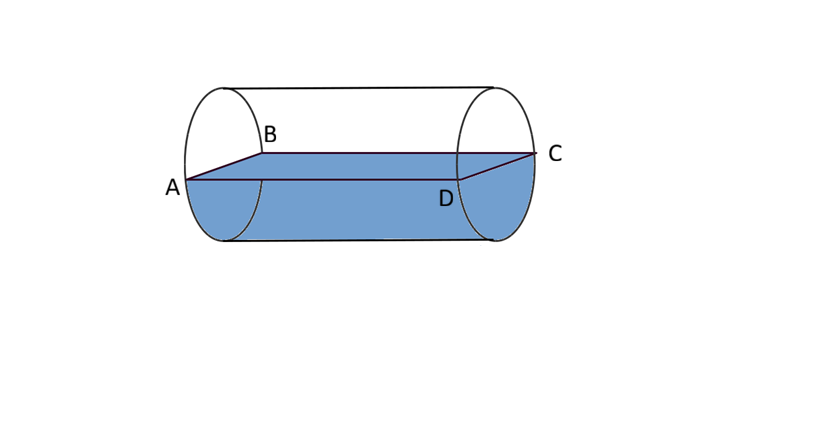
We are given the area of ABCD rectangle = 40 sq. cm and the length of the rectangle i.e. AD to be 10 cm.
This gives the length of the breadth of rectangle = 40/10 = 4 cm.
The breadth i.e. CD is a chord on the circular face.
However, there are 2 cases when the chord could be of length = 4 cm :
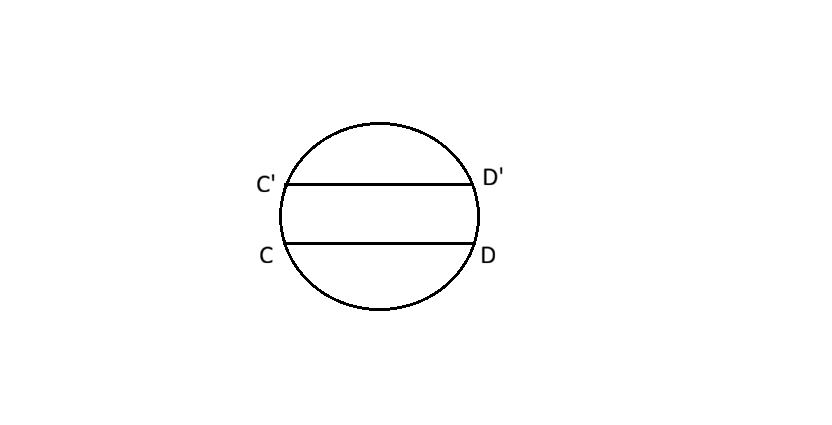
Now, the perpendicular distance of either of the chord from the center can be calculated using Pythagoras theorem in the triangle OPC. This gives OP = $$\sqrt{\ 5}$$ cm.
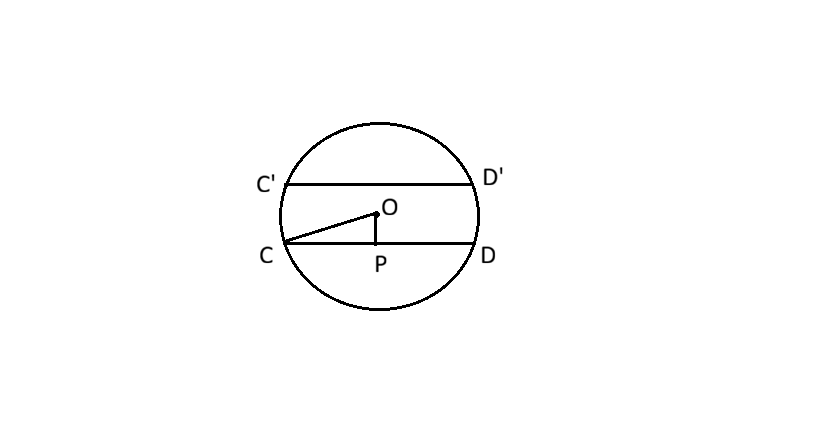
Thus, the depth of the water could either be R - $$\sqrt{\ 5}$$ OR R + $$\sqrt{\ 5}$$ i.e. $$3-\sqrt{\ 5}\ or\ 3+\sqrt{\ 5}$$ cm.
A square and an equilateral triangle have the same perimeter. Let A be the area of the circle circumscribed about the square and-B be the area of the circle circumscribed about thetriangle. Then the ratio A: B is
Let the common perimeter be $$c$$
So, each side of square = $$\frac{c}{4}$$
=> Circum radius of square = $$r_s=\frac{s}{\sqrt2}=\frac{c}{4\sqrt2}$$
Thus, area of circle circumscribed about the square will be
=> $$A=\pi (r_s)^2=\pi\frac{c^2}{32}$$ -------------(i)
Now, each side of triangle = $$\frac{c}{3}$$
=> Height of triangle = $$\frac{\sqrt3}{2}\times\frac{c}{3}$$
=> Circum radius of triangle = $$r_t=\frac{2}{3}\times(\frac{\sqrt3}{2}\times\frac{c}{3})=\frac{c}{3\sqrt3}$$
So area of the circle circumscribed about the triangle
=> $$B=\pi (r_t)^2=\pi\frac{c^2}{27}$$ -----------(ii)
$$\therefore$$ Required ratio $$A:B=27:32$$
=> Ans - (C)
Surface area of a cuboid is 22 $$cm^2$$ and the sum of the lengths of all its edges is 24 cm. The length of each diagonal of the cuboid, in cm, is
Let length, breadth and height be $$l,b,h$$ cm respectively.
=> Surface area of cuboid = $$2(lb+bh+hl)=22$$ -----------(i)
Sum of all edges = $$4(l+b+h)=24 \Rightarrow (l+b+h)=6$$
Squaring both sides, => $$(l^2+b^2+h^2)+2(lb+bh+hl)=36$$
Substituting value from equation (i), we get :
=> $$(l^2+b^2+h^2)+22=36$$
=> $$(l^2+b^2+h^2)=36-22 = 14$$
$$\therefore$$ Diagonal of cuboid = $$\sqrt{l^2+b^2+h^2}=\sqrt{14}$$
=> Ans - (D)
A right circular cylinder has its height two timesits radius. It is inscribed in a right circular cone having its diameter 10 cm and altitude 12 cm, and the axes of both the cylinder and cone coincide. The radius of the cylinder is
Let radius of cylinder = $$x$$ cm and its height = $$2x$$ cm
Height of cone = $$h=12$$ cm and radius of cone = $$r=5$$ cm

Since, the axes coincide, thus in the two similar triangles, we have : $$\frac{y}{h}=\frac{x}{r}$$
=> $$\frac{12-2x}{12}=\frac{x}{5}$$
=> $$60-10x=12x$$
=> $$12x+10x=22x=60$$
=> $$x=\frac{60}{22}=2\frac{8}{11}$$ cm
=> Ans - (A)
Words in the following questions have a definite relationship. Your task is to find out the pair with similar relationship from (1), (2), (3) and (4).
Cool : Cold
Cool and cold are two states that vary in intensity. For instance, cool is comfortable, but cold is not conducive to oneself. The same relation is displayed by sprain and fracture where sprain is lesser in intensity when compared with fracture.
Unity : Diversity
Unity and diversity are two opposite concepts altogether because diversity mainly overrides the concept of unity. The same relation is displayed by Lead and Follow, which are opposite poles as well.
Match the questions with (1) (2), (3) and (4) on the basis of the relationship among the items given in the questions. The relationship among the items, should be the same irrespective of the order in which they are placed.
Cow: Black : Dog
Easy way to look at this: Cow and Dog are two different kinds of animals. The same relation is exhibited by Forests and Mountains, which are two different forms of landscape/land forms.
Crow : Horse : Shark
Crow : Horse : Shark represents a collection of items belonging to the same broad category of 'Animals'. To complete the analogy, the selected option should also present a set of three items that fall within a distinct common category.
Option D: History : Geography : Economics is the correct choice because all three terms represent a collection of items belonging to the single broader category of 'Academic Subjects' or 'Social Studies Fields'. The other options fail to meet this criterion: Option A mixes containers and an item; Option B presents related but distinct concepts (a location, a person, and an object); and Option C lists three different types of geographical features.
Thus, the correct answer is Option D.
House : Fan : Room
The house has a fan, which is located inside the room. Similarly, pocket has money, which is kept in a purse.
We come across many funny incidents related to different walks of life. One of the funny incident is the punchline or a climax — which gives the incident a sudden transformation or twist (into something not expected). It is this punchline which makes the incident funny.
In each of the following questions an incident is described but the punchline is missing - indicated by a blank. After the incident, two statements numbered I and II are given. Considering the- incident, you have to decide which of the two statements fits as a punchline.
The patient was grumbling about the fee. Hundred Rupees for pulling out a tooth!”’, she exclaimed, ‘‘and it’s only a minute’s work.”
The dentist said, ‘‘well, ............
I. Ican give you 50% discountif you get all your teeth pulled out.
Il. I will pull it-out slowly, if you wish.
Here, the customer has expressed that the rate is too high for getting one single tooth pulled out, and that too for work that needs only a minute.
Hence, statement 1 can be a funny punchline, wherein the dentist mocks the patient by asking her to get all the teeth pulled out, which is not a practical solution to secure a discount.
Even the second statement is a good punchline that counters the argument made by the patient about the work needing only a minute.
This makes both statements good punchlines.
The grand-son reported to his father : “Dad the car has developed some trouble. There is water in its carburettor”? When the father asked how it happened, he replied : “........
I. Oh, I was checking the carburrettor when, suddenly, it began to rain.
II. Oh, I was driving the car when the bridge collapsed suddenly and fell into a river.
The son was talking about the carburetor having some water. Hence, any reason against the practical notions shall be a good punchline.
Statement 1 is not a funny line, considering the possibility of rain while he was checking the carburetor. It can actually be a valid reason.
Statement 2 is funny, since the line seems to exaggerate the incident, and had the car fallen off the bride, it would not exist anymore.
The psychiatrist was assuring the husband : “Don’t worry about your wife. You'll have a different woman when she gets back from hospital.”
Husband : ......
I. ‘And what if she finds out ?”
II. ‘No sir, I love my wife’.
The psychiatrist said that the man's wife would be completely different (in the sense that she would experience a major change in her personality) after the treatment. Hence, any line that uses the words 'different woman' in the context of having another person altogether shall be funny.
1. This is a funny statement as it shows that the words of the psychiatrist were used in a different context altogether, and the man used a punchline in the context of having another woman and his wife finding it out.
2. This is a funny statement as well as he uses the line in context of there being another woman. However, the two punchlines are opposite in nature as the man's attitude of having another woman is different in the two.
Wife : The cleaning woman seems to have stolen two of our new towels.
Husband : Which towel ?
Wife : .......
I.“The ones we had been gifted on our anniversary”.
II. “The ones we brought back from the hotel in Delhi.”
Both options are apt punchlines are they change the course of discussion altogether by twisting the phrase 'new towels' by first mentioning them as gifts on the anniversary and second by mentioning them as the ones brought from the hotel. In both the cases, the towels won't be new, but the two statements are different ideas altogether.
A asked his friend B how the latter had amassed so much wealth in such a short time. B said,
“J joined hands with a rich men. He had the money and I had the experience.” He added.....
I. “Now he has the experience and I the money.”
II. ‘When experience joins money, it creates miracles.”
Statement 1 is a punchline as B induced humor by saying that the interaction with J got him money and J got experience. The tradeoff is shown with a funny statement in this.
Statement 2 is a punchline as well, because it is presented in an unusual manner. However, the two statements are entirely different in the way they are presented.
Study the following information carefully and answer the given questions:
‘p’, ‘Q’. ‘R’, ‘S’, T’, ‘X’, ‘Y’ and ‘Z’ are sitting around a circular table facing the centre.
(A) ‘S’ sits exactly between ‘Z’ and ‘T’.
(B) ‘Z’ sits second to the left of “T’ and second to the right of ‘Q’.
(C) ‘Y’ sits third to the left of ‘X’.
(D) ‘P’ is not an immediate neighbour of ‘Q’.
‘p’ : ‘Z’ then ‘Q’: ?
For the sake of clarity, we shall know that ABCDE represents A as the starting point, and on moving anticlockwise we get B. On the other hand, clockwise movement gives E.
The following conclusions can be made:
A and B: The order shall be Q_ZST
Now, Y sits third to the left of X, which means Y's position is third to the left of X (clockwise).
Also, P is not an immediate neighbor of Q.
Hence, a possible combination can be: Y_QXZSTP
R can occupy the blank. Hence, the combination, in a clockwise direction, can be YRQXZSTP
Now, Z is third to the left of P. Hence, Third to the left of Q is P.
Who is immediate right of ‘S’ ?
For the sake of clarity, we shall know that ABCDE represents A as the starting point, and on moving anticlockwise we get B. On the other hand, clockwise movement gives E.
The following conclusions can be made:
A and B: The order shall be Q_ZST
Now, Y sits third to the left of X, which means Y's position is third to the left of X (clockwise).
Also, P is not an immediate neighbor of Q.
Hence, a possible combination can be: Y_QXZSTP
R can occupy the blank. Hence, the combination, in a clockwise direction, can be YRQXZSTP
Immediate right of S is T.
Who sits third to the left of ‘Z’ ?
For the sake of clarity, we shall know that ABCDE represents A as the starting point, and on moving anticlockwise we get B. On the other hand, clockwise movement gives E.
The following conclusions can be made:
A and B: The order shall be Q_ZST
Now, Y sits third to the left of X, which means Y's position is third to the left of X (clockwise).
Also, P is not an immediate neighbor of Q.
Hence, a possible combination can be: Y_QXZSTP
R can occupy the blank. Hence, the combination, in a clockwise direction, can be YRQXZSTP
Third to the left of Z is R.
How many people sit between ‘P’ and ‘Q’ when counted anti-clockwise direction from ‘Q’ ?
For the sake of clarity, we shall know that ABCDE represents A as the starting point, and on moving anticlockwise we get B. On the other hand, clockwise movement gives E.
The following conclusions can be made:
A and B: The order shall be Q_ZST
Now, Y sits third to the left of X, which means Y's position is third to the left of X (clockwise).
Also, P is not an immediate neighbor of Q.
Hence, a possible combination can be: Y_QXZSTP
R can occupy the blank. Hence, the combination, in a clockwise direction, can be YRQXZSTP
Between P and Q (anti clockwise from Q), we have XZST. Hence, four people.
In which of the following pairs, is the second person sitting to the immediate left of the first person ?
For the sake of clarity, we shall know that ABCDE represents A as the starting point, and on moving anticlockwise we get B. On the other hand, clockwise movement gives E.
The following conclusions can be made:
A and B: The order shall be Q_ZST
Now, Y sits third to the left of X, which means Y's position is third to the left of X (clockwise).
Also, P is not an immediate neighbor of Q.
Hence, a possible combination can be: Y_QXZSTP
R can occupy the blank. Hence, the combination, in a clockwise direction, can be YRQXZSTP
Here, R is sitting to the immediate left of Q.
Below are given two passages followed by several possible inferences which can be drawn from the facts stated in the passage. You have to examine each inference separately in the context of the passage and decide upon its degree of truth or falsity.
Data available from the National Institute of Nutrition (NIN) compares, separately for boys and girls, the average heights recorded during 2010 with the average for the period 2005-10 at different ages in the 10 states covered by the NNMBsurvey. The 2010 height turns out to be neither uniformly higher nor uniformly lower than the 2005-10 average heighe at ages 2, 5 and 9 in most of the states. However, the comparison at age 13 is more meaningful as it represents the cumulative result of childhood growth. At age 13, the average height recorded for boys in 2010 is lower than the average for 2005-10 in only one state; Karnataka. For girls at this age, the average height recorded in 2010 turns out to be lower than the 2005-10 average in four States — Andhra Pradesh, Gujarat, Madhya Pradesh and Uttar Pradesh. In all other States, the 2010 average was greater than or equal to the 2005-10 average.
There are only two institutes - NIN and NNMB which have collected data on average height.
The passage only mentions NIN and NNMB. However, we cannot say anything about the number of institutes that collected data on heights. Hence, the data is inadequate to corroborate the statement.
The data from Karnataka was collected by both NIN and NNMB.
The passage states: At age 13, the average height recorded for boys in 2010 is lower than the average for 2005-10 in only one state; Karnataka.
Hence, it is clear that there is data about Karnataka in both the time brackets, and hence we can say for sure that both the agencies have collected data from Karnataka.
In Karnataka, the average age recorded in 2010 for both boys and girls is lower than that for 2005-10.
The survey was intended to measure the average height of people in different age groups. However, the passage is silent over the average age of the states. Hence, there is no adequate data to corroborate the statement.
More States indicated higher average in 2010 as comparedto that 2005-10.
The passage talks about specific groups (say female in age group of 13 years, or boys at age 13). However, we cannot say anything about the cumulative average of the states. Also, we have no information about the overall average of other states. Hence, data inadequate.
There may not be large differences in the height of boys and girls from 2nd to 5th year.
The passage specifically talks about boys/girls at the age of 13. However, it is silent over the other age groups. Hence, there is no adequate data to corroborate the statement.
In a certain code, letters of English alphabet (consonants and vowels) are coded as given for some words. The numeric code for each letter is given in bracket under coded form and corresponds to the letter in the word in the sameserial order. Study the coded forms of the given words and find out the rules for their codification. Applying those rules, answer the questions that follow.

MODE
If the word is of 4 letters,
1. Consonants and Vowels are arranged as CVCV, then the code will be : 5 25 5 25
2. Consonants and vowels are arranged as VCVC, then the code will be : 30 5 30 5
3. Consonants and vowels are arranged as CVVC, then the code will be : 5 20 20 5
If the word has 3 letters,
1. Consonants and vowels are arranged as VCV, then the code will be : 0 5 0
2. Consonants and vowels are arranged as CVC, then the code will be : 5 10 5
This is what we can infer from all the codes given to us.
Now, the word is MODE and the consonants and vowels are arranged as CVCV, then the code will be 5 25 5 25 i.e. Option C.
RUN
If the word is of 4 letters,
1. Consonants and Vowels are arranged as CVCV, then the code will be : 5 25 5 25
2. Consonants and vowels are arranged as VCVC, then the code will be : 30 5 30 5
3. Consonants and vowels are arranged as CVVC, then the code will be : 5 20 20 5
If the word has 3 letters,
1. Consonants and vowels are arranged as VCV, then the code will be : 0 5 0
2. Consonants and vowels are arranged as CVC, then the code will be : 5 10 5
This is what we can infer from all the codes given to us.
Now, the word is RUN and the consonants and vowels are arranged as CVC, so the code will be 5 10 5 i.e. Option B.
ICON
If the word is of 4 letters,
1. Consonants and Vowels are arranged as CVCV, then the code will be : 5 25 5 25
2. Consonants and vowels are arranged as VCVC, then the code will be : 30 5 30 5
3. Consonants and vowels are arranged as CVVC, then the code will be : 5 20 20 5
If the word has 3 letters,
1. Consonants and vowels are arranged as VCV, then the code will be : 0 5 0
2. Consonants and vowels are arranged as CVC, then the code will be : 5 10 5
This is what we can infer from all the codes given to us.
Now, ICON has 4 letters and consonants and vowels are arranged as VCVC, so the code will be 30 5 30 5 i.e. Option A.
AGE
The code for AGE is directly given to be 0 5 0 i.e. Option D.
REAL
If the word is of 4 letters,
1. Consonants and Vowels are arranged as CVCV, then the code will be : 5 25 5 25
2. Consonants and vowels are arranged as VCVC, then the code will be : 30 5 30 5
3. Consonants and vowels are arranged as CVVC, then the code will be : 5 15 15 5 and if the vowels are identical, then the code will be 5 20 20 5.
If the word has 3 letters,
1. Consonants and vowels are arranged as VCV, then the code will be : 0 5 0
2. Consonants and vowels are arranged as CVC, then the code will be : 5 10 5
This is what we can infer from all the codes given to us.
Now, the word is REAL and the consonants and vowels are arranged as CVVC with distinct vowels, then the code will be 5 15 15 5 i.e. Option B.
Read the following information carefully and answerthe questions.
A famous monumentissuesentry passesto all its visitors for security reasons. Visitors are allowed in batches after every one hour. In a day there are six batches. A code is printed on entry pass which keeps on changing for every batch. Following is an illustration of pass-codes issued for each batch.
Batch I : clothes neat and clean liked are all by
Batch II : by clothes neat all are and clean liked
Batch III: liked by clothes clean and neat all are and so on.......
If pass-code for the second batch is ‘to confidence hard you leads work and success’, what will be the pass-code for the fourth batch ?
In the given arrangement, the next batch's code is written by first writing previous batch's last word, then next words from the beginning, then next 2 words from the end, then next 3 letters from the beginning.
So, if the previous batch's code is 12345678 (as there are 8 words and we assign them numbers for easier calculation), the next batch's code will be 8 12 76 345.
3rd batch will have 5 81 43 276
4th batch will have 6 58 72 143.
If 2nd batch's code i.e. 8 12 76 345 is "to confidence hard you leads work and success", 4th batch's code i.e. 6 58 72 143 will be: "leads success to you hard confidence and work" i.e. Option C.
If the pass-code issued for the last (sixth) batch is ‘and pencil by all boys used are pen’, what will be the pass-code for the first batch ?
In the given arrangement, the next batch's code is written by first writing previous batch's last word, then next words from the beginning, then next 2 words from the end, then next 3 letters from the beginning.
So, if the previous batch's code is 12345678 (as there are 8 words and we assign them numbers for easier calculation), the next batch's code will be 8 12 76 345.
3rd batch will have 5 81 43 276
4th batch will have 6 58 72 143
5th batch will have 3 65 41 872 and,
6th batch will have 2 36 78 541. If this code is "and pencil by all boys used are pen", then 1st batch's code i.e. 12345678 will be "pen and pencil are used by all boys" i.e. Option D.
If pass-code for the third batch is ‘night succeed day and hard workto for’ what will be the passcode for the sixth batch?
In the given arrangement, the next batch's code is written by first writing previous batch's last word, then next words from the beginning, then next 2 words from the end, then next 3 letters from the beginning.
So, if the previous batch's code is 12345678 (as there are 8 words and we assign them numbers for easier calculation), the next batch's code will be 8 12 76 345.
3rd batch will have 5 81 43 276
4th batch will have 6 58 72 143
5th batch will have 3 65 41 872 and,
6th batch will have 2 36 78 541.
If 3rd batch's code i.e. 5 81 43 276 is "night succeed day and hard work to for", then passcode for 6th batch i.e. 2 36 78 541 is "work hard for to succeed night and day".
Thus, the correct answer is Option B.
‘A’ went to visit the monument in the second batch. He was issued a pass-code ‘length the day equal of an night are’. However, he could not visit the monument in the second batch as he was little late. He then prefered to visit in the fifth batch. What will be the new pass-code issued to ‘A’ ?
If ‘visit in zoo should the we time day’ is the pass-code for the fifth batch, ‘zoo we the should visit day time in’ will be pass-code for which of the following batches ?
In the given arrangement, the next batch's code is written by first writing previous batch's last word, then next words from the beginning, then next 2 words from the end, then next 3 letters from the beginning.
So, if the previous batch's code is 12345678 (as there are 8 words and we assign them numbers for easier calculation), the next batch's code will be 8 12 76 345.
3rd batch will have 5 81 43 276
4th batch will have 6 58 72 143
5th batch will have 3 65 41 872 and,
6th batch will have 2 36 78 541.
So, if 5th batch's code i.e. 3 65 41 872 is "visit in zoo should the we time day", then "zoo we the should visit day time in" is 5 81 43 276 i.e. the code for 3rd batch.
Thus, the correct answer is Option A.
Below are given three statements a, b and c followed by four conclusions. You have to take the given statements to be true even if they appear to be at variance with commonly, known facts, and then decide which of the conclusionslogically follow(s) from the given statements. For each question, mark out an appropriate answer choice that you think is correct.
Statements:
a. All colleges are books.
b. Some colleges are students.
c. No chairs are books.
Conclusions :
I. Somestudents are chairs.
II. No colleges are chairs.
Ill. Some students are books.
IV. Some students are not en
We shall test each of the options and try to negate by coming up with a scenario where the particular conclusion won't hold true. If we cannot do that for a particular conclusion, that shall be the valid one.
1. Some students are chairs: We don't have any information about the connection between Books and Chairs. There can be an instance where students who are not books can come under the header of chairs. However, the other instance where chairs and students are disjoint sets can hold true as well. Hence, an invalid conclusion.
2. No college is a chair: Since it is clearly given that all colleges are books, and no book can be classified as a chair, we can definitely say that no college is a chair.
3. Some students are books: We know that all colleges are books, and at the same time, some students are college as well. Hence, we can definitely conclude that students which are classified as college are books as well.
4. Some students are not chairs: We definitely know that some students are college, which in turn are books. Further, it is also given that no book is a chair. Hence, students which are college cannot be chair.
Statements:
a. Only stars are moons.
b. No cosmosis star.
c. No planets are moons.
Conclusions :
I. Some moonsare notplanets.
II. No moon is a cosmos.
III. No cosmosis a planet.
IV. No stars are planets.
Only stars are moons, which shall be interpreted in this way: All moons are stars.
We shall verify each option:
1. Some moons are not planets: Since we know that only stars can be classified as moons, it is always true that some moons are not planets.
2. No moon is a cosmos: We know that only stars are moons; this is again, a valid conclusion.
3. No cosmos is a planet: We have no relation given for planet and cosmos; hence, we cannot say for sure whether some cosmos are planets or not.
4. No star is a planet: We have no relation given for stars and planets. We only know that no planets are moons. However, there might or might not be stars which are not moon but are planet indeed.
Statements :
a. some colleges are hospitals.
b. All hospitals are medicines.
c. Some medicines are machines.
Conclusions :
I. All hospitals are medicines.
II. Some colleges are medicines.
III. Some colleges are machines.
IV. Some colleges are not machines.
Testing each of the options:
1. All hospitals are medicines: This is directly given in the question.
2. Some colleges are medicines: We know that some colleges are hospitals, and all hospitals are medicines. Hence, the colleges which are hospitals are definitely medicines.
3 and 4: We don't have any relation given between colleges and machines. Hence, either of the statements shall hold true.
Statements :
a. No bookis a plate.
b. Nochair is a plate.
c. Some chairs are bags.
Conclusions :
I Some bagsare plates.
II. Some bags are notplates.
III. No book is a chair.
IV. Some chairs are books.
We shall verify each of the options:
1. Some bags are plates: We don't have any relation given for bags and plates. Hence, an invalid conclusion.
2. Some bags are not plates: We know that some chairs are bags, and none of the chairs are plates. Hence, the chairs that come under bags are not plates. This is a valid conclusion.
3 and 4: We don't have any relation given about books and chairs, hence either of these shall be true.
Statements:
a. No, hero is dancer.
b. some musicians are players.
c. All musicians are heros.
Conclusions:
I. Some dancers are not players.
II. No dancer is a musician.
III. Some players are heros.
IV. Some players are not dancers.
Let us verify each of the options:
1. Some dancers are not players: There can be an instance where players are a bigger set, only some of them fall within heroes and musicians, and in the rest of the set of players, all dancers are classified. Hence, this is an invalid conclusion.
2. No dancer is a musician: Since all dancers are heroes, and none of the dancers are heroes, we can say that none of the dancers are musicians.
3. Some players are heroes: Since some musicians are players, and all musicians are heroes, we can say the players that can be classified as musicians are heroes.
4. Some players are not dancers: Since some musicians are players, all musicians are heroes, and no dancer is a hero, we can say that players which are musicians are definitely not dancers.
Six children P, Q, R, S, T and U, were all born on the same day of the year, but each was born in a different year during a single six-year period.
P is older than R.
Q is older than both S and T.
U is two years older than S.
P was born either in 2007 or in 2008.
The oldest children was born in 2005.
If P is younger than S, all of the following must be true EXCEPT
We know:
P>R
Q>S and T
U>S (2 years)
P- 2007/2008
Oldest in 2005
Now, we can see that P is not the oldest. Hence, the oldest shall be either U or Q.
The birth years shall be: 2005, 2006, 2007, 2008, 2009, 2010.
Case 1: When the oldest is U
Hence, U (2005), S (2007), Q (2006), P (2008), R/T (2009/2010)
Case 2: When Q is the oldest
Hence, Q (2005), U (2006), S (2008), P (2007), R/T (2009/2010)
It has to be case 1, where P is younger than S. Hence, all the options must be true except for D, as either R or T can take 2009.
If U is the oldest of the children, then which of the following must be true ?
We know:
P>R
Q>S and T
U>S (2 years)
P- 2007/2008
Oldest in 2005
Now, we can see that P is not the oldest. Hence, the oldest shall be either U or Q.
The birth years shall be: 2005, 2006, 2007, 2008, 2009, 2010.
Case 1: When the oldest is U
Hence, U (2005), S (2007), Q (2006), P (2008), R/T (2009/2010)
Case 2: When Q is the oldest
Hence, Q (2005), U (2006), S (2008), P (2007), R/T (2009/2010)
It is case 1 where U is the oldest. There, Q has to be from 2006.
Which of the following could be a correctlisting of the children from the youngest to be oldest?
We know:
P>R
Q>S and T
U>S (2 years)
P- 2007/2008
Oldest in 2005
Now, we can see that P is not the oldest. Hence, the oldest shall be either U or Q.
The birth years shall be: 2005, 2006, 2007, 2008, 2009, 2010.
Case 1: When the oldest is U
Hence, U (2005), S (2007), Q (2006), P (2008), R/T (2009/2010)
Case 2: When Q is the oldest
Hence, Q (2005), U (2006), S (2008), P (2007), R/T (2009/2010)
Hence, the cases can be (youngest to oldest): R/T, P, S, Q, U or R/T, S, P. U, Q.
If P is older than U, then in how many different orders could the six children have been born ?
We know:
P>R
Q>S and T
U>S (2 years)
P- 2007/2008
Oldest in 2005
Now, we can see that P is not the oldest. Hence, the oldest shall be either U or Q.
The birth years shall be: 2005, 2006, 2007, 2008, 2009, 2010.
Case 1: When the oldest is U
Hence, U (2005), S (2007), Q (2006), P (2008), R/T (2009/2010)
Case 2: When Q is the oldest
Hence, Q (2005), U (2006), S (2008), P (2007), R/T (2009/2010)
It is case 2 where P is older than U. And there, two cases can be made depending on the year of R/T.
If T is older than S, which of the following must be true ?
I. Q was born in 2005.
II. T was born in 2006.
III. P was born in 2008.
If the eldest child was born in 2005, then all the children were born in the years ranging from 2005 to 2010.
Case 1: P was born in 2007.
As U is 2 years older than S, U was either born in 2008 or 2006.
Case 1A: U was born in 2008. S was born in 2010. As P is older than R, R must be born in 2009. Also, as Q is older than T, T must be born in 2006 and Q must be born in 2005.
Case 1B: U was born in 2006. S was born 2 years later i.e. 2008. Now, Q must be older than S which means that Q was born in 2005. R and T are born in either 2009 or 2010.
Case 2: P was born in 2008.
As U is 2 years older than S, U was either born in 2005 or 2007.
Case 2A: U was born in 2005. S was born in 2007. As Q is older than S, Q was born in 2006. R and T are born in either of 2009 or 2010.
Case 2B: U was born in 2007 so S was born in 2009. As P is older than R, R must be born in 2010. And as Q is older than T, Q must be born in 2005 and T must be born in 2006.
The possibilities when T is older than S are cases 1A and 2B.
In both the cases Q was born in 2005 and T was born in 2006.
So, only I and II statements are definitely true.
Which city is also known as the “Big Apple” ?
Which of the following vegetable oils does not contain essential fatty acids ?
Absolute zero is
Which of the following oceans has the shape of English alphabet S ?
What is ‘Barak’ ?
Where is the Bandipur National Park ?
What is ‘Jhum’ ?
If saving exceeds investment, the national income will
‘Teratali’ is the folk dance of
UN Day is celebrated on
Broadly, what are the blood corpuscles that help to built up resistance against diseases ?
What is the chromosome number in a human ovum ?
Which one of the following is the greatest circle ?
Who is Julian Assange ?
What does the letter ‘S denote in ‘AFSPA’, an abbreviation we very often see in Newspapers ?
The present ‘Somnath Temple’ located in the Kathiawar region of Gujarat is the seventh temple built on the original site. It was completed on.......
‘Akbar’ built Fatehpur Sikri (city of victory) near Agra, commemorating the emperor’s conquest of ..........
Who amongthe following has been appointed as the Goodwill Ambassador of the Rajiv Gandhi Scheme for Empowerment of Adolescent Girls (SABLA) by Ministry of Women and Child Development recently ?
King Idris was the last monarch of
What is ‘Operation Twist’ in news in September, 2011 ?
Which country’s Progress cargo rocket launch, ferrying food and fuel to the International Space Station, ended in a failure recently ?
Which of the following is not among the State/unionterritories that underwent a name — change after their creation ?
India assumed the Chairmanship of which of the following international organisation in September, 2011 ?
The Union Environment Ministry has decided to declare Sathymangalam Wildlife Sanctury a ‘Tiger Reserve’. The sanctuary is in which State ?
Which of the following has conducted a study on the economic impact of interlinking of rivers programme ?
Education Innovation Fund for India is an initiative of
Which Indian petroleum company was in news recently for the first hydrocarbon discovery in Sri Lanka ?
The term ‘Golden Revolution’ is mostclosely related to which of the following missions ?
What is the numberof digits in the MICR Magnetic Ink character Recognition code mentioned at the bottom of the cheque just after the cheque number ?
Which of the following has become the first Indian State to launch health insurance policy covering all its people ?
In which of the following States are India’s maximum number of mines producing minerals (excluding minor minerals, petroleum (crude), natural gas and atomic minerals) located
Economic and Social Commission for Asia and Pacific (ESCAP) is an organisation under which of the following ?
Who has written the biography of the Congress leader Sonia Gandhi, ‘Sonia Gandhi : An Extra-ordinary Life, An Indian Destiny’?
Who among the following has won the 26th Indira Gandhi Award for National Integration ?
Article, 32 of the Indian Constitution stands for
‘Peepli Live’ is a film directed by
What constitutes the social infrastructure of an economy ?
The asteroids revolve round the sun in between
‘Free throw’ is given in which of the following games ?
Who created the new form of information presentation known as World Wide Web ?

Educational materials for CAT preparation
 Share
Share