For the following questions answer them individually
For the following reaction, the mass of water produced from 445 g of $$C_{57}H_{110}O_6$$ is:
$$2 \; C_{57}H_{110}O_6(s) + 163O_2(g) \rightarrow 114 \; CO_2(g) + 110H_2O(l)$$
Which of the following combination of statements is true regarding the interpretation of the atomic orbitals?
(A) An electron in an orbital of high angular momentum stays away from the nucleus than an electron in the orbital of lower angular momentum.
(B) For a given value of the principal quantum number, the size of the orbit is inversely proportional to the azimuthal quantum number.
(C) According to wave mechanics, the ground state angular momentum is equal to $$\frac{h}{2\pi}$$.
(D) The plot of $$\psi$$ Vs $$r$$ for various azimuthal quantum numbers, shows peak shifting towards higher $$r$$ value.
When the first electron gain enthalpy $$(\Delta H_{eg})$$ of oxygen is $$-141$$ kJ/mol, its second electron gain enthalpy is:
In which of the following processes, the bond order has increased and paramagnetic character has changed to diamagnetic?
The entropy change associated with the conversion of 1 kg of ice at 273 K to water vapours at 383 K is: (Specific heat of water liquid and water vapour are 4.2 kJ K$$^{-1}$$ and 2.0 kJ K$$^{-1}$$ kg$$^{-1}$$; heat of liquid fusion and vaporization of water are 334 kJ kg$$^{-1}$$ and 2491 kJ kg$$^{-1}$$, respectively). (log 273 = 2.436, log 373 = 2.572, log 383 = 2.583)
The temporary hardness of water is due to:
The metal that forms nitride by reacting directly with $$N_2$$ of air is:
Which of the following compounds is not aromatic?
The pH of rain water is approximately:
Which of the following conditions in drinking water causes methemoglobinemia?
At 100$$^{\circ}$$C, copper (Cu) has FCC unit cell structure with cell edge length of $$x$$ $$\text{Ã…}$$. What is the approximate density of Cu (in g cm$$^{-3}$$) at this temperature? [Atomic Mass of Cu = 63.55 u]
A solution containing 62 g ethylene glycol in 250 g water is cooled to $$-10^{\circ}$$C. If $$K_f$$ for water is 1.86 K kg mol$$^{-1}$$, the amount of water (in g) separated as ice is:
If the standard electrode potential for a cell is 2 V at 300 K, the equilibrium constant (K) for the reaction.
$$Zn(s) + Cu^{2+}(aq) \rightleftharpoons Zn^{2+}(aq) + Cu(s)$$
at 300 K is approximately: ($$R = 8$$ J K$$^{-1}$$ mol$$^{-1}$$, $$F = 96000$$ C mol$$^{-1}$$)
For the reaction, $$2A + B \rightarrow$$ products, when the concentration of $$A$$ and $$B$$ both were doubled, the rate of the reaction increased from 0.3 mol L$$^{-1}$$ s$$^{-1}$$ to 2.4 mol L$$^{-1}$$ s$$^{-1}$$. When the concentration of $$A$$ alone is doubled, the rate increased from 0.3 mol L$$^{-1}$$ s$$^{-1}$$ to 0.6 mol L$$^{-1}$$ s$$^{-1}$$. Which one of the following statements is correct?
Consider the following reversible chemical reactions:
$$A_2(g) + B_2(g)Â \stackrel{k_1}{\rightleftharpoons} 2AB(g) \ldots (1)$$Â
$$6AB(g)Â \stackrel{k_2}{\rightleftharpoons} 3A_2(g) + 3B_2(g) \ldots (2)$$Â
The relation between $$K_1$$ and $$K_2$$ is:
For coagulation of arsenious sulphide sol, which of the following salt solutions will be most effective?
The correct match between Item I and Item II is:
Item IÂ Â Â Â Â Â Â Â Â Â Â Â Item II
(A) Benzaldehyde    (P) Mobile phase
(B) Alumina         (Q) Adsorbent
(C) Acetonitrile      (R) Adsorbate
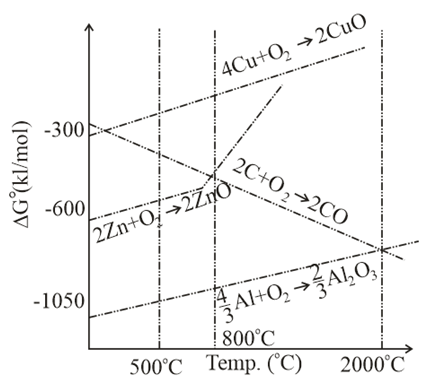
The correct statement regarding the given Ellingham diagram is:
Good reducing nature of $$H_3PO_2$$ is attributed to the presence of:
The transition element that has the lowest enthalpy of atomisation is:
Homoleptic octahedral complexes of a metal ion $$M^{3+}$$ with three monodentate ligands $$L_1$$, $$L_2$$ and $$L_3$$ absorb wavelengths in the region of green, blue and red respectively. The increasing order of the ligand strength is:
The complex that has highest crystal field splitting energy $$(\Delta)$$, is:
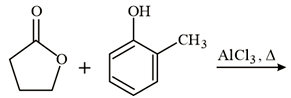
The major product of the following reaction is:
The products formed in the reaction of cumene with $$O_2$$ followed by treatment with dil HCl are:
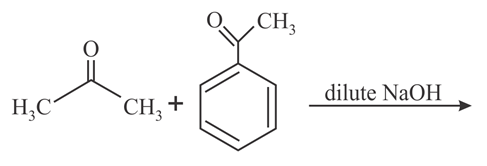
The major product formed in the following reaction is:
The test performed on compound x and their inferences are:
Test                       Inference
(a) 2,4-DNP test           Coloured precipitate yellow
(b) Iodoform test         Yellow precipitate
(c) Azo-dye test           No dye formation
Compound 'x' is:
The major product obtained in the following reaction is:
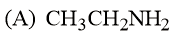
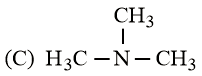
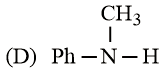
The increasing basicity order of the following compounds is:
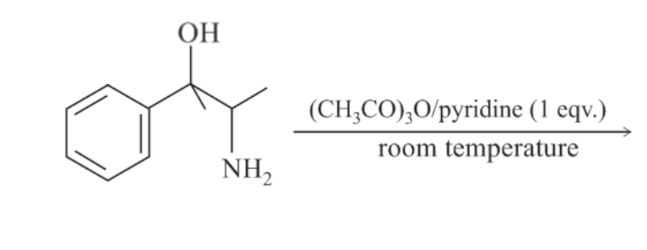
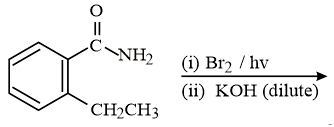
The major product of the following reaction is:
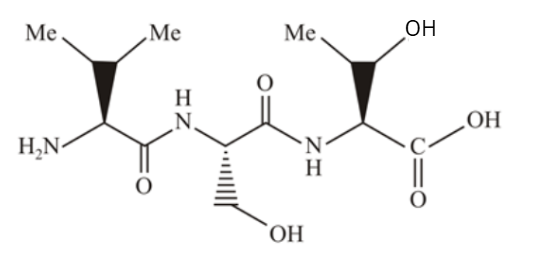
The correct sequence of amino acids present in the tripeptide given below is: