In an atom how many orbital(s) will have the quantum numbers; $$n = 3$$, $$l = 2$$ and $$m_l = +2$$?

Join Our JEE Preparation Group
Prep with like-minded aspirants; Get access to free daily tests and study material.
Sign in
Please select an account to continue using cracku.in
↓ →
Join Our JEE Preparation Group
Prep with like-minded aspirants; Get access to free daily tests and study material.
In an atom how many orbital(s) will have the quantum numbers; $$n = 3$$, $$l = 2$$ and $$m_l = +2$$?
Login to view the detailed solution.
Electron gain enthalpy with negative sign of fluorine is less than that of chlorine due to :
Login to view the detailed solution.
Which one of the following molecules is polar?
Login to view the detailed solution.
.webp)
In which of the following ionization processes the bond energy has increased and also the magnetic behaviour has changed from paramagnetic to diamagnetic?
Login to view the detailed solution.
By how many folds the temperature of a gas would increase when the root mean square velocity of the gas molecules in a container of fixed volume is increased from $$5 \times 10^4$$ cm/s to $$10 \times 10^4$$ cm/s?
Login to view the detailed solution.
Given: (I) $$H_2(g) + \frac{1}{2}O_2(g) \rightarrow H_2O(l)$$; $$\Delta H°_{298K} = -285.9$$ kJ mol$$^{-1}$$
(II) $$H_2(g) + \frac{1}{2}O_2(g) \rightarrow H_2O(g)$$; $$\Delta H°_{298K} = -241.8$$ kJ mol$$^{-1}$$
The molar enthalpy of vapourisation of water will be :
Login to view the detailed solution.
.webp)
In reaction $$A + 2B \rightleftharpoons 2C + D$$, initial concentration of B was 1.5 times of [A], but at equilibrium the concentrations of A and B became equal. The equilibrium constant for the reaction is :
Login to view the detailed solution.
Solid $$Ba(NO_3)_2$$ is gradually dissolved in a $$1.0 \times 10^{-4}$$ M $$Na_2CO_3$$ solution. At which concentration of $$Ba^{2+}$$, precipitate of $$BaCO_3$$ begins to form? ($$K_{sp}$$ for $$BaCO_3 = 5.1 \times 10^{-9}$$)
Login to view the detailed solution.
Given : $$XNa_2HAsO_3 + YNaBrO_3 + ZHCl \rightarrow NaBr + H_3AsO_4 + NaCl$$
The values of X, Y and Z in the above redox reaction are respectively :
Login to view the detailed solution.
.webp)
Sodium Carbonate cannot be used in place of $$(NH_4)_2CO_3$$ for the identification of $$Ca^{2+}$$, $$Ba^{2+}$$ and $$Sr^{2+}$$ ions (in group V) during mixture analysis because :
Login to view the detailed solution.
Which one of the following is most stable?
Login to view the detailed solution.
Rate of dehydration of alcohols follows the order:
Login to view the detailed solution.
.webp)
Which of the following compounds is not expected to show Lassaignes' test for nitrogen?
Login to view the detailed solution.
The addition of HI in the presence of peroxide catalyst does not follow anti-Markovnikov's rule because :
Login to view the detailed solution.
An element having an atomic radius of 0.14 nm crystallizes in an $$f_{cc}$$ unit cell. What is the length of a side of the cell?
Login to view the detailed solution.

12 g of a nonvolatile solute dissolved in 108 g of water produces the relative lowering of vapour pressure of 0.1. The molecular mass of the solute is :
Login to view the detailed solution.
Electrode potentials (E°) are given below :
$$Cu^+/Cu = +0.52$$ V,
$$Fe^{3+}/Fe^{2+} = +0.77$$ V,
$$\frac{1}{2}I_2(s)/I^- = +0.54$$ V,
$$Ag^+/Ag = +0.88$$ V.
Based on the above potentials, strongest oxidizing agent will be :
Login to view the detailed solution.
The instantaneous rate of disappearance of $$MnO_4^-$$ ion in the following reaction is $$4.56 \times 10^{-3}$$ Ms$$^{-1}$$
$$2MnO_4^- + 10I^- + 16H^+ \rightarrow 2Mn^{2+} + 5I_2 + 8H_2O$$
The rate of appearance of $$I_2$$ is :
Login to view the detailed solution.
_1.webp)
The migration of dispersion medium under the influence of an electric potential is called :
Login to view the detailed solution.
Calcination is the process in which:
Login to view the detailed solution.
Trigonal bipyramidal geometry is shown by:
Login to view the detailed solution.
Potassium dichromate when heated with concentrated sulphuric acid and a soluble chloride, gives brown-red vapours of :
Login to view the detailed solution.
The element with which of the following outer electron configuration may exhibit the largest number of oxidation states in its compounds :
Login to view the detailed solution.
Type of isomerism which exists between $$[Pd(C_6H_5)_2(SCN)_2]$$ and $$[Pd(C_6H_5)_2(NCS)_2]$$ is :
Login to view the detailed solution.
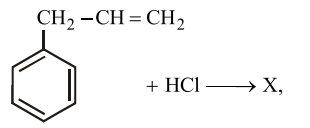
X is:
Login to view the detailed solution.
Aryl fluoride may be prepared from arene diazonium chloride using :
Login to view the detailed solution.
An ether (A), $$C_5H_{12}O$$, when heated with excess of hot concentrated HI produced two alkyl halides which when treated with NaOH yielded compounds (B) and (C). Oxidation of (B) and (C) gave a propanone and an ethanoic acid respectively. The IUPAC name of the ether (A) is :
Login to view the detailed solution.
Formaldehyde can be distinguished from acetaldehyde by the use of :
Login to view the detailed solution.
If a polythene sample contains two monodisperse fractions in the ratio 2 : 3 with degree of polymerization 100 and 200, respectively, then its weight average molecular weight will be :
Login to view the detailed solution.
Which of the following enzyme converts starch into maltose?
Login to view the detailed solution.
Educational materials for JEE preparation
 Share
Share