For the following questions answer them individually
Which of the graphs shown below does not represent the relationship between incident light and the electron ejected from metal surface?
The type of hybridization and no. of lone pair(s) of electron of Xe in $$XeOF_4$$, respectively, are:
Two pi and half sigma bonds are present in:
A process has $$\Delta H = 200$$ J mol$$^{-1}$$ and $$\Delta S = 40$$ J K$$^{-1}$$ mol$$^{-1}$$. Out of the values given below choose the minimum temperature above which the process will be spontaneous:
What are the values of $$\frac{K_p}{K_c}$$ for the following reactions at 300 K respectively?
(At 300 K, RT = 24.62 dm$$^2$$ atm mol$$^{-1}$$)
$$N_2(g) + O_2(g) \rightleftharpoons 2NO(g)$$
$$N_2O_4(g) \rightleftharpoons 2NO(g)$$
$$N_2(g) + 3H_2(g) \rightleftharpoons 2NH_3(g)$$
A mixture of 100 m mol of $$Ca(OH)_2$$ and 2 g of sodium sulphate was dissolved in water and the volume was made up to 100 mL. What is the mass of calcium sulphate formed and the concentration of $$OH^-$$ in resulting solution, respectively? (Molar mass of $$Ca(OH)_2$$, $$Na_2SO_4$$ and $$CaSO_4$$ are 74, 143 and 136 g mol$$^{-1}$$, respectively; $$K_{sp}$$ of $$Ca(OH)_2$$ is $$5.5 \times 10^{-6}$$)
The chemical nature of hydrogen peroxide is:
The total number of isotopes of hydrogen and number of radioactive isotopes among them, respectively, are:
The metal used for making X-ray tube window is:
The electronegativity of aluminum is similar to:
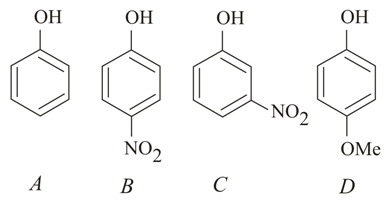
The increasing order of the pKa values of the following compounds is:
If Dichloromethane (DCM) and water $$H_2O$$ are used for differential extraction, which one of the following statements is correct?
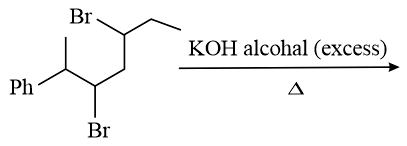
The major product of the following reaction is:
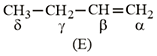
Which hydrogen in compound (E) is easily replaceable during bromination reaction in presence of light?
Water filled in two glasses A and B gave BOD values of 10 and 20, respectively. The correct statement regarding them is:
Which primitive unit cell has unequal edge lengths ($$a \neq b \neq c$$) and all axial angles different from 90$$^{\circ}$$?
Liquids A and B form an ideal solution in the entire composition range. At 350K, the vapour pressure of pure A and pure B are $$7 \times 10^3$$ Pa and $$12 \times 10^3$$ Pa, respectively. The composition of the vapour in equilibrium with a solution containing 40 mole percent of A at this temperature is:
Consider the following reduction processes:
$$Zn^{2+} + 2e^- \rightarrow Zn(s); E^{\circ} = -0.76$$ V
$$Ca^{2+} + 2e^- \rightarrow Ca(s); E^{\circ} = -2.87$$ V
$$Mg^{2+} + 2e^- \rightarrow Mg(s); E^{\circ} = -2.36$$ V
$$Ni^{2+} + 2e^- \rightarrow Ni(s); E^{\circ} = -0.25$$ V
The reducing power of the metals increases in the order:
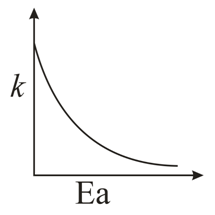
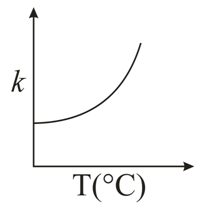
Consider the given plots for a reaction obeying Arrhenius equation ($$0^{\circ}$$C < T < 300$$^{\circ}$$C): (K and $$E_a$$ are rate constant and activation energy, respectively)

Which of the following is not an example of heterogeneous catalysis reaction?
Hall Heroult's process is given by:
The effect of lanthanoid contraction in the lanthanoid series of elements by and large means:
The total number of isomers for a square planar complex: $$[MCl(F)(NO_2)(SCN)]$$ is:
Wilkinson catalyst is:
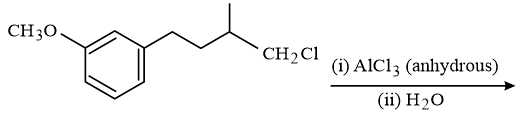
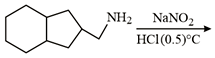
The major product of the following reaction is:
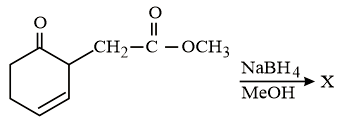
The major product 'X' formed in the following reaction is:
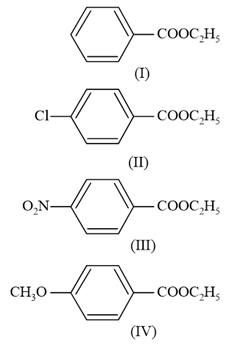
The decreasing order of ease of alkaline hydrolysis for the following esters is:
With dehydrating agent present which dicarboxylic acid is least reactive towards forming an anhydride?
The major product formed in the reaction given below will be:
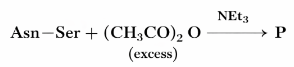
The correct structure of the product 'P' in the following reaction is