91- 6303239042
Which of the following is not a function of mature RBCs?
Sign in
Please select an account to continue using cracku.in
↓ →

Join Our JEE Preparation Group
Prep with like-minded aspirants; Get access to free daily tests and study material.
Which of the following is not a function of mature RBCs?
In which of the following classes of vertebrates there are groups of animals without limbs?
Loading solution...
Which of the following groups have only one pair of wings?
Loading solution...

During an expedition to planet ‘Imagitica’, scientists analysed the genetic material of
the organisms found there and noted the following features:
i. Amount of purines and pyrimidines is unequal
ii. Absence of thymine
iii. Unstable genetic material, with high frequency of mutation
iv. Rapid degradation at pH above 12
From the above data, what genetic material might the Imagitica inhabitants contain?
Loading solution...
Which of the following is most likely to show aerenchyma?
Loading solution...
Given below are three statements about bryophytes:
i. Bryophytes are lower plants with plant body differentiated into root, stem and
leaves.
ii. Bryophytes are devoid of xylem and phloem.
iii. Bryophytes require water for completion of their life cycle.
Which of the above statement/s is/are true with respect to bryophytes?
Loading solution...

Carbon fixation in most of the succulent plants takes place through which pathway?
Loading solution...
If a flower is large, wide-mouthed, white, showing anthesis after sunset, and emitting fruity or musky fragrance, it is most likely to be pollinated by
Loading solution...
Coal is a common fossil fuel. It contains 0.2 to 5.0 percent sulphur which on burning produces a gas responsible for acid rain. The number of atoms in one mole of this gas is
Loading solution...
The stomach fluid in human contains HCl, KCl and NaCl. The stomach fluid is highly acidic and plays an important role in the digestion of food as well as killing of bacteria. The increased acidity may lead to abdominal pain, nausea, bloating, and heartburn. Such a patient is prescribed antacid tablet which mainly contains aluminium hydroxide with molar mass 78. If the concentrations of HCl, KCl and NaCl are $$0.01\,\mathrm{M}$$ each and the stomach fluid volume is 2 litre, the amount of $$\mathrm{Al(OH)_3}$$ required to neutralize the fluid will be
Loading solution...
A $$0.500\,\mathrm{g}$$ mixture of calcium carbonate and calcium oxide was strongly heated to produce a non-combustible gas. If the weight of the residue obtained on heating is found to be $$0.434\,\mathrm{g}$$, the percentage of calcium oxide in the mixture is
Loading solution...
Arrange the following in the increasing order of their metallic character Na, C, O, Li, Be
Loading solution...
A 50 mL of $$0.1\,\mathrm{M}$$ acetic acid solution is taken in a beaker and two wires are dipped in it as shown in following figure.
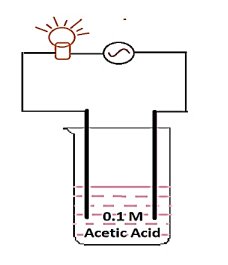
When electric supply is switched on, the bulb glows. To this solution, distilled water is added slowly till the volume doubles. During the addition of water, the intensity of the bulb
Loading solution...
A compound X when heated with NaOH solution produces a pungent gas that turns red litmus blue. When an aqueous solution of X is treated with $$\mathrm{AgNO_3}$$ solution, a white precipitate Y is obtained which on keeping in sunlight turns grey liberating pale yellowish green gas. The aqueous solution of compound X is
Loading solution...
Equal masses of two gases among $$\mathrm{N_2}$$, $$\mathrm{NO}$$, $$\mathrm{O_2}$$, $$\mathrm{CO}$$, $$\mathrm{CO_2}$$ and $$\mathrm{SO_2}$$ occupy same volume at STP. These two gases are
Loading solution...
When a solution and the pure solvent are separated by a semipermeable membrane, the solution exerts a pressure on the membrane called osmotic pressure. The osmotic pressure increases with increase in number of particles, ions or molecules, in the solution. If 10 millimoles of each of the sulphate salts of sodium, magnesium and aluminium are dissolved in 1.0 litre of water in three different beakers labelled as P, Q and R respectively, the osmotic pressure follows the order
Loading solution...
The axes of a coordinate system $$S_2$$ are inclined at an angle $$\theta$$ to those of another coordinate system $$S_1$$. The origins of both the systems are coinciding. A particle $$P_1$$ at rest in system $$S_1$$ starts from point $$(-2,0)$$ and travels along positive direction of $$X_1$$ axis with uniform acceleration of $$1.25\,\mathrm{m/s^2}$$ for 4 s and stops. In system $$S_2$$, particle $$P_2$$ starts from rest from the origin and travels for 2 s along positive direction of $$X_2$$ axis with uniform acceleration $$5\,\mathrm{m/s^2}$$ and stops. If the final distance between $$P_1$$ and $$P_2$$ is 6 m, then the angle between $$+Y_1$$ axis and $$+X_2$$ axis is
Loading solution...
The variation of a certain physical parameter Z with variable u is given by the relation $$Z = A\left(\frac{R}{R+u}\right)^3$$, where R and A are constants and the maximum value of u is much less than R. Then to find R, a student plots a graph of variation of Z, Y axis, against u, X axis. The graph is a
Loading solution...
A submarine $$S_1$$ is parked at a depth of 200 m in an ocean on earth. Assume oceans exist on Mars. At about what depth a submarine $$S_2$$ has to be parked in an ocean on Mars so that $$S_2$$ will experience same pressure as that of $$S_1$$? Acceleration due to gravity on Mars is $$3.7\,\mathrm{m/s^2}$$. Assume that sea water density on Earth and Mars is same, $$\rho = 1.03 \times 10^3\,\mathrm{kg/m^3}$$.
Loading solution...
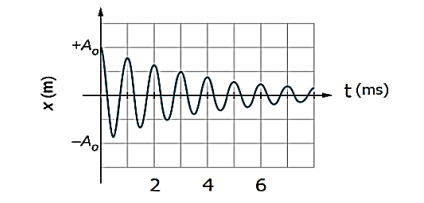
In an oscillating system, damping results in dissipation of the stored energy. The following figure shows the variation of displacement x with time t for an oscillating system. Which of the following statements best describes this physical phenomenon.
Loading solution...
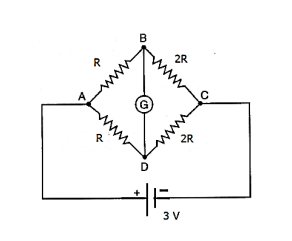
In the adjacent circuit, the galvanometer G does not show any deflection. If $$R = 2\,\Omega$$, the current drawn from the cell is
Loading solution...
Gear is a mechanical system used to transfer mechanical and rotary motion from one mechanical system to another. As shown in the figure below the driving wheel A drives the driven wheel B without slipping and thus forms the gear system. The wheel A has 16 teeth and B has 24 teeth. Wheel B has a projection of radius $$\frac{14}{11}\,\mathrm{cm}$$.
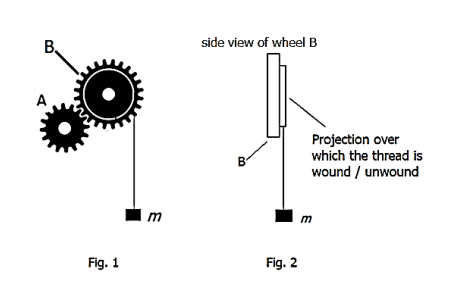
A long massless, inextensible string can be wound or unwound over this circular projection. A mass m is attached to the free end of this long string. If the wheel A makes 6 revolutions per second in the clockwise direction, without slipping, then in $$\frac{1}{2}$$ second the potential energy of the mass m in CGS unit
Loading solution...
Canopus is the second brightest star in the night sky. It is about 300 light years away. The energy is produced inside the star through nuclear reactions. If we receive $$5.0 \times 10^{-8}\,\mathrm{W/m^2}$$ energy from Canopus, how much mass does it lose per second?
Loading solution...
An average human adult radiates about 100 W energy mainly in infra-red region of the electromagnetic spectrum. 50 persons are sitting in a hall with an air conditioning system which is 50 percent efficient. How much electricity must be used to maintain temperature of the hall at $$25^\circ\mathrm{C}$$ for 4 hours?
Loading solution...
Given below are four statements about viruses. Which of the following statement or statements is or are incorrect?
Loading solution...
During a race, Ramesh was thrown off the horse back and suffered an injury in the front part of head. Upon thorough examination, Ramesh was found to have injury to the front part of the head. Which of the following can be the possible outcome or outcomes of this injury?
Loading solution...
Which of the following molecules are primarily responsible for structural support and motility?
Loading solution...
The types of bonding found in dry ice is or are
Loading solution...
The compound or compounds that raise the temperature of water from room temperature on dissolving in it is or are
Loading solution...
Soaps and detergents are common agents used in laundry industry. They are long chain hydrocarbons with ionic terminals of cationic or anionic nature. A 1 percent w/v soap solution X and 1 percent w/v detergent solution Y were prepared in distilled water. Each of the solutions was divided in two equal parts and labelled as X1, X2, Y1 and Y2. 1 g NaCl was added to X1 and Y1 each while 1 g CaCl2 was added to X2 and Y2 each. Which of the following observations is or are correct?
Loading solution...
According to Einstein's theory, light can be assumed to be in the form of a large number of discrete energy packets called photons. In case of light of frequency $$\nu$$, each photon carries energy $$E=h\nu$$. In a certain surgical procedure a surgeon uses LASER beam of wavelength 650 nm in pulses of 30.0 ms duration. The average power of each pulse is 0.6 W. Here h is Planck's constant. Then
Loading solution...
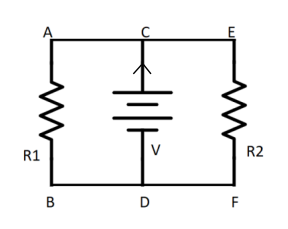
In the following circuit, $$R_1 = 6\,\Omega$$, $$R_2 = 12\,\Omega$$, $$V = 16\,\mathrm{V}$$. The currents $$I_1$$ and $$I_2$$ flow through the resistances $$R_1$$ and $$R_2$$ respectively.
Loading solution...
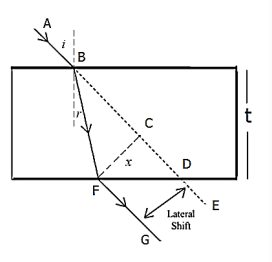
A glass plate of uniform thickness $$t$$ and refractive index $$\mu$$ is as shown in the diagram. AB is the incident ray and FG is the emergent ray. The angles of incidence and refraction are $$i$$ and $$r$$ respectively. The perpendicular distance FC = x between the incident and the emergent rays is called the lateral shift. Then
Loading solution...
Start your IIM journey with the right preparation and crack CAT 2026.

Educational materials for JEE preparation