NMTC Stage 2 GAUSS Primary Level 2018

For the following questions answer them individually

Write down all the ten digit numbers whose digital sum is 2. (The digital sum of a number is the sum of the digits of the number. The digital sum of 4022 is $$4+0+2+2=8$$.) Find the sum of all the 10 digit numbers with digital sum 2.

Backspace
789
456
123
0.-
Clear All

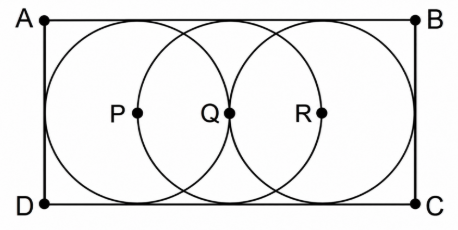
Three congruent circles with centres P, Q and R are tangent to the sides of rectangle ABCD as shown. The circle with centre at Q has diameter 5cm and passes through the points P and R. Find the area of the rectangle ABCD.

image
Backspace
789
456
123
0.-
Clear All

A lucky year is one in which at least one date, when written in the form day/month/year, has the following property. The product of the month times the day equals the last two digits of the year. For example, 1944 is a lucky year because it has the date 11/4/44 where $$11 \times 4 = 44$$. From 1951 to 2000 how many years are not lucky? Give proper explanation for your answer.

Backspace
789
456
123
0.-
Clear All

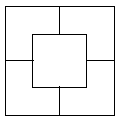
The area of each of the four congruent L-shaped regions of this 100cm by 100cm square is $$\frac{3}{16}$$ of the total area. How many centimeters long is the side of the centre square?

image
Backspace
789
456
123
0.-
Clear All

For any positive integer n, $$s(n)$$ is the sum of the digits of n. What is the minimum value of $$\frac{n}{s(n)}$$ when (1) $$10 \le n \le 99$$ and (2) $$100 \le n \le 999$$?

Backspace
789
456
123
0.-
Clear All

A 122 digit number is obtained by writing the 2 digit numbers 39 to 99, i.e., $$39404142434445...96979899$$. You have to remove 61 digits from this number in such a way that the remaining digits in that order form the largest number possible.(For example in 15161718 if weΒ  removeΒ the four 1’s we get the number 5678, but if we remove 1, 5, 1 and the 1 after 6, we get 6718. This willΒ be the largest number possible in this case.) What will be the first 10 digits of the largest number obtained?

Backspace
789
456
123
0.-
Clear All

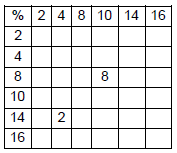
Given the numbers 2, 4, 8, 10, 14 and 16, $$a \% b$$ is defined as the remainder when the ordinary product $$a \cdot b$$ is divided by 18. Find the % product of every pair of these numbers, including the product of a number with itself, and fill in the table given below.
(1) Find $$2\%2\%2\%...\%2$$, where we find the % product of fifteen 2s.
(2) Find $$8\%8\%8\%...\%8$$ where we have ten 8s.

image
Backspace
789
456
123
0.-
Clear All

50,000+ JEE Students Trusted Our Score Calculator

Predict your JEE Main percentile, rank & performance in seconds