If $$4921 \times D = ABBBD$$, then the sum of the digits of $$ABBBD \times D$$ is
Sign in
Please select an account to continue using cracku.in
↓ →
Join Our JEE Preparation Group
Prep with like-minded aspirants; Get access to free daily tests and study material.
If $$4921 \times D = ABBBD$$, then the sum of the digits of $$ABBBD \times D$$ is
Testing digits for $$D$$, only $$D=7$$ gives a product of the required form: $$4921 \times 7 = 34447$$, matching the pattern $$ABBBD$$ with $$A=3$$, $$B=4$$, $$D=7$$. Then $$34447 \times 7 = 241129$$, whose digits sum to $$2+4+1+1+2+9=19$$.
What is the 2019th digit to the right of the decimal point, in the decimal representation of $$\frac{5}{28}$$?
Long division gives $$\frac{5}{28}=0.1\overline{785714}$$, with the first digit 1 followed by a repeating block of 6 digits starting from the second decimal place. Since $$(2019-2) \bmod 6 = 1$$, the 2019th digit matches the 2nd digit of the repeating block "785714", which is 8.
If $$X$$ is a 1000 digit number, $$Y$$ is the sum of its digits, $$Z$$ the sum of the digits of $$Y$$ and $$W$$ the sum of the digits of $$Z$$, then the maximum possible value of $$W$$ is
Since $$X$$ has 1000 digits, $$Y \leq 9000$$, so $$Z$$ can be any digit-sum achievable by a number up to 9000, with the highest such digit-sum being 29 (for example when $$Y=2999$$). Taking $$Z=29$$ gives $$W=2+9=11$$, which is the maximum since no value up to 35 (the true maximum of $$Z$$) has a higher digit sum than 29.
Let $$x$$ be the number $$0.000\ldots001$$ which has 2019 zeroes after the decimal point. Then which of the following numbers is the greatest?
Since $$x=10^{-2020}$$ is extremely small, $$10000+x$$ and $$10000-x$$ are both close to 10000, while $$\frac{10000}{x}=10^{2024}$$ is enormous, but $$\frac{1}{x^2}=10^{4040}$$ is far larger still.
Where A, B, C, D, E are distinct digits satisfying this addition fact, then E is
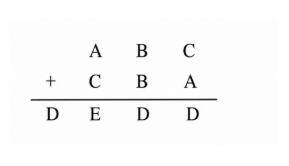
The addition reads $$ABC+CBA=DEDD$$, which simplifies to $$101(A+C)+20B=1011D+100E$$. Since the sum is at most 1998, $$D=1$$, and analyzing the equation modulo 20 shows $$A+C$$ must equal 11 for an integer solution, which forces $$E=2$$ (with $$B=5$$ and, for example, $$A=3$$, $$C=8$$).
In a 5 x 5 grid having 25 cells, Janani has to enter 0 or 1 in each cell such that each sub square grid of size 2 x 2 has exactly three equal numbers. What is the maximum possible sum of the numbers in all the 25 cells put together?
Placing 0s at just the four cells (2,2), (2,4), (4,2), (4,4) and 1s everywhere else makes every one of the sixteen 2 by 2 sub grids contain exactly one 0, satisfying the condition with the minimum possible number of 0s. This gives a maximum sum of $$25-4=21$$.
$$ABCD$$ is a square. $$E$$ is one fourth of the way from $$A$$ to $$B$$ and $$F$$ is one fourth of the way from $$B$$ to C. $$X$$ is the centre of the square. Side of the square is 8 cm. Then the area of the shaded region in the figure in $$\text{cm}^2$$ is
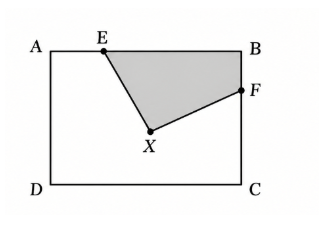
Placing $$A=(0,8)$$, $$B=(8,8)$$, $$C=(8,0)$$, $$D=(0,0)$$ gives $$E=(2,8)$$, $$F=(8,6)$$ and $$X=(4,4)$$. Applying the shoelace formula to the quadrilateral $$E, B, F, X$$ gives an area of 16.
$$ABCD$$ is a rectangle with $$E$$ and $$F$$ are midpoints of $$CD$$ and $$AB$$ respectively and $$G$$ is the mid-point of $$AF$$. The ratio of the area of $$ABCD$$ to area of $$AECG$$ is
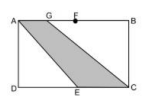
Taking the rectangle with width $$w$$ and height $$h$$, the quadrilateral $$AECG$$ has area $$\frac{3wh}{8}$$ by the shoelace formula, while the rectangle has area $$wh$$. So the ratio is $$wh \colon \frac{3wh}{8} = 8 \colon 3$$.
each alphabet represents a different digit, what is the maximum possible value of FLAT?
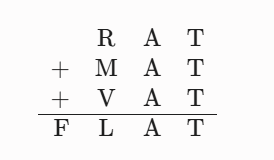
The equation reads $$RAT+MAT+VAT=FLAT$$. Matching units and tens digits forces $$T=0$$ and $$A=5$$, and to maximize the thousands digit, $$R+M+V$$ should be as large as possible using distinct remaining digits while avoiding a units-digit conflict. Taking $$R, M, V = 9, 8, 6$$ gives $$R+M+V=23$$, leading to $$FLAT=2450$$.
How many positive integers smaller than 400 can you get as a sum of eleven consecutive positive integers?
The sum of eleven consecutive integers starting at $$n$$ is $$11(n+5)$$, which must be less than 400 and at least $$11 \times 6=66$$ (for $$n=1$$). This gives $$n$$ ranging from 1 to 31, so there are 31 possible sums.
Let $$x, y$$ and $$z$$ be positive real numbers and let $$x \geq y \geq z$$ so that $$x+y+z=20.1$$. Which of the following statements is true?
Testing values shows $$xy$$ can exceed 99 (e.g. $$x=y=10.05$$), can be made arbitrarily close to 0, and can equal 75 exactly (e.g. $$x=15, y=5, z=0.1$$), ruling out the first three options. For $$yz=49$$ with $$y \geq z$$, the constraint $$x \geq y$$ combined with $$x+y+z=20.1$$ can be shown to always fail, so $$yz \neq 49$$ always holds.
A sequence $$\{a_n\}$$ is generated by the rule, $$a_n = a_{n-1} - a_{n-2}$$ for $$n \geq 3$$. Given $$a_1 = 2$$ and $$a_2 = 4$$, then sum of the first 2019 terms of the sequence is given by
Computing terms shows the sequence is periodic with period 6, and the sum of any full period is 0. Since $$2019 = 6 \times 336 + 3$$, the total sum equals the sum of the first 3 terms, $$2+4+2=8$$.
There are exactly 5 prime numbers between 2000 and 2030. Note $$2021 = 43 \times 47$$ is not a prime number. The difference between the largest and the smallest among these is
The five primes in this range are $$2003, 2011, 2017, 2027, 2029$$. The difference between the largest and smallest is $$2029-2003=26$$.
Which of the following geometric figures is possible to construct?
A pentagon's angles sum to $$540^\circ$$, so 4 right angles would force the fifth to be a degenerate $$180^\circ$$, which is impossible. A parallelogram only has two distinct angle values (equal pairs), so it can never have exactly 3 obtuse angles, and a hexagon with 4 proper reflex angles would already exceed its total angle sum of $$720^\circ$$. The octagon in option (b) has angles summing correctly to $$1080^\circ$$ and is a genuinely constructible equilateral star-like shape.
If $$y^{10} = 2019$$, then
Since $$2^{10}=1024$$ and $$3^{10}=59049$$, and $$1024 < 2019 < 59049$$, it follows that $$2 < y < 3$$.
A sequence of all natural numbers whose second digit (from left to right) is 1, is written in strictly increasing order without repetition as follows. $$11, 21, 31, 41, 51, 61, 71, 81, 91, 110, 111, \ldots$$ Note that the first term of the sequence is 11. The third term is 31, eighth term is 81 and tenth term is 110. The 100th term of the sequence will be
There are 9 two-digit terms (11 through 91) and 90 three-digit terms (110-119, 210-219, and so on up to 910-919), together accounting for the first 99 terms. So the 100th term is the smallest four-digit number with second digit 1, which is 1100.
In $$\triangle ABC $$, $$AB=6\text{cm}$$, $$AC=8\text{cm}$$, median $$AD=5\text{cm}$$. Then, the area of $$ \triangle ABC $$ in $$\text{cm}^2$$ is
Using the median length formula, $$AD^2=\frac{2AB^2+2AC^2-BC^2}{4}$$ gives $$BC^2=100$$. Since $$AB^2+AC^2=36+64=100=BC^2$$, the triangle is right angled at $$A$$, so its area is $$\frac{1}{2}\times6\times8=24$$.
Given $$a, b, c$$ are real numbers such that $$9a+b+8c=12$$ and $$8a-12b-9c=1$$. Then $$a^2-b^2+c^2=$$
Combining the two equations eliminates $$b$$ to give $$4a+3c=5$$, and the direction vector of the resulting solution line is $$(-3,-5,4)$$, whose components satisfy $$(-3)^2-(-5)^2+4^2=9-25+16=0$$. This means $$a^2-b^2+c^2$$ is constant along all solutions, and evaluating at one solution (such as $$a=1.25, b=0.75, c=0$$) gives the value 1.
In the given figure, $$ \triangle ABC $$ is a right angled triangle with $$\angle ABC = 90^\circ$$. D, E, F are points on AB, AC, BC respectively such that $$AD = AE$$ and $$CE = CF$$. Then, $$\angle DEF =$$ (in degree)
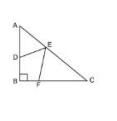
Since $$AD=AE$$, triangle $$ADE$$ is isosceles with base angles $$90-\frac{A}{2}$$, and since $$CE=CF$$, triangle $$CEF$$ is isosceles with base angles $$90-\frac{C}{2}$$. Since $$D$$, $$E$$, $$F$$ lie such that $$A$$, $$E$$, $$C$$ are collinear, $$\angle DEF = 180-(90-\frac{A}{2})-(90-\frac{C}{2})=\frac{A+C}{2}=\frac{90}{2}=45$$.
Numbers of 5-digit multiples of 13 is
The smallest 5-digit multiple of 13 is $$13\times770=10010$$ and the largest is $$13\times7692=99996$$. The count of multiples is $$7692-770+1=6923$$.
The area of a sector and the length of the arc of the sector are equal in numerical value. Then the radius of the circle is
With angle $$\theta$$ in radians, the sector area is $$\frac{1}{2}r^2\theta$$ and the arc length is $$r\theta$$. Setting these equal and dividing both sides by $$r\theta$$ gives $$\frac{r}{2}=1$$, so $$r=2$$.
If a, b, c, d are positive integers such that $$a+\cfrac{1}{b+\cfrac{1}{c+\cfrac{1}{d}}} = \frac{43}{30}$$, then d is
Since $$\frac{43}{30}=1+\frac{13}{30}$$, we get $$a=1$$ and the remaining fraction $$\frac{30}{13}=2+\frac{4}{13}$$ gives $$b=2$$. Then $$\frac{13}{4}=3+\frac{1}{4}$$ gives $$c=3$$ and $$d=4$$.
A teacher asks 10 of her students to guess her age. They guessed it as 34, 38, 40, 42, 46, 48, 51, 54, 57 and 59. Teacher said "At least half of you guessed it too low and two of you are off by one. Also my age is a prime number". The teacher's age is
The only candidate ages with two guesses exactly one away are the midpoints of consecutive guesses differing by 2, namely 39, 41, 47 and 58, and among these only 41 and 47 are prime. Since 47 has exactly 5 guesses below it (satisfying "at least half too low") while 41 only has 3, the teacher's age is 47.
The sum of 8 positive integers is 22 and their LCM is 9. The number of integers among these that are less than 4 is
Since the LCM is 9, every integer must be a divisor of 9, namely 1, 3, or 9. Writing the counts of each as $$a, b, c$$ with $$a+b+c=8$$ and $$a+3b+9c=22$$ gives the unique solution $$a=4, b=3, c=1$$. So the number of integers less than 4 (the 1s and 3s) is $$4+3=7$$.
The number of natural numbers $$n \leq 2019$$ such that $$\sqrt[4]{48n}$$ is an integer is
Since $$48=2^4 \times 3$$, for $$48n$$ to be a perfect fourth power, $$n$$ must supply a factor of $$3^3$$ times a perfect fourth power, so $$n=27s^4$$ for a positive integer $$s$$. Checking $$n \leq 2019$$ gives $$s=1$$ ($$n=27$$) and $$s=2$$ ($$n=432$$) as the only solutions, so there are 2 such values.
Predict your JEE Main percentile, rank & performance in seconds
Educational materials for JEE preparation