 91- 6303239042
If $$\left(8\ast4\right)+6-\left(10\div5\right)=8$$, then $$\ast$$ stands for the operation
Sign in
Please select an account to continue using cracku.in
↓ →

Join Our JEE Preparation Group
Prep with like-minded aspirants; Get access to free daily tests and study material.
If $$\left(8\ast4\right)+6-\left(10\div5\right)=8$$, then $$\ast$$ stands for the operation
We need $$8\ast4+6-10\div5=8$$. The multiplication and division choices give $$36$$ and $$6$$ respectively, while addition gives $$20$$. With subtraction, $$8-4+6-2=8$$, so $$\ast$$ represents subtraction.
$$20\%$$ of a number is equal to $$30\%$$ of another number. Six times the bigger of these numbers added to the smaller number is $$2000$$. Then $$10\%$$ of the smallest number is
Loading solution...
Samrud chooses a two-digit number. He subtracts it from $$200$$ and doubles the result. The largest number he can get is
Loading solution...
.webp)
The least number which leaves $$2$$ as remainder when divided by $$5,6,8,9$$ and $$12$$ is
Loading solution...
Saket takes the number 2021. There are two 2s, one 0 and one 1. Using these numbers, he makes 3-digit numbers, the sum of all these numbers is
Loading solution...
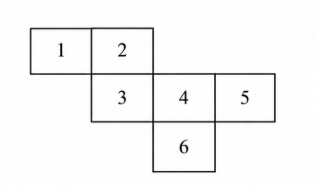
In the net of the adjoining figure numbers $$1$$ to $$6$$ are marked. The net is folded to form a cube. The number that appears on the face opposite to $$6$$ is
Loading solution...
.webp)
$$10^{2021}-1$$ is written as an integer in the usual decimal form. The sum of all digits of this written number is
Loading solution...
August $$15^{\text{th}}$$ $$1992$$ was a Saturday. What day was August $$15^{\text{th}}$$ $$1991$$?
Loading solution...
Two thirds of the students in a class room are seated in three fourths of the chairs. The rest of the students are punished for not submitting the homework and hence asked to stand. There are $$6$$ empty chairs. The number of persons, that is the number of students including the teacher, in the classroom is
Loading solution...
.webp)
There are $$24$$ four digit numbers with different digits, formed by $$2,4,5$$ and $$7$$. One of these four digit numbers is a multiple of another. Which one of the following is it?
Loading solution...
Twelve friends went to a restaurant to have lunch. They ordered for $$12$$ meals. When they were served, they found that the food was too much which can be shared by $$18$$ people. The number of meals they would order to cater to only $$12$$ is
Loading solution...
The least multiple of $$23$$ which when divided by $$18,21$$ and $$24$$ leaves the remainders $$7,10$$ and $$13$$ respectively is
Loading solution...
The value of $$\sqrt{\frac{(0.1)^2+(0.01)^2+(0.008)^2}{(0.01)^2+(0.001)^2+(0.0008)^2}}$$ is
Loading solution...
Two numbers are respectively $$20\%$$ and $$50\%$$ of a third number. The percentage of the first number to the second is
Loading solution...
Water flows through a rectangular opening $$3\text{ m}\times2\text{ m}$$ with a speed of $$1.5\text{ km/hr}$$. The amount of water that passes through the opening in $$5$$ minutes is $$x^3$$. Then the value of $$x$$ is
Loading solution...
If $$A=\frac{1111+3333+5555}{222+333+444}$$, $$B=\frac{555+222}{1111+2222+4444}$$, then $$A\ast B$$ is
Loading solution...
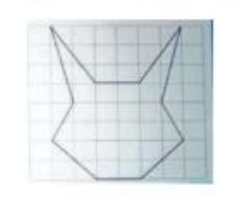
In the adjoining figure of a cat, each small square is $$1\text{ cm}^2$$. The area of the cat, in $$\text{cm}^2$$, is
Loading solution...
The sum of the digits of the number given by the product $$ \frac{666.....666}{2021 digits}$$ X$$ \frac{999.....999}{2021 digits}$$ is
Loading solution...
Two buses $$X,Y$$ started from two different places $$P_1$$ and $$P_2$$ respectively, moving towards each other. The ratio of the speed of bus $$X$$ to that of bus $$Y$$ was $$5:4$$. After they meet, the speed of bus $$X$$ was reduced by $$20\%$$ and the speed of $$Y$$ was increased by $$20\%$$. When bus $$X$$ arrived at $$P_2$$, bus $$Y$$ was still $$10\text{ km}$$ away from $$P_1$$. The distance between the places $$P_1$$ and $$P_2$$, in kilometers, is
Loading solution...
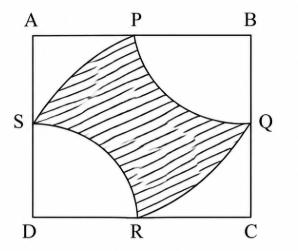
In the adjoining diagram, $$ABCD$$ is a square. $$P,Q,R,S$$ are the mid points of sides $$AB,BC,CD$$ and $$DA$$ respectively. $$PQ$$ and $$SR$$ are quadrants of circles with $$B,D$$ as the centres and $$BP$$ as radius. $$PS$$ and $$RQ$$ are part of the circle passing through $$P,Q,R$$ and $$S$$. If $$AB=20\text{ cm}$$, the area of the shaded region, in $$\text{cm}^2$$, is
Loading solution...
Predict your JEE Main percentile, rank & performance in seconds

Educational materials for JEE preparation