How many glasses of $$120\text{ millilitres}$$ can you fill from a $$3\text{ litre}$$ can of juice?
Sign in
Please select an account to continue using cracku.in
↓ →
Join Our JEE Preparation Group
Prep with like-minded aspirants; Get access to free daily tests and study material.
How many glasses of $$120\text{ millilitres}$$ can you fill from a $$3\text{ litre}$$ can of juice?
Convert $$3\text{ litres}$$ to $$3000\text{ millilitres}$$. Then $$3000\div120=25$$, so exactly $$25$$ glasses can be filled and no juice remains.
The sum of $$2211+2213+2215+2217+2219+2221+2223+2225+2227+2229$$ is
There are $$10$$ terms in the arithmetic progression, with first term $$2211$$ and last term $$2229$$. The average is $$\frac{2211+2229}{2}=2220$$, so the sum is $$10\times2220=22200$$.
If a number is first multiplied by $$\frac{4}{7}$$ and then divided by $$\frac{12}{7}$$, then it is equivalent to which of the following operations on the number?
Let the number be $$x$$. The two operations give $$x\times\frac{4}{7}\div\frac{12}{7}=x\times\frac{4}{7}\times\frac{7}{12}=\frac{x}{3}$$, which is the same as multiplying by $$\frac{1}{3}$$.
$$X$$ is a $$5$$ digit number. Let $$Y$$ be the sum of the digits of $$X$$. Let $$Z$$ be the sum of the digits of $$Y$$. Then the maximum possible value that $$Z$$ can have is
The largest possible digit sum of a five digit number is $$45$$. Among the integers from $$1$$ to $$45$$, the largest digit sum is obtained at $$39$$, whose digit sum is $$3+9=12$$. Hence the maximum possible value of $$Z$$ is $$12$$.
A square is constructed on a graph paper which has a square grid of $$1\text{ cm}$$ width. Ram paints all the squares which cross the two diagonals of the square and finds that there are $$19$$ of them. Then the side of the square is
For a square of side $$n$$ grid units, the two diagonals pass through a total of $$2n-1$$ grid squares in the intended counting of the problem. Thus $$2n-1=19$$, giving $$n=10$$. Since each grid unit is $$1\text{ cm}$$, the side is $$10\text{ cm}$$.
Look at the set of numbers $$2,3,5,7,8,10,12$$. Four numbers are selected from this and made into two pairs. The pairs are added and the resulting two numbers are multiplied. The smallest such product is
To minimize the product, choose the four smallest numbers $$2,3,5,7$$ and pair them as $$2+3$$ and $$5+7$$. Their product is $$5\times12=60$$, which is the smallest possible value.
Anita wants to enter a number into each small triangular cell of the triangular table. The sum of the numbers in any two such cells with a common side must be the same. She has already entered two numbers. What is the sum of all the numbers in the table?
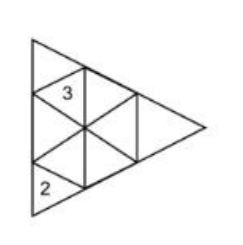
The triangular cells form a connected bipartite pattern, so cells of one alternating class have the same value and cells of the other class have the other value. The two given cells with values $$3$$ and $$2$$ belong to the same class, and there are four cells in each class. Hence the total is $$4\times3+4\times2=20$$.
Where $$A,B,C,D,E$$ are distinct digits satisfying this addition fact, then $$E$$ is
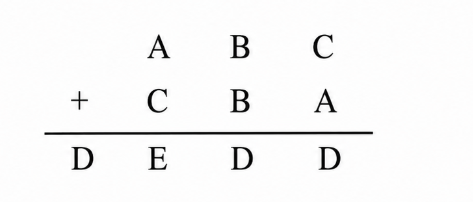
The addition is $$ABC+CBA=DEDD$$. Checking the column carries gives $$D=1$$ and $$E=2$$, while the distinct digit condition is satisfied by choices such as $$A=3,B=5,C=8$$. Therefore $$E=2$$.
A large rectangle is made up of eleven identical rectangles whose longer sides are $$21\text{ cm}$$ long. The perimeter of the large rectangle in $$\text{cm}$$ is
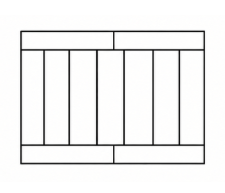
The two horizontal rectangles at the top and bottom each have length $$21\text{ cm}$$, so the large rectangle has width $$42\text{ cm}$$. The seven vertical rectangles across the middle therefore have width $$42\div7=6\text{ cm}$$, making the large height $$21+6+6=33\text{ cm}$$. Thus the perimeter is $$2(42+33)=150\text{ cm}$$.
The sum of the odd numbers from $$1$$ to $$2019$$ both inclusive, is divisible by
There are $$1010$$ odd numbers from $$1$$ through $$2019$$, and their sum is $$1010^2=1020100$$. This number is divisible by $$100$$ and also by $$101$$ because $$1020100=100\times101\times101$$. Hence it is divisible by both.
The circumference of a circle is numerically greater than the area of the circle. Then the maximum length of the radius cannot be greater than
For radius $$r$$, the circumference is $$2\pi r$$ and the area is $$\pi r^2$$. The condition $$2\pi r>\pi r^2$$ gives $$r<2$$. Therefore the radius cannot be greater than $$2$$.
A calendar for $$2019$$ is made using $$4$$ sheets, each sheet having $$3$$ months. The total number of days shown in each of the four sheets $$\left(1^{\text{st}},2^{\text{nd}},3^{\text{rd}},4^{\text{th}}\right)$$ respectively is
The first three months have $$31+28+31=90$$ days. The next three have $$30+31+30=91$$ days, the next three have $$31+31+30=92$$ days, and the final three have $$31+30+31=92$$ days. Thus the required sequence is $$\left(90,91,92,92\right)$$.
Triples of odd numbers $$\left(a,b,c\right)$$ with $$a<b<c$$, with $$a,b,c$$ from $$1$$ to $$10$$ are generated such that $$a+b+c$$ is prime number. The number of such triple is
The odd numbers available are $$1,3,5,7,9$$. The triples whose sums are prime are $$\left(1,3,7\right)$$, $$\left(1,3,9\right)$$, $$\left(1,5,7\right)$$, $$\left(1,7,9\right)$$, $$\left(3,5,9\right)$$ and $$\left(3,7,9\right)$$. Hence there are $$6$$ such triples.
A number leaves a remainder $$2$$ when divided by $$6$$. Then the possible remainder or remainders when the same number is divided by $$9$$ is
Write the number as $$6k+2$$. Modulo $$9$$, the value depends on $$k\pmod3$$, giving the possible remainders $$2,8,5$$. Therefore the possible remainders are $$2,5,8$$.
A box of dimension $$40\times35\times28\text{ units}$$ is used to keep smaller cuboidal boxes so that no space is left between the boxes. If the box is packed with $$100$$ such smaller boxes of the same size, then dimension of the smaller box is
The large box has volume $$40\times35\times28=39200$$ cubic units. Dividing by $$100$$ gives $$392$$ cubic units per small box, and $$392=7\times8\times7$$. Therefore the small box has dimensions $$7\times8\times7$$ units.
The number of two digit numbers which are divisible by the sum of their digits is
Checking the two digit numbers by writing each as $$10a+b$$ and testing divisibility by $$a+b$$ gives the valid numbers $$10,12,18,20,21,24,27,30,36,40,42,45,48,50,54,60,63,70,72,80,81,84,90$$. There are $$23$$ such numbers.
Given below is the triangular form of AMTI. The number of ways you can spell AMTI, top to bottom, right to left or left to right or a combination of these is
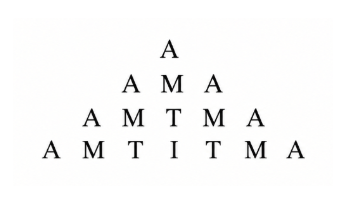
Starting at the top $$A$$, the next required letter $$M$$ must be the middle entry in the second row. From there, the only compatible $$T$$ in the third row leads to the central $$I$$ in the fourth row. Thus there is exactly $$1$$ way to spell AMTI from top to bottom.
The number of odd prime numbers less than $$100$$ which can be written as the sum of two squares is
An odd prime can be written as a sum of two squares exactly when it is congruent to $$1\pmod4$$. The primes less than $$100$$ of this form are $$5,13,17,29,37,41,53,61,73,89,97$$. Hence the number of such primes is $$11$$.
If $$4921\times D=ABBBD$$ then $$B$$ is
Testing the possible nonzero digit values of $$D$$, we obtain $$4921\times7=34447$$. This has the form $$ABBBD$$ with $$A=3$$, $$B=4$$ and $$D=7$$. Therefore $$B=4$$.
$$36$$ children took a math talent test. For a contestant Anu the number of students who scored above her was $$1.5$$ times the number who scored below her. Her rank when the scores are put in decreasing order is
Let the number below Anu be $$x$$. Then the number above her is $$1.5x$$, and $$1.5x+x+1=36$$. This gives $$2.5x=35$$ and $$x=14$$, so $$21$$ students scored above her. Therefore her rank is $$21+1=22$$.
Small rectangular sheets of length $$\frac{2}{3}$$ units and breadth $$\frac{3}{5}$$ units are available. These sheets are assembled and pasted in a big cardboard sheet, edge to edge and made into a square. The minimum number of such sheet required is
Scale the dimensions by $$15$$, so each rectangle has dimensions $$10\times9$$. To form a square using whole rectangles, the smallest square side compatible with both dimensions is $$90$$ in the scaled units. It requires $$\frac{90}{10}\times\frac{90}{9}=9\times10=90$$ sheets.
Ramanujan's number is $$1729$$. The number of composite divisors of $$1729$$ less than $$1729$$ is
Factor $$1729$$ as $$7\times13\times19$$. It has $$8$$ divisors in total, namely $$1$$, the three primes, the three products of two primes, and $$1729$$ itself. The three composite divisors less than $$1729$$ are $$91,133,247$$, so the answer is $$3$$.
$$N$$ is an $$100000$$ digit number with no zero digit and the sum of the digits of $$N$$ is $$100001$$, then the number of such $$N$$s is
Each of the $$100000$$ digits is at least $$1$$, so their minimum total is $$100000$$. The required sum is only $$1$$ greater than this minimum, so exactly one digit must be $$2$$ and all the remaining digits must be $$1$$. The digit equal to $$2$$ can occupy any of the $$100000$$ positions, giving $$100000$$ numbers.
Peter $$8$$ years old asked his mother how old she was. She said, "when you are as old as I am now, I will be $$54$$ years old". Peter's mother's current age is
Let the mother's current age be $$m$$. Peter will reach age $$m$$ after $$m-8$$ years, so the mother's age then will be $$m+(m-8)=2m-8$$. Since this is $$54$$, we get $$2m-8=54$$ and hence $$m=31$$.
A string of beads has a recurring pattern as follows: $$5$$ blue, $$4$$ black, $$4$$ white, $$5$$ blue, $$4$$ black, $$4$$ white and so on. The colour of the $$321^{\text{st}}$$ bead is
The repeating pattern has $$5+4+4=13$$ beads. Since $$321=13\times24+9$$, the $$321^{\text{st}}$$ bead is the ninth bead of the repeating pattern. Positions $$6$$ through $$9$$ are black, so the colour is black. For the required numeric answer field, black is represented by $$2$$ after blue, black, white are assigned $$1,2,3$$ respectively.
Predict your JEE Main percentile, rank & performance in seconds
Educational materials for JEE preparation