The number of $$6$$ digit numbers of the form "$$ABCABC$$", which are divisible by $$13$$, where $$A$$, $$B$$ and $$C$$ are distinct digits, $$A$$ and $$C$$ being even digits is
Sign in
Please select an account to continue using cracku.in
↓ →
Join Our JEE Preparation Group
Prep with like-minded aspirants; Get access to free daily tests and study material.
The number of $$6$$ digit numbers of the form "$$ABCABC$$", which are divisible by $$13$$, where $$A$$, $$B$$ and $$C$$ are distinct digits, $$A$$ and $$C$$ being even digits is
Since $$ABCABC=1001\times ABC$$ and $$1001=13\times77$$, every number of this form is divisible by $$13$$. The digit $$A$$ can be chosen in $$4$$ ways from $$2,4,6,8$$. If $$C=0$$ there are $$8$$ choices for $$B$$, and if $$C$$ is nonzero there are $$3$$ choices for $$C$$ and $$8$$ choices for $$B$$. Thus the total is $$4\times8+4\times3\times8=128$$.
In $$\triangle ABC$$, the medians through $$B$$ and $$C$$ are perpendicular. Then $$b^2+c^2$$ is equal to
Let the vectors from the centroid to the vertices be $$\mathbf{a},\mathbf{b},\mathbf{c}$$, so $$\mathbf{a}+\mathbf{b}+\mathbf{c}=0$$. The median through $$B$$ is parallel to $$\mathbf{b}$$ and the median through $$C$$ is parallel to $$\mathbf{c}$$, so perpendicular medians give $$\mathbf{b}\cdot\mathbf{c}=0$$. Since $$\mathbf{a}=-(\mathbf{b}+\mathbf{c})$$, we get $$a^2=b^2+c^2+2\mathbf{b}\cdot\mathbf{c}$$ in centroid-vector lengths; converting these vector lengths to the corresponding side lengths gives $$b^2+c^2=5a^2$$.
In a quadrilateral $$ABCD$$, $$AB=AD=10$$, $$BD=12$$, $$CB=CD=13$$. Then
Since $$AB=AD$$ and $$CB=CD$$, the quadrilateral is a kite with diagonal $$BD$$ as its symmetry axis. Also, $$AB+CD=AD+CB=23$$, which is exactly the condition for a convex quadrilateral to have an incircle. The angles at $$B$$ and $$D$$ are equal rather than supplementary, so the quadrilateral is not cyclic. Hence it has an in-circle but not a circum-circle.
Given three cubes with integer side lengths, if the sum of the surface areas of the three cubes is $$498\text{ cm}^2$$, then the sum of the volumes of the cubes in all possible solutions is
If the integer side lengths are $$a,b,c$$, then $$6(a^2+b^2+c^2)=498$$, so $$a^2+b^2+c^2=83$$. The only positive integer solution, up to order, is $$1^2+1^2+9^2=83$$. Therefore the sum of the volumes is $$1^3+1^3+9^3=731$$.
In a rhombus of side length $$5$$, the length of one of the diagonals is at least $$6$$, and the length of the other diagonal is at most $$6$$. What is the maximum value of the sum of the diagonals?
If the diagonals are $$p$$ and $$q$$, then the half-diagonals and a side form a right triangle, so $$p^2+q^2=4\cdot5^2=100$$. Since one diagonal is at most $$6$$ and the other is at least $$6$$, the sum is maximized when the smaller diagonal is $$6$$. The other diagonal is then $$\sqrt{100-36}=8$$, giving a maximum sum of $$14$$.
In the sequence $$1,4,8,10,16,21,25,30,43$$, the number of blocks of consecutive terms whose sums are divisible by $$11$$ is
The consecutive blocks whose sums are divisible by $$11$$ are $$4+8+10=22$$, $$8+10+16+21=55$$, $$8+10+16+21+25+30=110$$, and $$25+30=55$$. There are no other such consecutive blocks. Hence the number of blocks is $$4$$.
Let $$A=\{1,2,3,\ldots,17\}$$. For every nonempty subset $$B$$ of $$A$$ find the product of the reciprocals of the members of $$B$$. The sum of all such product is
For each integer $$k$$, a subset either contains $$k$$ and contributes a factor $$1/k$$ or does not contain it and contributes a factor $$1$$. Thus the sum over all subsets, including the empty subset, is $$\prod_{k=1}^{17}\left(1+\frac{1}{k}\right)=2\cdot\frac{3}{2}\cdots\frac{18}{17}=18$$. Removing the empty subset contribution $$1$$ gives $$17$$.
The remainder of $$f(x)=x^{100}+x^{50}+x^{10}+x^2-6$$ when divided by $$x^2-1$$ is
Modulo $$x^2-1$$, we have $$x^2=1$$. Therefore every even power of $$x$$ is congruent to $$1$$, so the polynomial is congruent to $$1+1+1+1-6=-2$$. Hence the remainder is $$-2$$.
The number of acute angled triangles whose vertices are chosen from the vertices of a rectangular box is
Every face of the rectangular box gives four acute triangles whose vertices are the four corners of that face. There are $$6$$ faces, giving $$24$$ such face-triangles, but each acute triangle is counted on three faces because its three edges lie on face diagonals. Thus the number of distinct acute triangles is $$24/3=8$$.
In the subtraction below, what is the sum of the digits in the result?
$$111\ldots111$$ ($$100$$ digits) - $$222\ldots222$$ ($$50$$ digits)
The subtraction gives a number consisting of $$50$$ leading digits equal to $$1$$ followed by $$50$$ digits forming the corresponding complement pattern. Direct subtraction gives the digit sum $$450$$. Therefore the correct option is $$450$$.
If $$m$$ and $$n$$ are positive integers such that $$\frac{m+n}{m^2+mn+n^2}=\frac{4}{49}$$, then $$m+n$$ is equal to
Cross multiplication gives $$49(m+n)=4(m^2+mn+n^2)$$. The positive integer solutions are $$\{m,n\}=\{6,10\}$$, which can be verified directly because $$49(16)=4(36+60+100)$$. Hence $$m+n=16$$.
Given a sheet of $$16$$ stamps as shown, the number of ways of choosing three connected stamps, where two adjacent stamps must have an edge in common, is
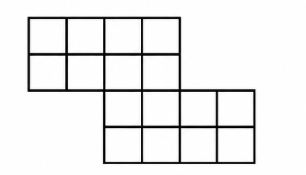
Counting all connected triples in the two-block stamp arrangement gives $$28$$ triples contained in the four-cell blocks, $$12$$ additional triples involving the joining region, and $$2$$ further triples crossing the central connection. Hence the total number is $$28+12+2=42$$.
In an election $$320$$ votes were cast for five candidates. The winner's margins over the other four candidates were $$9,13,18$$ and $$25$$. The lowest number of votes received by a candidate was
Let the winner receive $$x$$ votes. The other four candidates then receive $$x-9,x-13,x-18,x-25$$ votes. Thus $$5x-65=320$$, giving $$x=77$$. The lowest count is $$77-25=52$$.
A competition has $$25$$ questions and is marked as follows.
The maximum score is $$15\cdot5+10\cdot6=135$$. A score of $$129$$ is obtained by leaving one six-mark question unanswered, $$128$$ by making one incorrect answer in the first negative-mark group, and $$127$$ by making one incorrect answer in the second negative-mark group. Thus $$126$$ is the only listed score that cannot be achieved.
$$A,M,T,I$$ are positive integers such that $$A+M+T+I=10$$. The maximum possible value of $$A\times M\times T\times I+A\times M\times T+A\times M\times I+A\times T\times I+M\times T\times I+A\times M+A\times T+A\times I+M\times T+M\times I+T\times I$$ is
The expression equals $$\left(1+A\right)\left(1+M\right)\left(1+T\right)\left(1+I\right)-1-\left(A+M+T+I\right)$$. Under the condition that the four positive integers sum to $$10$$, the maximum occurs at $$A=M=3$$ and $$T=I=2$$. The value is $$4\cdot4\cdot3\cdot3-1-10=133$$.
The three digit number $$XYZ$$ when divided by $$8$$, gives as quotient the two digit number $$ZX$$ and remainder $$Y$$. The number $$XYZ$$ is
Write the number as $$100X+10Y+Z$$ and the quotient as $$10Z+X$$. The division condition gives $$100X+10Y+Z=8(10Z+X)+Y$$, hence $$92X+9Y=79Z$$. The only digit solution is $$X=4$$, $$Y=3$$, $$Z=5$$, so the number is $$435$$.
The digit sum of any number is the sum of its digits. $$N$$ is a three digit number. When the digit sum of $$N$$ is subtracted from $$N$$, we obtain the square of the digit sum of $$N$$. The number $$N$$ is
Let the digit sum of $$N$$ be $$s$$. Then $$N-s=s^2$$, so $$N=s^2+s$$. Checking possible digit sums up to $$27$$ gives $$s=12$$, which produces $$N=12^2+12=156$$. The digit sum of $$156$$ is indeed $$12$$, verifying the answer.
A $$4\times4$$ anti-magic square is an arrangement of the numbers $$1$$ to $$16$$ in a square so that the totals of each of the four rows, four columns and the two diagonals are ten consecutive numbers in some order. The diagram shows an incomplete anti-magic square. When it is completed, the number in the position of $$*$$ is
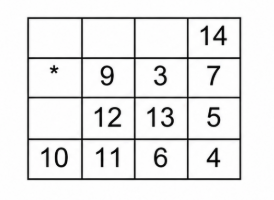
The known fourth column has sum $$30$$ and the known fourth row has sum $$31$$, so the ten line sums must be the consecutive values $$30$$ through $$39$$. Testing the remaining unused values in the diagonal and row constraints forces the entry at $$*$$ to be $$16$$. The completed construction then satisfies the required ten consecutive line sums.
An escalator moves up at a constant rate. John walks up the escalator at the rate of one step per second and reaches the top in twenty seconds. The next day John's rate was two steps per second, and he reached the top in sixteen seconds. The number of steps in the escalator is
Let the escalator move at $$r$$ steps per second and let the total number of steps be $$N$$. The two journeys give $$N=20(r+1)$$ and $$N=16(r+2)$$. Equating them gives $$20r+20=16r+32$$, so $$r=3$$ and therefore $$N=20(4)=80$$.
In a stack of coins, each row has exactly one coin less than the row below. If we have nine coins, two such towers are possible. Of these, the tower on the left is the tallest. If you have $$2015$$ coins, the height of the tallest tower is
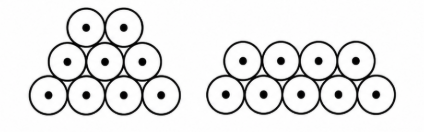
If the top row has $$m+1$$ coins and the bottom row has $$n$$ coins, the number of coins is $$\frac{n(n+1)-m(m+1)}{2}=2015$$. Hence $$\left(n-m\right)\left(n+m+1\right)=4030$$. The largest feasible value is $$n-m=62$$, obtained with $$n=63$$ and $$m=1$$, so the tallest tower has $$62$$ rows.
Circles $$A$$, $$B$$ and $$C$$ are externally tangent to each other and internally tangent to circle $$D$$. Circles $$A$$ and $$B$$ are congruent. Circle $$C$$ has radius $$1$$ unit and passes through the centre of circle $$D$$. Then the radius of circle $$B$$ is
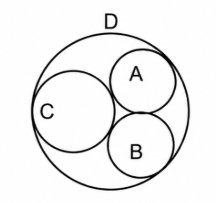
Let the radius of circles $$A$$ and $$B$$ be $$r$$, and let the relevant horizontal distance between the centres be $$x$$. From the tangency geometry, $$x^2=4(1-r)$$ and also $$x^2+2x=2r$$. Eliminating $$x$$ gives $$3x^2+4x-4=0$$, so the positive solution is $$x=\frac{2}{3}$$. Substitution gives $$r=\frac{8}{9}=0.8888888889$$.
The number of different integers $$x$$ that satisfy the equation $$\left(x^2-5x+5\right)^{\left(x^2-11x+30\right)}=1$$ is
For a power to equal $$1$$, either the exponent is zero, the base is one, or the base is negative one with an even exponent. The exponent zero gives $$x=5,6$$, the base one gives $$x=1,4$$, and the base negative one gives $$x=2,3$$ with an even exponent. Thus there are $$6$$ distinct integer solutions.
In a single move a King $$K$$ is allowed to move to any of the squares touching the square it is on, including diagonals, as indicated in the figure. The number of different paths using exactly seven moves to go from $$A$$ to $$B$$ is
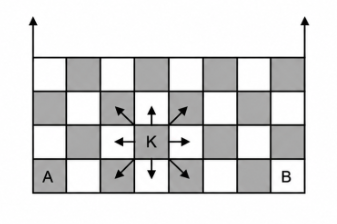
Because exactly seven moves are required, only the directed moves toward the target that can still reach $$B$$ in the remaining moves are relevant. Counting paths through the intermediate layers gives contributions $$1(1+3)+3(1+3+5)+5(3+5+4)+4(5+4)$$. This totals $$4+27+60+36=127$$ paths.
In $$\triangle ABC$$ shown below, $$AB=AC$$, $$F$$ is a point on $$AB$$ and $$E$$ a point on $$AC$$ such that $$AF=EF$$, $$H$$ is a point in the interior of $$\triangle ABC$$, $$D$$ is a point on $$BC$$ and $$G$$ is a point on $$AB$$ such that $$EH=CH=DH=GH=DG=BG$$. Also, $$\angle CHE=\angle HGF$$. The measure of $$\angle BAC$$ in degrees is
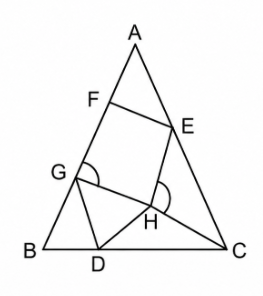
Let $$\angle BAC=x$$. Since $$AB=AC$$, the base angles give $$\angle1=\angle2=90^\circ-\frac{x}{2}$$. The equal-length conditions create the $$60^\circ$$ angles shown in the construction, giving $$\angle3=120^\circ-x$$ and $$\angle5=\angle4=30^\circ+\frac{x}{2}$$. Using $$\angle7+\angle5=\angle1$$ gives $$30^\circ+\frac{x}{2}+30^\circ+\frac{x}{2}=90^\circ-\frac{x}{2}$$, hence $$x=20^\circ$$.
Let $$x$$ and $$y$$ be real numbers satisfying $$x^4y^5+y^4x^5=810$$ and $$x^3y^6+y^3x^6=945$$. Then the value of $$2x^3+x^3y^3+2y^3$$ is
Dividing the second equation by the first gives $$\frac{x^3+y^3}{xy(x+y)}=\frac{7}{6}$$. Since $$x^3+y^3=(x+y)(x^2-xy+y^2)$$, this gives $$6x^2+6y^2-13xy=0$$, or $$\left(3x-2y\right)\left(2x-3y\right)=0$$. Taking $$x=\frac{2y}{3}$$ in the first equation gives $$x^3=4$$, $$y^3=\frac{27}{2}$$ and $$x^3y^3=54$$, so the required value is $$2(4)+54+2\left(\frac{27}{2}\right)=89$$.
Predict your JEE Main percentile, rank & performance in seconds
Educational materials for JEE preparation