 91- 6303239042


Examples
Example 9.1 In a group activity, students place $$4.0 \, \mathrm{g}$$ of calcium carbonate with $$2.92 \, \mathrm{g}$$ of hydrochloric acid in a closed container. After the reaction is over, they measured $$1.76 \, \mathrm{g}$$ of carbon dioxide, $$0.72 \, \mathrm{g}$$ of water, and $$4.44 \, \mathrm{g}$$ of calcium chloride. Verify whether the Law of Conservation of Mass is obeyed or not.
Solution
Given data
- Mass of calcium carbonate added: $$m_{\mathrm{CaCO_3}} = 4.0\,\mathrm{g}$$
- Mass of hydrochloric acid added: $$m_{\mathrm{HCl}} = 2.92\,\mathrm{g}$$
- Mass of products obtained:
- Carbon dioxide: $$m_{\mathrm{CO_2}} = 1.76\,\mathrm{g}$$
- Water: $$m_{\mathrm{H_2O}} = 0.72\,\mathrm{g}$$
- Calcium chloride: $$m_{\mathrm{CaCl_2}} = 4.44\,\mathrm{g}$$
Step 1: Calculate the total mass of reactants
The reaction is carried out in a closed container, so every gram of each reactant is present inside the system.
\[\text{Total mass of reactants} = m_{\mathrm{CaCO_3}} + m_{\mathrm{HCl}}\]
Substituting the given values,
$$\text{Total mass of reactants} = 4.0\,\mathrm{g} + 2.92\,\mathrm{g}$$
$$\phantom{\text{Total mass of reactants}} = 6.92\,\mathrm{g}$$
Step 2: Calculate the total mass of products
All the products are weighed after the reaction is complete.
\[\text{Total mass of products} = m_{\mathrm{CO_2}} + m_{\mathrm{H_2O}} + m_{\mathrm{CaCl_2}}\]
Inserting the measured masses,
$$\text{Total mass of products} = 1.76\,\mathrm{g} + 0.72\,\mathrm{g} + 4.44\,\mathrm{g}$$
First add the gases and water:
$$1.76\,\mathrm{g} + 0.72\,\mathrm{g} = 2.48\,\mathrm{g}$$
Then add the solid product:
$$2.48\,\mathrm{g} + 4.44\,\mathrm{g} = 6.92\,\mathrm{g}$$
\[\text{Total mass of products} = 6.92\,\mathrm{g}\]
Step 3: Compare the two totals
$$\text{Total mass before reaction} = 6.92\,\mathrm{g}$$
$$\text{Total mass after reaction}\; = 6.92\,\mathrm{g}$$
Since the two masses are identical, no loss or gain of matter is detected inside the closed container.
Conclusion
The total mass of the reactants equals the total mass of the products. Therefore, the experiment satisfies the Law of Conservation of Mass.
Answer
Yes, the law is obeyed because the reactant mass (6.92 g) exactly equals the product mass (6.92 g).
Example 9.2 $$12 \, \mathrm{g}$$ of carbon combines with $$32 \, \mathrm{g}$$ of oxygen to form $$44 \, \mathrm{g}$$ of carbon dioxide as per the given equation.
Carbon + Oxygen → Carbon dioxide
If $$2.4 \, \mathrm{g}$$ of carbon reacts completely with oxygen, how much carbon dioxide will be produced?
Solution
Given chemical equation
Carbon + Oxygen → Carbon dioxide
Step 1 · Write the mass data for the complete reaction
For every $$12 \, \mathrm{g}$$ of carbon the reaction uses $$32 \, \mathrm{g}$$ of oxygen and forms $$44 \, \mathrm{g}$$ of $$\mathrm{CO_2}$$.
Step 2 · Find the fixed mass ratio between carbon and carbon dioxide
The ratio of the mass of carbon dioxide produced to the mass of carbon that reacts is
\[ \frac{\text{mass of } \mathrm{CO_2}}{\text{mass of C}} = \frac{44 \, \mathrm{g}}{12 \, \mathrm{g}} = \frac{11}{3}. \quad(1) \]Step 3 · Apply the ratio to $$2.4 \, \mathrm{g}$$ of carbon
If the reacting carbon is only $$2.4 \, \mathrm{g}$$, then the mass of carbon dioxide formed is
$$\text{mass of } \mathrm{CO_2} = 2.4 \, \mathrm{g} \times \frac{11}{3}.$$Compute the product:
$$2.4 \times \frac{11}{3} = 2.4 \times 3.666\overline{6} = 8.8 \, \mathrm{g}.$$Check by calculating oxygen mass
The mass ratio of oxygen to carbon from the given data is
$$\frac{32}{12} = \frac{8}{3}.$$Hence for $$2.4 \, \mathrm{g}$$ of carbon the oxygen required is
$$2.4 \times \frac{8}{3} = 6.4 \, \mathrm{g}.$$Total mass of products:
$$2.4 \, \mathrm{g} + 6.4 \, \mathrm{g} = 8.8 \, \mathrm{g},$$which agrees with the earlier result and satisfies the law of conservation of mass.
Therefore, the mass of carbon dioxide produced is $$8.8 \, \mathrm{g}$$.
Answer
$$8.8 \, \mathrm{g}$$
Example 9.3 Sodium chloride ($$\mathrm{NaCl}$$) contains sodium and chlorine in the mass ratio of $$23 : 35.5$$. If $$46 \, \mathrm{g}$$ of sodium reacts completely, how much chlorine is needed to form $$\mathrm{NaCl}$$?
Solution
The compound sodium chloride contains sodium and chlorine in the fixed mass ratio $$23 : 35.5$$.
That is,
\[ \frac{\text{mass of Na}}{\text{mass of Cl}} = \frac{23}{35.5} \]Let the mass of chlorine required to combine with $$46\,\mathrm{g}$$ of sodium be $$m\,\mathrm{g}$$.
\[ \frac{46}{m} = \frac{23}{35.5} \]Cross-multiplying gives
\[ 46 \times 35.5 = 23 \times m \]Calculate the product on the left:
$$46 \times 35.5 = 1633$$
Now isolate $$m$$:
\[ m = \frac{1633}{23} = 71 \]Hence, $$71\,\mathrm{g}$$ of chlorine are needed to react completely with $$46\,\mathrm{g}$$ of sodium to form $$\mathrm{NaCl}$$.
Answer
$$71\,\mathrm{g}$$ of chlorine is required.
Example 9.4 Find the molecular mass of water ($$\mathrm{H_2O}$$).
Atomic mass — H = 1 u; O = 16 u.
Solution
Given data
- Atomic mass of hydrogen, $$\mathrm{H} = 1\,\text{u}$$
- Atomic mass of oxygen, $$\mathrm{O} = 16\,\text{u}$$
Step 1 – Identify the number of each type of atom in water
The chemical formula of water is $$\mathrm{H_2O}$$. This shows:
- 2 atoms of hydrogen (the subscript 2 next to H)
- 1 atom of oxygen (no subscript is written, so it is understood to be 1)
Step 2 – Write the expression for molecular mass
The molecular mass is the sum of the atomic masses of all atoms present in one molecule:
\[ \text{Molecular mass of } \mathrm{H_2O} = (\text{number of H atoms}) \times (\text{atomic mass of H}) + (\text{number of O atoms}) \times (\text{atomic mass of O}) \]Step 3 – Substitute the known values
\[ = 2 \times 1\,\text{u} + 1 \times 16\,\text{u} \]Step 4 – Perform the arithmetic
\[ = 2\,\text{u} + 16\,\text{u} = 18\,\text{u} \]Therefore, the molecular mass of water is
\[18\,\text{u}\]Answer
$$18\,\text{u}$$
Example 9.5 Find the molecular mass of carbon dioxide ($$\mathrm{CO_2}$$).
Atomic mass — C = 12 u; O = 16 u.
Solution
Given data
- Chemical formula of carbon dioxide : $$\mathrm{CO_2}$$
- Atomic mass of carbon (C) = $$12\,\text{u}$$
- Atomic mass of oxygen (O) = $$16\,\text{u}$$
Step 1 — Count the atoms present in one molecule
| Element | Number of atoms in one $$\mathrm{CO_2}$$ molecule |
|---|---|
| Carbon (C) | 1 |
| Oxygen (O) | 2 |
Step 2 — Multiply the atomic mass by the number of atoms
- Mass contributed by carbon: $$1 \times 12\,\text{u} = 12\,\text{u}$$
- Mass contributed by oxygen: $$2 \times 16\,\text{u} = 32\,\text{u}$$
Step 3 — Add the individual masses to obtain the molecular mass
Total molecular mass = $$12\,\text{u} + 32\,\text{u}$$
Therefore,
\[44\,\text{u}\]
The molecular mass of carbon dioxide is $$44\,\text{u}$$.
Answer
$$M_{\mathrm{CO_2}} = 44\,\text{u}$$
Example 9.6 Find the formula unit mass of sodium oxide ($$\mathrm{Na_2O}$$).
Atomic mass — Na = 23 u; O = 16 u.
Solution
Step 1 : Note the atomic masses given
For sodium, $$A_{\mathrm{Na}} = 23 \;\text{u}$$
For oxygen, $$A_{\mathrm{O}} = 16 \;\text{u}$$
Step 2 : Identify the number of each kind of atom in one formula unit of $$\mathrm{Na_2O}$$
The formula $$\mathrm{Na_2O}$$ tells us that one formula unit contains:
- 2 atoms of sodium (Na)
- 1 atom of oxygen (O)
Step 3 : Write the expression for the formula unit mass
The formula unit mass is the sum of the individual atomic masses multiplied by their respective number of atoms:
$$m_{\text{f.u.}} = \bigl(2 \times A_{\mathrm{Na}}\bigr) + \bigl(1 \times A_{\mathrm{O}}\bigr)$$
Step 4 : Substitute the numerical values
$$m_{\text{f.u.}} = \bigl(2 \times 23\bigr) + \bigl(1 \times 16\bigr)$$
Step 5 : Do the arithmetic carefully
$$m_{\text{f.u.}} = 46 + 16 = 62$$
Step 6 : State the unit
The unit for atomic and formula masses is the unified atomic mass unit, written as “u”.
Therefore, the formula unit mass of sodium oxide is 62 u.
Answer
Formula unit mass of $$\mathrm{Na_2O}$$ = 62 u.
Example 9.7 Find the formula unit mass of calcium nitrate, $$\mathrm{Ca(NO_3)_2}$$.
Atomic mass — Ca = 40 u; N = 14 u; O = 16 u.
Solution
Given data
- Atomic mass of calcium, $$\mathrm{Ca}$$ = 40 u
- Atomic mass of nitrogen, $$\mathrm{N}$$ = 14 u
- Atomic mass of oxygen, $$\mathrm{O}$$ = 16 u
Step 1 – Count the number of each atom in one formula unit of $$\mathrm{Ca(NO_3)_2}$$
The subscript ‘2’ outside the bracket means there are two nitrate groups, $$\mathrm{(NO_3)^-}$$, in one formula unit.
| Element | Per nitrate, $$\mathrm{NO_3}$$ | Number of nitrate groups | Total atoms |
|---|---|---|---|
| Ca | – | – | 1 |
| N | 1 | 2 | $$1 \times 2 = 2$$ |
| O | 3 | 2 | $$3 \times 2 = 6$$ |
Step 2 – Multiply each atomic mass by the number of atoms present
- Mass from calcium: $$1 \times 40 \text{ u} = 40 \text{ u}$$
- Mass from nitrogen: $$2 \times 14 \text{ u} = 28 \text{ u}$$
- Mass from oxygen: $$6 \times 16 \text{ u} = 96 \text{ u}$$
Step 3 – Add all the contributions
Total (formula unit) mass = $$40 \text{ u} + 28 \text{ u} + 96 \text{ u} = 164 \text{ u}$$
The formula unit mass of $$\mathrm{Ca(NO_3)_2}$$ is therefore
\[ 164\,\text{u} \]
Answer
Formula unit mass of $$\mathrm{Ca(NO_3)_2}$$ = 164 u.
Intext Questions
Think It Over (i) Water can be obtained from various sources. Are all these samples of water chemically identical?
Solution
Step 1 – Recall the formula of water
Pure water is composed of molecules whose formula is $$\mathrm{H_2O}$$. Each molecule therefore contains 2 atoms of hydrogen and 1 atom of oxygen.
Step 2 – Use atomic masses to find the fixed mass ratio
The relative atomic masses are
$$\text{H} : 1\;\text{u}, \qquad \text{O} : 16\;\text{u}$$
Hence the mass of one molecule is
$$\text{mass of }\mathrm{H_2O}=2(1\,\text{u})+16\,\text{u}=18\,\text{u}$$
The mass ratio of hydrogen to oxygen in any sample of water is therefore
\[ \frac{\text{mass of H}}{\text{mass of O}} = \frac{2\,\text{u}}{16\,\text{u}} = \frac{1}{8} \]
Step 3 – State the Law of Definite Proportions
The law states that a chemical compound always contains the same elements combined together in the same fixed proportion by mass, irrespective of the method of preparation or the source.
Step 4 – Apply the law to water from different sources
Whether water is collected from rain, a river, a well, or distilled in the laboratory, after removing suspended matter and dissolved impurities every sample shows the same 1 : 8 mass ratio of hydrogen to oxygen. Thus the chemical composition of water is identical in all cases.
Step 5 – Clarify the role of impurities
Naturally occurring water often carries dissolved salts, gases and microscopic particles. These impurities can give samples different tastes, colours or odours, but they do not change the identity of the $$\mathrm{H_2O}$$ molecules themselves. Once impurities are removed (e.g. by distillation or de-ionisation), only pure water remains, exactly the same for every source.
Conclusion
Therefore, after accounting for and removing any impurities, all samples of water obtained from different natural or laboratory sources are chemically identical.
Answer
Yes. After impurities are removed, every sample consists of the same compound $$\mathrm{H_2O}$$ in the fixed 1 : 8 mass ratio of hydrogen to oxygen, so chemically all water is identical.
Think It Over (ii) Oxygen is sometimes represented as O and sometimes as $$\mathrm{O_2}$$. What is the difference between these symbols?
Solution
When chemists write the symbol $$\mathrm{O}$$ and the formula $$\mathrm{O_2}$$ they are talking about two different scales of the same element ‑- the atom and the molecule.
The symbol $$\mathrm{O}$$ (just one O)
• represents one atom of oxygen.
• has an atomic mass of $$16\,\text{u}$$ (u = unified atomic mass unit).
• 1 mol of oxygen atoms is $$6.022\times10^{23}$$ atoms and has a mass of $$16\,\text{g}$$: $$\text{mass of 1 mol O atoms}=16\,\text{u}\times6.022\times10^{23}=16\,\text{g}$$.The formula $$\mathrm{O_2}$$
• represents one molecule of oxygen gas in which two oxygen atoms are chemically bonded.
• has a molecular mass of $$16\,\text{u}+16\,\text{u}=32\,\text{u}$$.
• 1 mol of oxygen molecules is $$6.022\times10^{23}$$ molecules and has a mass of $$32\,\text{g}$$. Each of those molecules contains 2 atoms, so the same 1 mol of molecules actually contains $$2\times6.022\times10^{23}$$ oxygen atoms.
Thus:
$$\mathrm{O}$$ = 1 oxygen atom (or 1 mol of atoms = 16 g)
$$\mathrm{O_2}$$ = 1 oxygen molecule made of 2 atoms (or 1 mol of molecules = 32 g)
That is the essential difference between the two symbols.
Answer
$$\mathrm{O}$$ denotes one oxygen atom (atomic mass 16 u; 1 mol = 16 g), whereas $$\mathrm{O_2}$$ denotes one oxygen molecule consisting of two atoms (molecular mass 32 u; 1 mol = 32 g).
Think It Over (iii) Why does dissolved salt in water conduct electricity, but sugar does not?
Solution
Step 1 — Identify the nature of the two solids
- Common salt is sodium chloride, $$\mathrm{NaCl}$$. It is an ionic compound, i.e. it is built from positive sodium ions $$\mathrm{Na^+}$$ and negative chloride ions $$\mathrm{Cl^-}$$.
- Ordinary table sugar is sucrose, $$\mathrm{C_{12}H_{22}O_{11}}$$. It is a covalent (molecular) compound in which all atoms are joined by shared-electron (covalent) bonds and the molecule as a whole is electrically neutral.
Step 2 — What happens on dissolving in water?
- Salt: Water molecules surround the $$\mathrm{Na^+}$$ and $$\mathrm{Cl^-}$$ ions and pull them out of the crystal lattice. This process is called dissociation.
\[ \mathrm{NaCl_{(s)}} \xrightarrow[\text{in water}]{} Na^+_{(aq)} + Cl^-_{(aq)} \] - Sugar: Water molecules separate the sugar molecules from one another, but the molecules themselves stay intact. No ions are produced.
\[ \mathrm{C_{12}H_{22}O_{11 ext{(s)}}} \xrightarrow[\text{in water}]{} C_{12}H_{22}O_{11 ext{(aq)}} \]
Step 3 — Electric current in liquids needs mobile charge carriers
When electrodes from a circuit are dipped into a solution and a potential difference is applied, current will flow only if the liquid contains species that can move and carry charge:
- In a salt solution the free ions $$\mathrm{Na^+}$$ and $$\mathrm{Cl^-}$$ migrate toward the oppositely charged electrodes. Their movement constitutes an electric current.
- A sugar solution has only neutral molecules, which cannot migrate under the electric field to give a net charge flow. Hence almost no current passes.
Step 4 — Conclusion using the idea of electrolytes
- Salt solution is an electrolyte: a substance that furnishes ions in solution and therefore conducts electricity.
- Sugar solution is a nonelectrolyte: a substance that dissolves without forming ions and therefore remains practically non-conducting.
Final answer
Dissolved salt conducts electricity because it dissociates into free ions, whereas dissolved sugar does not produce ions and therefore cannot carry current.
Answer
Salt solution conducts because $$\mathrm{NaCl}$$ dissociates to give mobile ions $$\mathrm{Na^+}$$ and $$\mathrm{Cl^-}$$, which carry current; sugar remains as neutral $$\mathrm{C_{12}H_{22}O_{11}}$$ molecules, so no ions, no conduction.
Think as a Scientist You are given a chemical reaction in which zinc reacts with dilute hydrochloric acid to form zinc chloride and hydrogen gas.
Zinc + Hydrochloric acid (dilute) → Zinc chloride + Hydrogen
Design and perform an experiment to test the hypothesis that mass is conserved during the chemical reaction. You may use a set-up different from the one shown in Activity 9.2.
Solution
Objective
To verify the Law of Conservation of Mass for the reaction
$$\mathrm{Zn} + 2\mathrm{HCl} \rightarrow \mathrm{ZnCl_2} + \mathrm{H_2}$$
Principle
The total mass of the closed system (reactants + apparatus + air trapped inside) must remain unchanged after the chemical change if mass is conserved.
Apparatus and materials
- 250 mL conical flask with airtight rubber stopper
- Small test tube (≈8 cm length)
- Thread or cotton yarn
- Electronic balance (least-count 0.01 g)
- Measuring cylinder (10 mL)
- ≈2 g zinc granules (washed, dried)
- ≈5 mL dilute hydrochloric acid (≈2 M)
- Dropper, spatula, tissue paper
Experimental set-up (describe to the student artist)
- Draw a conical flask. A small test tube is hanging inside by a thread from the stopper. The test tube contains HCl. Zinc granules lie at the bottom of the flask. The stopper fits tightly; no delivery tube is provided (gas will remain in the flask).
Procedure
- Dry the flask, stopper and small test tube thoroughly. (Moisture alters mass.)
- Weigh the empty, dry flask with its stopper and record mass $$m_0$$.
- Place about $$m_\text{Zn}=2.00\;\text{g}$$ zinc granules in the flask. Record combined mass $$m_1$$.
- Using a dropper, transfer $$V_{\mathrm{HCl}} = 5.0\;\text{mL}$$ dilute HCl into the small test tube. Do not spill any on the outside.
- Gently suspend the acid-filled test tube inside the flask with thread, ensuring its mouth stays above the zinc. Replace the stopper airtight. Wipe any fingerprints and weigh the entire closed set-up; record $$m_2$$ (this is the initial mass). Typical value: $$m_2 = 203.14\;\text{g}$$.
- Hold the flask firmly and tilt it so that the acid spills onto the zinc. Swirl lightly to ensure complete mixing, then keep the flask upright. Effervescence (hydrogen gas) begins.
- When fizzing ceases (≈5 min) place the flask back on the balance without opening it. Record the mass as $$m_3$$ (the final mass).
Observations
| Quantity | Symbol | Measured value (g) |
|---|---|---|
| Initial mass of closed system | $$m_2$$ | 203.14 |
| Final mass of closed system | $$m_3$$ | 203.11 |
Difference $$\Delta m = m_3 - m_2 = -0.03\;\text{g}$$ (within balance error ±0.05 g).
Calculations for theoretical check
Molar masses: $$M_{\mathrm{Zn}} = 65.4\;\text{g mol}^{-1}$$, $$M_{\mathrm{H_2}} = 2.0\;\text{g mol}^{-1}$$.
Moles of zinc taken: $$n_{\mathrm{Zn}} = \dfrac{2.00}{65.4} \approx 0.0306\;\text{mol}$$.
Stoichiometry predicts equal moles of $$\mathrm{H_2}$$ formed, so
Mass of hydrogen produced inside the flask:
$$m_{\mathrm{H_2}} = n_{\mathrm{H_2}} M_{\mathrm{H_2}} = 0.0306 \times 2.0 \approx 0.061\;\text{g}$$.
This hydrogen remains trapped, so total mass theoretically unchanged. The observed 0.03 g loss is smaller than the balance uncertainty; hence experiment agrees with theory.
Result & Conclusion
- Initial mass $$m_2$$ ≈ Final mass $$m_3$$ within experimental error.
- Therefore, during the reaction of zinc with dilute hydrochloric acid, mass is conserved, validating the Law of Conservation of Mass.
Precautions
- Flask must be perfectly dry before weighing.
- Stopper must fit tightly; apply petroleum jelly if necessary.
- Weigh on the same balance; allow bubbling to finish before final weighing.
- Use dilute acid to avoid vigorous reaction that could force gas past the stopper.
Thus the hypothesis is experimentally supported.
Answer
The measured mass of the tightly closed system was the same before and after the reaction (difference < balance error), so the experiment confirms that total mass is conserved in the reaction $$\mathrm{Zn}+2\mathrm{HCl}\rightarrow\mathrm{ZnCl_2}+\mathrm{H_2}$$.
1 A student burns $$10 \, \mathrm{g}$$ of ethanol in an open beaker. After the reaction, no residue is left in the beaker. Does this mean the Law of Conservation of Mass is violated? Explain.
Solution
Given data
The student places $$10\,\text{g}$$ of liquid ethanol in an open beaker and ignites it. After the flame goes out, absolutely nothing (no ash, no liquid) is found in the beaker.
This observation might tempt one to think that the initial mass of $$10\,\text{g}$$ has "disappeared", apparently contradicting the Law of Conservation of Mass. Let us test this logically and numerically.
1. What exactly does the Law of Conservation of Mass state?
In any closed system the total mass of all the reactants equals the total mass of all the products: no mass is created and none is destroyed during a chemical change.
Key phrase — closed system: all matter must stay inside the vessel so that we can weigh it before and after the reaction.
2. Chemical equation for the combustion of ethanol
Ethanol: $$\mathrm{C_2H_5OH}$$ burns in oxygen to form carbon dioxide and water vapour.
Unbalanced skeleton: $$\mathrm{C_2H_5OH + O_2 \rightarrow CO_2 + H_2O}$$
Balancing C, H, O step by step:
- Carbon: 2 atoms on LHS, so put 2 in front of $$\mathrm{CO_2}$$.
- Hydrogen: 6 atoms on LHS, so put 3 in front of $$\mathrm{H_2O}$$.
- Oxygen count after these insertions: RHS has $$2\times2 + 3\times1 = 7$$ atoms. LHS already has 1 atom inside ethanol, leaving $$7-1 = 6$$ atoms to be supplied by $$\mathrm{O_2}$$, i.e. $$3\,\mathrm{O_2}$$.
Balanced equation:
\[\mathrm{C_2H_5OH + 3\,O_2 \;\longrightarrow\; 2\,CO_2 + 3\,H_2O}\]
3. Check mass equality for one mole of ethanol
| Substance | Molar mass (g mol−1) | Moles used/formed | Mass (g) |
|---|---|---|---|
| $$\mathrm{C_2H_5OH}$$ | $$2(12)+6(1)+16 = 46$$ | 1 | $$1\times46 = 46$$ |
| $$\mathrm{O_2}$$ | $$2(16)=32$$ | 3 | $$3\times32 = 96$$ |
| Total reactants | 142 | ||
| $$\mathrm{CO_2}$$ | $$12+2(16)=44$$ | 2 | $$2\times44 = 88$$ |
| $$\mathrm{H_2O}$$ | $$2(1)+16=18$$ | 3 | $$3\times18 = 54$$ |
| Total products | 142 |
The reactant side and product side each weigh exactly $$142\,\text{g}$$. Hence, at the molecular level, mass is perfectly conserved.
4. Why does the beaker look "empty" then?
- The oxygen needed (part of the reactants) came from the surrounding air, not from the beaker, so it was never part of the "weighed" system.
- The products $$\mathrm{CO_2}$$ and hot $$\mathrm{H_2O}$$ vapour are gases at room temperature. Being in an open beaker, they simply diffused out into the air. Therefore nothing remained in the vessel to be seen or weighed.
5. Proper application of the law
If the same combustion were carried out in a sealed but otherwise identical container (so that no gas could enter or leave), weighing the container before ignition and after cooling would give identical readings, thereby verifying the Law of Conservation of Mass experimentally.
Conclusion
The disappearance of the visible liquid does not violate the Law of Conservation of Mass. The apparent loss occurs only because the experiment was performed in an open system; mass was merely transferred to the surrounding air.
Answer
No. The 10 g of ethanol was converted into gaseous $$\mathrm{CO_2}$$ and $$\mathrm{H_2O}$$, which escaped, while additional oxygen from the air entered as a reactant. In a closed vessel the total mass of reactants and products would be unchanged, so the Law of Conservation of Mass remains valid.
2 When $$20 \, \mathrm{g}$$ of hydrogen reacts completely with $$160 \, \mathrm{g}$$ of oxygen, how much water is formed according to the Law of Conservation of Mass?
Solution
Given data
- Mass of hydrogen $$m_{\mathrm H}=20\,\mathrm g$$
- Mass of oxygen $$m_{\mathrm O}=160\,\mathrm g$$
The reaction that forms water is
$$2\;\mathrm{H_2}+\;\mathrm{O_2}\;\longrightarrow\;2\;\mathrm{H_2O}$$
Step 1 – Find the molar masses
- $$M_{\mathrm{H_2}}=2\times1=2\,\mathrm{g\,mol^{-1}}$$
- $$M_{\mathrm{O_2}}=2\times16=32\,\mathrm{g\,mol^{-1}}$$
- $$M_{\mathrm{H_2O}}=2\times1+16=18\,\mathrm{g\,mol^{-1}}$$
Step 2 – Use the stoichiometric mass ratio
From the balanced equation, 2 moles of $$\mathrm{H_2}$$ (mass $$2\times2=4\,\mathrm g$$) react with 1 mole of $$\mathrm{O_2}$$ (mass $$32\,\mathrm g$$) to give 2 moles of $$\mathrm{H_2O}$$ (mass $$2\times18=36\,\mathrm g$$).
Thus for every
$$4\,\mathrm g : 32\,\mathrm g : 36\,\mathrm g$$ (of $$\mathrm{H_2} : \mathrm{O_2} : \mathrm{H_2O}$$)
Step 3 – Scale up to the given masses
The factor by which hydrogen mass is increased is
$$k=\frac{m_{\mathrm H}}{4}=\frac{20}{4}=5$$
Multiply all the stoichiometric masses by this same factor $$k$$:
- Required oxygen $$=32\times5=160\,\mathrm g$$ (matches the given 160 g, so O2 is exactly sufficient).
- Water formed $$=36\times5=180\,\mathrm g$$.
Step 4 – Check with the Law of Conservation of Mass
Total mass of reactants $$=20\,\mathrm g+160\,\mathrm g=180\,\mathrm g$$.
Total mass of product (calculated) $$=180\,\mathrm g$$.
The two totals are equal, so the calculation obeys the law.
Therefore, the mass of water formed is
\[m_{\mathrm{H_2O}}=180\,\mathrm g\]
Answer
$$m_{\mathrm{H_2O}} = 180\,\mathrm g$$
What if... What if atoms could combine in any ratio and not in a fixed ratio? How would this affect the substances around us?
Solution
Step 1 ⟶ Recall the existing rule
Under ordinary conditions atoms combine according to fixed whole-number ratios. This is stated in the Law of Definite Proportions:
"A given compound always contains the same elements combined together in the same fixed mass ratio."
For example, water is always $$2\,\mathrm{H} : 1\,\mathrm{O}$$ (2 atoms of hydrogen to 1 atom of oxygen) so its molecular formula is $$\mathrm{H_2O}$$ and its constant mass ratio is $$\dfrac{2\times 1\;\text{u}}{16\;\text{u}} = 1:8$$.
Step 2 ⟶ Imagine the rule is removed
Suppose atoms could join in any numerical ratio, e.g.
- $$\mathrm{H_3O}$$, $$\mathrm{H_7O_4}$$, $$\mathrm{H_{11}O_2}$$ instead of just $$\mathrm{H_2O}$$
- $$\mathrm{C_5O_{17}}$$, $$\mathrm{C_{28} O}$$ instead of the fixed $$\mathrm{CO_2}$$ or $$\mathrm{CO}$$
No single molecular formula would be privileged; infinitely many variants would be allowed.
Step 3 ⟶ Consequences for substances
- No well-defined composition
Each sample of what we now call “water” could have a different H : O ratio. There could be millions of non-identical “waters”. The concept of a pure substance would fail. - Physical properties would drift
Boiling point, melting point, density, colour, taste, etc. depend on the exact atomic ratio. If the ratio can vary continuously, these properties will also vary continuously. A liquid you boiled at $$100^{\circ}\text{C}$$ yesterday might boil at $$73^{\circ}\text{C}$$ today because its composition changed. - Chemical equations could not be balanced
Balancing relies on set numbers of atoms on both sides, e.g.
$$\mathrm{2H_2 + O_2 \rightarrow 2H_2O}$$
If $$\mathrm{H_2O}$$ might just as well be $$\mathrm{H_5O_2}$$, there is no single correct coefficient set, so the law of conservation of mass would become impossible to verify experimentally. - Predictability and technology would collapse
Food, medicines, fuels, building materials, plastics, alloys, etc. owe their reliable behaviour to definite composition. Without it, identical performance could never be guaranteed. - The periodic table would lose its organising power
Because compounds would not display regular valencies, trends in groups and periods would blur; chemistry would become an unmanageable catalogue of arbitrary mixtures.
Step 4 ⟶ Final inference
Fixed combining ratios give rise to distinct substances with reproducible properties. If atoms combined in any ratio, the clear distinction between compounds and mixtures would vanish, and the material world would be chaotic and unpredictable.
Answer
Without fixed combining ratios, every compound could exist in limitless atomic versions, so substances would lose definite composition and, with it, their reliable physical and chemical properties. The world around us would become a collection of continuously varying, unpredictable materials instead of the well-defined substances we now depend on.
3 A compound consists of 40% sulfur and 60% oxygen by mass. In a sample of the same compound containing $$20 \, \mathrm{g}$$ of sulfur, what mass of oxygen must be present to satisfy the Law of Constant Proportions?
Solution
Given data
- The compound contains 40 % sulfur (S) by mass.
- The compound contains 60 % oxygen (O) by mass.
- In the sample provided, the mass of sulfur is $$m_\mathrm{S}=20\,\mathrm{g}$$.
Objective
Find the mass of oxygen, $$m_\mathrm{O}$$, that must accompany 20 g of sulfur so that the sample still obeys the Law of Constant (Definite) Proportions.
Step 1 · Set up the fixed mass ratio
According to the Law of Constant Proportions, every pure sample of the compound has the same mass ratio
$$\text{mass ratio} = \frac{\text{mass of S}}{\text{mass of O}}$$
From the percentage composition:
$$\frac{40\,\%}{60\,\%}=\frac{40}{60}$$
Simplify the fraction:
$$\frac{40}{60}=\frac{4}{6}=\frac{2}{3}$$
Therefore, every 2 g of sulfur are combined with 3 g of oxygen.
Step 2 · Apply the ratio to the given mass of sulfur
The proportion is maintained, so
$$\frac{m_\mathrm{S}}{m_\mathrm{O}}=\frac{2}{3}$$
Insert the known value $$m_\mathrm{S}=20\,\mathrm{g}$$ and solve for $$m_\mathrm{O}$$:
$$\frac{20}{m_\mathrm{O}}=\frac{2}{3}$$
Cross-multiply:
$$2\,m_\mathrm{O}=20\times 3$$
$$2\,m_\mathrm{O}=60$$
Divide both sides by 2:
$$m_\mathrm{O}=\frac{60}{2}=30\,\mathrm{g}$$
Step 3 · Verify
The calculated masses are 20 g S and 30 g O. Their percentage in the sample is
$$\%\,\mathrm{S}=\frac{20}{20+30}\times100=40\,\%$$
$$\%\,\mathrm{O}=\frac{30}{20+30}\times100=60\,\%$$
The percentages match the original composition, so the answer is consistent.
Conclusion
To satisfy the Law of Constant Proportions, a 20 g portion of sulfur in this compound must be accompanied by 30 g of oxygen.
Answer
Required mass of oxygen: $$30\;\text{g}$$
4 Carbon monoxide (CO) contains carbon and oxygen in the mass ratio of $$3 : 4$$. How much oxygen will combine with $$9 \, \mathrm{g}$$ of carbon to form carbon monoxide?
Solution
Given information
- In carbon monoxide $$\mathrm{CO}$$ the masses of carbon and oxygen are always in the fixed ratio $$3 : 4$$ (Law of Constant Proportions).
- Mass of carbon actually taken = $$9\,\mathrm g$$.
Let the mass of oxygen that will combine with this carbon be $$x\,\mathrm g$$.
Set up the proportion
The ratio of carbon to oxygen in any sample of $$\mathrm{CO}$$ must remain $$3:4$$. Therefore
$$ \dfrac{\text{mass of carbon}}{\text{mass of oxygen}} = \dfrac{3}{4} $$
Substituting the known value (carbon = $$9\,\mathrm g$$):
$$ \dfrac{9}{x} = \dfrac{3}{4} $$
Solve for $$x$$
Cross-multiply:
$$ 9 \times 4 = 3 \times x $$
$$ 36 = 3x $$
Divide both sides by 3:
$$ x = \dfrac{36}{3} = 12 $$
Result
The mass of oxygen required is
\[ x = 12\,\mathrm g \]Answer
$$12\,\text{g}$$ of oxygen will combine with $$9\,\text{g}$$ of carbon to form carbon monoxide.
5 The Law of Definite Proportions holds true for compounds but not for mixtures. Give reason.
Solution
Step 1 : Recall the statement of the Law of Definite Proportions
The law says that a given chemical compound always contains exactly the same elements combined together in the same fixed mass ratio, no matter how or where the compound is prepared.
Mathematically, if a compound is made of elements A and B, then the ratio
$$\frac{\text{mass of A in the compound}}{\text{mass of B in the compound}} = \text{a constant value}$$
is the same for every sample of that compound.
Step 2 : Why this law must hold for a compound
- A compound is formed by a chemical combination. Atoms of the constituent elements unite in an integer, stoichiometric ratio, fixed by their valencies or combining capacities.
- Thus every molecule of water is exactly $$\mathrm{H_2O}$$ — 2 atoms of hydrogen combined with 1 atom of oxygen.
- Because atomic masses are fixed (H = 1 u, O = 16 u), the mass ratio will always be \[\frac{2\,(1\,\text{u})}{1\,(16\,\text{u})} = \frac{2}{16} = 1:8\]
- Whether we electrolyse water, burn hydrogen in oxygen, or condense steam from the atmosphere, every pure sample of water is forced by its formula to contain hydrogen and oxygen in the 1 : 8 mass ratio. Hence the law is obeyed.
Step 3 : Contrast with a mixture
- A mixture is produced by a physical combination of two or more substances. No chemical bonds have to form, so the components can be taken in any proportion.
- Example 1: Air is a mixture of $$\mathrm{N_2}$$, $$\mathrm{O_2}$$, $$\mathrm{CO_2}$$, water vapour, etc. The composition changes from place to place and day to day (e.g. humid vs. dry air).
- Example 2: Common salt in water can be 5 g per 100 mL, 20 g per 100 mL or any other strength we choose. Each sample is still a ‘salt solution’, yet the mass ratio of $$\mathrm{NaCl}$$ to $$\mathrm{H_2O}$$ is different every time.
- Because there is no fixed chemical formula governing the entire mixture, the relative masses of its constituents are free to vary, so the mass ratio is not constant.
Step 4 : Final reasoning
The Law of Definite Proportions depends on the existence of a definite chemical formula, which only compounds possess. Mixtures lack such a formula; therefore the law cannot and does not apply to them.
Answer
The law applies to compounds because their elements unite chemically in a fixed atomic (and therefore mass) ratio dictated by a definite molecular formula; every pure sample of the same compound has that same composition. In mixtures the components are only physically intermingled, so they can be present in any proportion, making the mass ratio variable; hence the law of definite proportions does not hold for mixtures.
6 Students X and Y, both prepared an oxide of copper by combining copper and oxygen in the ratios of $$4 : 1$$ and $$8 : 2$$, respectively. Do their results justify the Law of Constant Proportions? Explain.
Solution
Law of Constant Proportions (Proust’s Law)
Elements in a pure chemical compound are always present in a fixed proportion by mass, irrespective of the method of preparation or the amount of reactants taken.
Data collected
- Student X: copper = $$4\,\text{g}$$, oxygen = $$1\,\text{g}$$
- Student Y: copper = $$8\,\text{g}$$, oxygen = $$2\,\text{g}$$
Step 1 – Calculate the mass ratio \(\mathrm{Cu:O}\) for each student
| Student | Cu mass (g) | O mass (g) | Cu : O |
|---|---|---|---|
| X | 4 | 1 | $$\dfrac{4}{1}=4:1$$ |
| Y | 8 | 2 | $$\dfrac{8}{2}=4:1$$ |
Step 2 – Compare the ratios
Both students obtained exactly the same simplest ratio of masses:
$$\mathrm{Cu:O}=4:1$$
Conclusion
Since the copper-to-oxygen mass ratio in the oxide is constant, regardless of whether the starting amounts were $$4:1$$ or $$8:2$$, the experimental results satisfy the Law of Constant Proportions.
Answer
Yes. Both samples give the identical fixed mass ratio $$\mathrm{Cu:O}=4:1$$, so the oxide obeys the Law of Constant Proportions.
7
Assertion (A): $$2 \, \mathrm{g}$$ of hydrogen combines with $$16 \, \mathrm{g}$$ of oxygen to form $$18 \, \mathrm{g}$$ of water.
Reason (R): According to Dalton's Atomic Theory, atoms combine in a simple whole number ratio by mass to form compounds.
Choose the correct option:
(i) Both A and R are true, and R is the correct explanation of A.
(ii) Both A and R are true, but R is not the correct explanation of A.
(iii) A is true, but R is false.
(iv) A is false, but R is true.
Solution
Step 1 : Verify the Assertion (A)
For water
| Element | Molar mass (g mol−1) | Atoms in one molecule of water |
|---|---|---|
| Hydrogen | 1 | 2 |
| Oxygen | 16 | 1 |
Mass of hydrogen present in one mole of water = $$2\times 1 = 2\,\mathrm{g}$$
Mass of oxygen present in one mole of water = $$1\times 16 = 16\,\mathrm{g}$$
Total mass of one mole of water = $$2\,\mathrm{g}+16\,\mathrm{g}=18\,\mathrm{g}$$
Thus $$2\,\mathrm{g}$$ of hydrogen indeed combine with $$16\,\mathrm{g}$$ of oxygen to give $$18\,\mathrm{g}$$ of water. Hence Assertion (A) is true.
Step 2 : Examine the Reason (R)
Dalton’s postulate actually states: “Atoms of different elements combine in simple whole-number ratios of atoms to form compounds.”
It refers to the number of atoms, not to their masses. Therefore the Reason, which claims a simple whole-number ratio by mass, is incorrect. Hence Reason (R) is false.
Step 3 : Pick the correct option
A is true and R is false ⇒ Option (iii).
Answer
(iii)
8
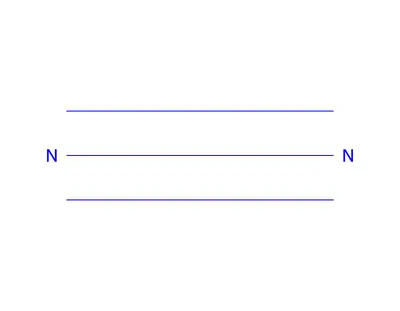
Solution
Step 1 – Write the electronic configuration of one nitrogen atom
Nitrogen has atomic number 7, so
$$Z = 7 \;\Rightarrow\; \text{electronic configuration} = 2,\,5$$
This means each nitrogen atom possesses five valence electrons.
Step 2 – State the octet requirement
For stability every nitrogen atom tries to attain the nearest noble-gas configuration, i.e. eight electrons (an octet) in its valence shell.
Step 3 – Decide how many electrons must be shared
- Each N atom already has 5 valence electrons.
- To reach an octet it needs $$8 - 5 = 3$$ more electrons.
- Therefore two nitrogen atoms must share three electron pairs (6 electrons in total).
Sharing three pairs creates a triple covalent bond.
Step 4 – Show the distribution of shared and lone-pair electrons
- Out of the five valence electrons on each N, three are contributed to the bond region (one from each N per bond pair).
- The remaining two electrons on each N stay together as a lone pair.
Step 5 – Draw / describe the structural formula
Write the two N symbols side by side, connect them by three lines (≡) representing the triple bond, and place one lone pair (two dots) on the left of the left N and one lone pair on the right of the right N.
Description for the notebook diagram:
- Put N on the left, N on the right.
- Between them draw three parallel lines to show a triple bond: N ≡ N.
- Add two dots (a lone pair) to the outer side of each N.
The completed structure satisfies the octet rule for both atoms: each N counts 2 (its lone pair) + 6 (three shared pairs) = 8 valence electrons.
Final structural formula
$$\mathrm{N{:}\!\!\,\equiv\,\!\!{:}N}$$ (each “:” stands for a lone pair of electrons)
Answer
The nitrogen molecule is represented as N ≡ N, with one lone pair of electrons on the outer side of each N atom ( : N ≡ N : ).
9 The atomic number of fluorine is 9. Explain the formation of the fluorine molecule ($$\mathrm{F_2}$$).
Solution
Step 1 – Determine the electronic configuration of a single fluorine atom
Fluorine has atomic number $$Z = 9$$, so each neutral atom contains 9 electrons. Filling the electrons in the order of increasing energy levels we get
$$1s^2 2s^2 2p^5$$
Thus the outer (second) shell contains
$$2s^2 2p^5 \Rightarrow 2 + 5 = 7$$ valence electrons.
Step 2 – Locate the deficiency to complete the octet
An octet requires 8 electrons in the valence shell. Each F atom already has $$7$$, so it lacks
$$8 - 7 = 1$$ electron.
Therefore each fluorine atom needs one additional electron to acquire the stable noble-gas configuration of neon.
Step 3 – Explain how two F atoms help each other
If two fluorine atoms come close, each can share one electron with the other. The shared pair belongs simultaneously to both atoms and is represented as a single covalent bond.
Verbal Lewis description to draw:
• Write two F symbols side by side.
• Place six dots around each symbol to show the three lone pairs on every atom.
• Place one dot from the left-hand atom and one dot from the right-hand atom between the two symbols; circle or connect this pair to emphasise that it is shared.
This produces the structure
$$\mathrm{F\,–\,F}$$
Step 4 – Check the octet for each atom
After sharing, each fluorine “sees”
- its own 6 non-bonding electrons (3 lone pairs)
- the 2 electrons in the shared pair
Step 5 – State the final molecule
Because exactly one covalent bond is formed between the two identical atoms, the resulting molecule is diatomic fluorine:
\[ \boxed{\mathrm{F_2}} \]
Answer
Each fluorine atom ($$Z=9$$) has the valence configuration $$2s^22p^5$$, i.e. 7 outer-shell electrons and needs 1 more for an octet. Two F atoms share one pair of electrons, forming a single covalent bond $$\mathrm{F–F}$$. After sharing, both acquire 8 valence electrons, so the stable diatomic molecule $$\mathrm{F_2}$$ is obtained.
10 Show the formation of the following molecules:
(i) Carbon dioxide ($$\mathrm{CO_2}$$)
Solution
Step 1 – Write the electronic configuration of each atom
- Carbon (Z = 6): K 2, L 4 ⇒ $$4$$ valence electrons.
- Oxygen (Z = 8): K 2, L 6 ⇒ $$6$$ valence electrons.
Step 2 – Find how many electrons each atom needs for an octet
- Carbon lacks $$8-4 = 4$$ electrons.
- Each oxygen lacks $$8-6 = 2$$ electrons.
Step 3 – Decide the sharing pattern
One carbon atom can complete its octet by sharing two electron pairs with each of the two oxygen atoms. In this way
- Carbon shares $$2\times2 = 4$$ electrons altogether (exactly the number it needs).
- Every oxygen receives the two electrons it needs from the double bond.
Step 4 – Draw the Lewis (dot-and-cross) structure
Let “●” stand for carbon’s valence electrons and “×” stand for oxygen’s valence electrons. Carbon contributes 2 of its 4 ● electrons towards each side, and each oxygen contributes 2 of its 6 × electrons towards the bond. The remaining 4 × electrons on each oxygen sit as two lone pairs on its outer side:
$$\mathrm{\overset{\times\,\times}{\underset{\times\,\times}{O}}\!\overset{\bullet\,\bullet}{\underset{\times\,\times}{=}}\!C\!\overset{\bullet\,\bullet}{\underset{\times\,\times}{=}}\!\overset{\times\,\times}{\underset{\times\,\times}{O}}}$$
Each C=O bond holds four shared electrons (two ● from carbon + two × from oxygen), i.e. a double covalent bond. After sharing, every atom has 8 electrons around it: each O has 4 lone-pair × electrons plus 4 shared electrons, and C has its 4 ● electrons plus 4 shared × electrons.
Step 5 – Write the condensed structural formula
\[ \mathrm{O = C = O} \]
Thus carbon dioxide contains two C = O double bonds, and all three atoms obey the octet rule.
Answer
Carbon dioxide is formed by two C = O double covalent bonds: $$\mathrm{O = C = O}$$.
(ii) Hydrogen sulfide ($$\mathrm{H_2S}$$)
Solution
Step 1 – Electronic configuration
- Sulphur (Z = 16): K 2, L 8, M 6 ⇒ $$6$$ valence electrons.
- Hydrogen (Z = 1): K 1 ⇒ $$1$$ valence electron.
Step 2 – Need for stability
- Sulphur needs $$8-6 = 2$$ electrons to complete an octet.
- Each hydrogen needs $$2-1 = 1$$ electron to acquire a duplet.
Step 3 – Sharing scheme
Sulphur shares one electron with each of two hydrogen atoms, forming two single covalent bonds. After sharing
- Each hydrogen attains the stable duplet of $$2$$ electrons.
- Sulphur attains the octet (6 own + 1 + 1 shared = 8).
Step 4 – Lewis electron-dot representation
Let “●” be sulphur’s electrons and “×” be hydrogen’s electrons:
$$\mathrm{H\,\times\; - \; \;\,\!\!S\,\,\,\!\!\!\bullet\,\bullet\,\bullet\,\bullet\; - \; \times\,H}$$
(The four unshared electron pairs on S are its lone pairs.)
Step 5 – Condensed structural formula
\[ \mathrm{H - S - H} \]
Hence hydrogen sulfide contains two S–H single covalent bonds.
Answer
Hydrogen sulphide has two S–H single covalent bonds: $$\mathrm{H - S - H}$$.
(iii) Ammonia ($$\mathrm{NH_3}$$)
Solution
Step 1 – Electronic configuration
- Nitrogen (Z = 7): K 2, L 5 ⇒ $$5$$ valence electrons.
- Hydrogen (Z = 1): K 1 ⇒ $$1$$ valence electron.
Step 2 – Requirement for stability
- Nitrogen needs $$8-5 = 3$$ electrons ⇒ forms three bonds.
- Each hydrogen needs one electron ⇒ forms one bond.
Step 3 – Bond formation
Nitrogen shares one electron with each of three hydrogen atoms, giving three N–H single covalent bonds. After sharing:
- Every hydrogen achieves a duplet.
- Nitrogen obtains an octet (5 own + 3 shared).
Step 4 – Lewis electron-dot structure
Using “●” for nitrogen’s electrons and “×” for hydrogen’s electrons:
$$\begin{array}{c} & \times H \\[-2pt] \quad | \\[-2pt] \times H - \! \! N\,\bullet\,\bullet \quad (lone\,pair)\\[-2pt] \quad | \\[-2pt] & \times H \end{array}$$
The two dots on nitrogen that are not shared constitute one lone pair.
Step 5 – Condensed structural (bond-line) formula
All three N–H single covalent bonds drawn around the central N, with the lone pair on N shown as a colon:
H
|
H — N : (one lone pair on N)
|
H
The molecule is conventionally written as
\[ \mathrm{NH_3} \]
with three N–H single covalent bonds and one lone pair on nitrogen.
Answer
Ammonia contains three N–H single covalent bonds and one lone pair on N: $$\mathrm{NH_3}$$.
11 Neon (atomic number 10) neither transfers nor shares its valence electrons. Explain.
Solution
Step 1 — Write the electronic configuration of neon
The atomic number of neon is $$Z = 10$$, which means a neutral neon atom possesses $$10$$ protons and (in the neutral state) $$10$$ electrons.
Electrons are filled in energy levels (shells) according to the rule $$2n^{2}$$, where $$n$$ is the shell number.
- K-shell (first shell, $$n = 1$$) can hold up to $$2 \times 1^{2} = 2$$ electrons.
- L-shell (second shell, $$n = 2$$) can hold up to $$2 \times 2^{2} = 8$$ electrons.
Thus the $$10$$ electrons of neon are arranged as
$$2\,\text{(K-shell)} + 8\,\text{(L-shell)} = 10$$.
Therefore the electronic configuration of neon is often written as
$$\mathrm{Ne\ (2,\,8)}$$.
Step 2 — Identify the valence shell and its occupancy
The valence shell of an atom is its outermost occupied shell. For neon, the L-shell is the valence shell and already contains $$8$$ electrons:
$$\text{Valence electrons of }\mathrm{Ne} = 8$$.
Step 3 — Recall the octet rule
According to the octet rule, atoms tend to achieve a stable configuration of $$8$$ electrons in their valence shell (an octet) by losing, gaining or sharing electrons. When this shell is completely filled, the potential energy of the electrons is at a minimum and the atom is chemically stable.
Step 4 — Explain why transfer or sharing is unnecessary for neon
- Because neon already possesses an octet (its L-shell holds the maximum possible $$8$$ electrons), it has no energetic incentive to gain electrons: adding any extra electron would force it into the higher-energy M-shell.
- Similarly, neon has no tendency to lose electrons; removing even one electron would break the stable octet and require energy input.
- Finally, since both gaining/losing are unfavourable, neon also does not need to share electrons via covalent bonding to reach stability; it is already stable.
Step 5 — State the conclusion
Neon does not take part in chemical reactions that involve transfer (ionic bonding) or sharing (covalent bonding) of its valence electrons. In other words, neon is chemically inert.
Answer
Neon already has a complete octet in its outer (L) shell — electronic configuration $$\mathrm{Ne\ (2,\,8)}$$. Because this valence shell is full, the atom is maximally stable, so it neither gains/loses (transfers) nor shares electrons with other atoms.
What if... What if we could see atoms directly? How would it help scientists and what challenges would it cause?
Solution
Step 1 – Recall why atoms are normally “invisible”
- The diameter of an atom is of the order of $$10^{-10}\,\text{m}$$ (one ångström).
- Visible light has wavelengths $$\lambda \approx 4\times10^{-7}\,\text{m}$$ to $$7\times10^{-7}\,\text{m}$$, about 1 000 times larger than an atom. According to the wave-nature of light we cannot resolve objects that are much smaller than the wavelength used.
- Hence ordinary microscopes cannot show atoms; scientists infer their presence from indirect evidence (Brownian motion, X-ray diffraction, etc.).
Step 2 – Imagine a device that really “photographs” single atoms
Suppose we invent an instrument whose resolving power is better than $$10^{-10}\,\text{m}$$, perhaps using a beam of electrons or some completely new technology, and we can display the image directly on a screen like an everyday camera.
Step 3 – How it would help scientists
- Direct confirmation of atomic theories
Seeing the exact arrangement of $$\mathrm{H}$$ and $$\mathrm{O}$$ atoms in a single molecule of water would give visual proof of the atomic-molecular model that we now accept mainly on indirect grounds. - Faster materials research
Engineers could watch in real time how atoms migrate in a metal on heating, or how dislocations move when the metal is bent, and therefore design stronger alloys much more quickly. - Observation of chemical reactions frame by frame
At present reaction mechanisms are deduced from products, rate data and spectroscopy. A true atomic-camera would let chemists “film” the breaking and making of bonds, verifying transition-state theories directly. - Biology at atomic resolution
Proteins, viruses and cell membranes could be inspected atom by atom without the need for complex crystallisation or computer reconstruction used in X-ray crystallography and cryo-EM. - Quality control at the ultimate scale
Chip manufacturers could count the exact number and position of dopant atoms in a transistor channel, pushing Moore’s law further.
Step 4 – Challenges and new problems it would create
- Disturbance of the very atoms observed
To see an object you must interact with it. A particle beam energetic enough to resolve $$10^{-10}\,\text{m}$$ carries enormous momentum $$p=\dfrac{h}{\lambda}$$. It could knock the atoms out of their natural positions, altering the system you wanted to study. - Radiation damage
High-energy photons/electrons would break chemical bonds and create ions and free radicals, destroying delicate biological samples. - Unmanageable data volume
A cubic centimetre of solid contains roughly $$N=\dfrac{\rho N_A}{M}\approx10^{23}$$ atoms. Storing even one grayscale pixel per atom every microsecond would flood global data centres within minutes. - Loss of privacy at the nanoscale
If such imaging became portable, industrial espionage could copy patented nanodevices simply by “looking” at them; new legal frameworks would be needed. - Ethical and safety limits
Observing living tissue atom-by-atom might require radiation doses fatal to the organism. Society would have to balance knowledge gained versus harm done.
Step 5 – Balanced conclusion
Therefore, being able to see atoms directly would be a revolutionary tool confirming theories, speeding innovation and deepening our grasp of matter. Yet the very act of imaging at that scale introduces technical, ethical and safety challenges that scientists would have to solve before routine use becomes possible.
Answer
Direct atomic vision would verify atomic theory, let scientists watch reactions, design better materials and study biology at unprecedented detail, but it would be hard to use because the imaging beam might rearrange or destroy the atoms, generate enormous data, raise security issues and endanger living samples. Hence it offers great promise and serious practical challenges.
12 What kind of ion will oxygen (O) form?
Solution
Step 1 — Write the electronic configuration of oxygen
The atomic number of oxygen is 8, so its electrons are arranged as
$$K\text{-shell}:\;2 \quad L\text{-shell}:\;6$$
or, in the long form, $$1s^2\,2s^2\,2p^4$$.
Step 2 — Locate the valence electrons
Only the outermost (L) shell decides chemical behaviour. Oxygen has
$$6$$ valence electrons.
Step 3 — Reach the octet
To attain the stable octet (8 electrons), oxygen can
- lose its 6 valence electrons, or
- gain 2 additional electrons.
Losing 6 electrons would require far more energy than gaining 2, so oxygen gains electrons.
Step 4 — Determine charge on the ion
Each electron gained adds one unit of negative charge. Gaining $$2$$ electrons gives
$$\text{charge} = -2$$.
Step 5 — Name and symbol of the ion
An ion carrying a negative charge is called an anion. Thus oxygen forms a divalent anion known as the oxide ion:
\[\mathrm{O^{2-}}\]
Answer
Oxygen gains two electrons and forms the divalent anion $$\mathrm{O^{2-}}$$, called the oxide ion.
13 Fill in the blanks.
Among magnesium and chlorine, magnesium atom can give two electrons to become $$\mathrm{Mg^{2+}}$$. However, chlorine can take only one electron to become __________. Now, _________ ion of magnesium and _________ ions of chlorine combine to give magnesium chloride.
Solution
First, recall how atoms form ions in order to obtain the stable electronic configuration of the nearest noble gas.
- Magnesium: atomic number = 12. Its electronic configuration is $$2,\;8,\;2$$. By losing its two outer-shell electrons it achieves the neon configuration $$2,\;8$$ and becomes the divalent cation
\[ \mathrm{Mg \;\longrightarrow\; Mg^{2+} + 2e^-} \]
- Chlorine: atomic number = 17. Its electronic configuration is $$2,\;8,\;7$$. By gaining one electron it attains the argon configuration $$2,\;8,\;8$$ and becomes the monovalent anion
\[ \mathrm{Cl + e^- \;\longrightarrow\; Cl^-} \]
Thus chlorine forms the chloride ion, $$\mathrm{Cl^-}$$.
To combine into an electrically neutral compound, the total positive charge must balance the total negative charge. One $$\mathrm{Mg^{2+}}$$ ion carries $$+2$$ charge, while one $$\mathrm{Cl^-}$$ ion carries $$-1$$ charge. Therefore we need two chloride ions to balance one magnesium ion:
\[ \mathrm{Mg^{2+} + 2\,Cl^- \;\longrightarrow\; MgCl_2} \]
Magnesium chloride thus consists of
one $$\mathrm{Mg^{2+}}$$ ion and two $$\mathrm{Cl^-}$$ ions.
Hence the completed statement is:
“Among magnesium and chlorine, magnesium atom can give two electrons to become $$\mathrm{Mg^{2+}}$$. However, chlorine can take only one electron to become $$\mathrm{Cl^-}$$ (chloride ion). Now, one $$\mathrm{Mg^{2+}}$$ ion of magnesium and two $$\mathrm{Cl^-}$$ ions of chlorine combine to give magnesium chloride.”
Answer
$$\mathrm{Cl^-}$$ (chloride ion); one $$\mathrm{Mg^{2+}}$$ ion; two $$\mathrm{Cl^-}$$ ions.
14 Show the formation of cations of potassium (K) and calcium (Ca) atoms, and the formation of their corresponding chlorides using diagrams.
Solution
1 Potassium atom → Potassium cation
- Atomic number of potassium = 19.
Electron distribution: $$2,\,8,\,8,\,1$$ (the fourth shell has one valence electron). - To achieve the stable octet of argon, the atom loses this single valence electron:
$$\mathrm{K \;\longrightarrow\; K^+ + e^-}$$ - Electron distribution after loss: $$2,\,8,\,8$$ (same as argon).
- Diagram to draw: one large circle for the K nucleus, four concentric shells with electrons 2, 8, 8, 1; an arrow showing the outermost electron leaving; a second picture of the ion with three shells (2, 8, 8) and the symbol K+ inside.
2 Calcium atom → Calcium cation
- Atomic number of calcium = 20.
Electron distribution: $$2,\,8,\,8,\,2$$. - It attains the noble-gas configuration by losing two valence electrons:
$$\mathrm{Ca \;\longrightarrow\; Ca^{2+} + 2e^-}$$ - Electron distribution after loss: $$2,\,8,\,8$$.
- Diagram to draw: four-shell picture for Ca with two outer electrons; two arrows showing both electrons leaving; second picture of Ca2+ with three shells (2, 8, 8).
3 Formation of potassium chloride (KCl)
- Chlorine atom: atomic number 17, electron distribution $$2,\,8,\,7$$. It needs one electron to complete its octet.
- Ionic bond formation:
$$\mathrm{K^+ + Cl^- \;\longrightarrow\; KCl}$$ - Dot-and-cross diagram to draw:
- Write K with one cross (its valence electron).
- Write Cl with seven dots (its own electrons).
- Arrow from the cross to the Cl symbol.
- Show the resulting bracketed ions: [K]+ and [··Cl··]− with eight dots around Cl.
- Place the two ions side by side and label the compound KCl.
4 Formation of calcium chloride (CaCl2)
- Each Ca atom provides two electrons; each Cl atom needs one. Hence one Ca atom combines with two Cl atoms.
- Ionic equation:
$$\mathrm{Ca^{2+} + 2Cl^- \;\longrightarrow\; CaCl_2}$$ - Dot-and-cross diagram to draw:
- Write Ca with two crosses.
- Draw two separate Cl atoms, each with seven dots.
- Arrow from each Ca cross to a different Cl atom.
- Resulting ions: [Ca]2+ (no dots) and two [··Cl··]− (each with eight dots).
- Arrange them as [Ca]2+ between the two chloride ions to represent the formula CaCl2.
Key points to remember
- Metals form cations by losing electrons, non-metals form anions by gaining electrons.
- Ionic compounds are electrically neutral: total positive charge = total negative charge.
Answer
Ions formed: $$\mathrm{K^+}$$ and $$\mathrm{Ca^{2+}}$$.
Chlorides obtained: $$\mathrm{KCl}$$ and $$\mathrm{CaCl_2}$$.
15 Illustrate how sodium sulfide ($$\mathrm{Na_2S}$$) is formed.
Solution
Step 1 – Write the atomic numbers and electronic configurations
For sodium, $$Z_{\mathrm{Na}} = 11$$, so the electronic configuration is $$2,\;8,\;1$$ (one valence electron).
For sulphur, $$Z_{\mathrm{S}} = 16$$, so the electronic configuration is $$2,\;8,\;6$$ (six valence electrons).
Step 2 – Recognise the tendency of each atom
- Each sodium atom can obtain a stable octet by losing its single valence electron, becoming a monovalent cation $$\mathrm{Na^{+}}$$.
- The sulphur atom attains a stable octet by gaining two electrons, becoming a divalent anion $$\mathrm{S^{2-}}$$.
Step 3 – Show the electron-transfer equations
Loss of an electron by each sodium atom:
$$\mathrm{Na} \;\longrightarrow\; \mathrm{Na^{+}} + e^{-}$$
Since two electrons are required in total, the process happens twice:
$$2\bigl( \mathrm{Na} \longrightarrow \mathrm{Na^{+}} + e^{-}\bigr)$$
Gain of two electrons by sulphur:
$$\mathrm{S} + 2e^{-} \;\longrightarrow\; \mathrm{S^{2-}}$$
Step 4 – Combine the half-equations
Adding the two sodium losses to the sulphur gain gives the overall ionic reaction
\[ 2\,\mathrm{Na} + \mathrm{S} \;\longrightarrow\; 2\,\mathrm{Na^{+}} + \mathrm{S^{2-}}\;\longrightarrow\; \mathrm{Na_2S} \]Step 5 – Write the formula from the ion charges
The compound must be electrically neutral. Two monovalent $$\mathrm{Na^{+}}$$ ions (total charge $$+2$$) balance one divalent $$\mathrm{S^{2-}}$$ ion (charge $$-2$$), so the simplest ratio is $$2{:}1$$, giving the empirical formula $$\mathrm{Na_2S}$$.
Step 6 – Electron-dot (Lewis) representation
- Draw the sulphur symbol with six dots (its valence electrons).
- Place one crossed electron from each of the two sodium atoms next to the sulphur, showing their transfer.
- After transfer, show [S] surrounded by eight electrons (an octet) and square brackets with charge $$2-$$. Each sodium symbol is shown with no valence electrons inside [ ]+.
This diagram makes it clear that an ionic bond is produced—electrostatic attraction between the opposite charges—resulting in the crystalline ionic compound $$\mathrm{Na_2S}$$.
Hence, sodium sulfide is formed by the transfer of one electron from each of two sodium atoms to a single sulphur atom.
Answer
Two sodium atoms each lose one electron to the same sulphur atom: $$2\,\mathrm{Na} \rightarrow 2\,\mathrm{Na^{+}} + 2e^{-}$$ and $$\mathrm{S} + 2e^{-} \rightarrow \mathrm{S^{2-}}$$. The ions combine in a $$2{:}1$$ ratio, giving the electrically neutral ionic compound $$\mathrm{Na_2S}$$.
16 Name the following:
(i) $$\mathrm{CO_2}$$
Solution
First identify the two non-metals present in the molecular formula $$\mathrm{CO_2}$$.
- Element 1 (written first): carbon — only one atom.
- Element 2 (written second): oxygen — two atoms.
For binary covalent (molecular) compounds we use the Greek numerical prefixes:
| No. of atoms | Prefix |
|---|---|
| 1 | mono- |
| 2 | di- |
| 3 | tri- |
| 4 | tetra- |
| 5 | penta- |
| 6 | hexa- |
Rules applied:
- The first element keeps its element name and the prefix mono- is omitted when only one atom is present → "carbon".
- The second element ends in “-ide” and must take the numerical prefix → 2 oxygen atoms → di- + “oxide” → “dioxide”.
Combining both parts gives the systematic name:
carbon dioxide.
Answer
carbon dioxide
(ii) $$\mathrm{NO_2}$$
Solution
The molecular formula is $$\mathrm{NO_2}$$.
- Nitrogen: 1 atom.
- Oxygen: 2 atoms.
Apply binary covalent-compound rules:
- The first element (nitrogen) keeps its name; the prefix mono- is left out.
- The second element gets the prefix di- (because 2) and the ending “-ide” → “dioxide”.
Hence the compound is named:
nitrogen dioxide.
Answer
nitrogen dioxide
(iii) $$\mathrm{SF_6}$$
Solution
The molecular formula is $$\mathrm{SF_6}$$.
- Sulfur: 1 atom → name stays “sulfur” without prefix.
- Fluorine: 6 atoms → prefix hexa-, change ending to “-ide” → “hexafluoride”.
Therefore the systematic name is:
sulfur hexafluoride.
Answer
sulfur hexafluoride
(iv) $$\mathrm{PCl_3}$$
Solution
The molecular formula is $$\mathrm{PCl_3}$$.
- Phosphorus: 1 atom → “phosphorus”.
- Chlorine: 3 atoms → prefix tri- + “chloride” → “trichloride”.
Thus, the compound is called:
phosphorus trichloride.
Answer
phosphorus trichloride
17 Write the formula for the following:
(i) Sodium hydrogencarbonate
Solution
Step 1 – Write the ion symbols with their charges
- Sodium ion : $$\mathrm{Na^+}$$ (because sodium is in group 1)
- Hydrogencarbonate (bicarbonate) ion : $$\mathrm{HCO_3^-}$$ (a poly-atomic ion carrying –1 charge)
Step 2 – Balance total charge to zero
Charges already add to zero with one of each ion: $$+1 + (–1) = 0$$ so the combining ratio is 1 : 1.
Step 3 – Write the formula
Therefore, the formula is $$\mathrm{NaHCO_3}$$.
Answer
$$\mathrm{NaHCO_3}$$
(ii) Sulfur dioxide
Solution
Step 1 – Identify the elements and their valencies
- Sulfur generally shows valency 4 in sulfur dioxide.
- Oxygen has valency 2.
Step 2 – Criss-cross method
Exchange the valencies to obtain subscripts:
$$\mathrm{S^{4}}$$ and $$\mathrm{O^{2}}\;\;\Longrightarrow\;\;\mathrm{S_2O_4}$$
Step 3 – Simplify subscripts by the HCF (=2)
Divide both subscripts by 2:
$$\mathrm{S_2O_4}\;\div 2 \;\longrightarrow\;\mathrm{SO_2}$$
Step 4 – Write the formula
The correct molecular formula is $$\mathrm{SO_2}$$.
Answer
$$\mathrm{SO_2}$$
(iii) Ferric chloride
Solution
Step 1 – Write the ion symbols
- "Ferric" means iron in the +3 oxidation state: $$\mathrm{Fe^{3+}}$$
- Chloride ion: $$\mathrm{Cl^-}$$
Step 2 – Balance charges
The LCM of 3 and 1 is 3, so we need 3 chloride ions to balance one $$\mathrm{Fe^{3+}}$$:
$$\mathrm{Fe^{3+}} + 3\,(\mathrm{Cl^-}) \;\to\; (3+) + 3\,(–1) = 0$$
Step 3 – Write the formula
Hence, the formula is $$\mathrm{FeCl_3}$$.
Answer
$$\mathrm{FeCl_3}$$
(iv) Cuprous oxide
Solution
Step 1 – Write the ion symbols
- "Cuprous" indicates copper(I): $$\mathrm{Cu^+}$$
- Oxide ion: $$\mathrm{O^{2-}}$$
Step 2 – Balance charges
To neutralise –2 on oxygen, two $$\mathrm{Cu^+}$$ ions are required:
$$2\,(\mathrm{Cu^+}) + \mathrm{O^{2-}} \;\to\; 2(+1) + (–2) = 0$$
Step 3 – Write the formula
Thus, the empirical formula is $$\mathrm{Cu_2O}$$.
Answer
$$\mathrm{Cu_2O}$$
18 Write the formulae for the compounds formed from the following pairs of ions:
(i) $$\mathrm{Fe^{3+}}$$ and $$\mathrm{OH^{-}}$$
Solution
Step 1 – Write the ions with their charges.
Metal ion: $$\mathrm{Fe^{3+}}$$ (ferric ion)
Non-metal/polyatomic ion: $$\mathrm{OH^{-}}$$ (hydroxide ion)
Step 2 – Balance the total positive and negative charges.
The magnitude of the charges are 3 (from $$\mathrm{Fe^{3+}}$$) and 1 (from $$\mathrm{OH^{-}}$$).
Find the lowest common multiple (LCM) of 3 and 1, which is 3.
Number of each ion needed:
• One $$\mathrm{Fe^{3+}}$$ (gives +3)
• Three $$\mathrm{OH^{-}}$$ ions (each gives -1, so 3 × -1 = -3)
Step 3 – Write the neutral formula.
The metal comes first, followed by the anionic group in parentheses with its subscript:
$$\mathrm{Fe(OH)_3}$$
Answer
$$\mathrm{Fe(OH)_3}$$
(ii) $$\mathrm{K^{+}}$$ and $$\mathrm{CO_3^{2-}}$$
Solution
Step 1 – Write the ions with their charges.
Cation: $$\mathrm{K^{+}}$$
Anion: $$\mathrm{CO_3^{2-}}$$ (carbonate ion)
Step 2 – Balance the charges.
The magnitude of the charges are 1 (for K+) and 2 (for CO32-).
The LCM of 1 and 2 is 2.
Number of each ion needed:
• Two $$\mathrm{K^{+}}$$ ions (2 × +1 = +2)
• One $$\mathrm{CO_3^{2-}}$$ ion (-2)
Step 3 – Write the neutral formula.
The subscript "2" is placed after potassium; no parentheses are needed for a single carbonate group:
$$\mathrm{K_2CO_3}$$
Answer
$$\mathrm{K_2CO_3}$$
19 What type of chemical bond is present in a solid compound that does not conduct electricity in the solid state but conducts electricity when dissolved in water?
Solution
Step 1 – Recall the electrical behaviour of different bond types
- Covalent (molecular) solids consist of neutral molecules. They lack mobile charge-carriers both in the solid state and after dissolving in water (most do not even dissolve), so they do not conduct electricity in either situation.
- Metallic solids contain a ‘sea’ of delocalised electrons. These electrons are mobile inside the crystal, so metallic solids do conduct in the solid state.
- Ionic (electrovalent) solids are built from oppositely charged ions held in a rigid lattice. In the solid state the ions are fixed in position, therefore no conduction occurs. When the lattice melts or when the substance dissolves in water, the ions become free to move; the resulting melt or aqueous solution does conduct electricity.
Step 2 – Match the given behaviour with the descriptions
The compound in the question
- “does not conduct electricity in the solid state” ➔ rules out metallic bonding;
- “conducts electricity when dissolved in water” ➔ requires mobile ions in solution, a feature of ionic compounds but not of covalent ones.
Step 3 – State the bond type
The only bond type that fits both observations is the ionic (electrovalent) bond.
Answer
An ionic (electrovalent) bond is present in the compound.
20 Metal M, with two electrons in its valence shell (M shell), reacts with oxygen to form a compound that is slightly soluble in water. Predict its: (i) formula (ii) type of bond (iii) electrical conductivity of its aqueous solution.
Solution
Step 1 ▶ Determine the valency of the metal M
Valence-shell data: the atom has two electrons in its outermost (M) shell.
This is the same electronic situation as the alkaline–earth metals (Group 2).
Hence the metal atom needs to lose those two electrons to acquire the stable noble-gas configuration.
Therefore its valency is
$$\text{valency of }\mathrm M = 2$$
and the ion produced is the divalent cation $$\mathrm{M^{2+}}$$.
Step 2 ▶ Work out the formula with oxygen
Oxygen (group 16) has six valence electrons and attains the octet by gaining two electrons, giving the oxide ion $$\mathrm{O^{2-}}$$; its valency is 2.
To obtain an electrically neutral compound the charges must cancel:
| Ion | Charge |
|---|---|
| $$\mathrm{M^{2+}}$$ | +2 |
| $$\mathrm{O^{2-}}$$ | −2 |
The simplest whole-number ratio is therefore 1 : 1, giving the empirical formula
\[\mathrm{MO}\]
Step 3 ▶ Nature of bonding
Because electrons are transferred from the metal atom to the oxygen atom, the bond formed is an ionic (electrovalent) bond.
Step 4 ▶ Electrical behaviour of its aqueous solution
The solid $$\mathrm{MO}$$ is only slightly soluble in water, but the small amount that dissolves reacts with water to form the hydroxide:
$$\mathrm{MO + H_2O \longrightarrow M(OH)_2}$$
which dissociates as
$$\mathrm{M(OH)_2 \rightarrow M^{2+} + 2\,OH^-}$$
The presence of free $$\mathrm{M^{2+}}$$ and $$\mathrm{OH^-}$$ ions makes the solution capable of conducting an electric current. (Because the solubility is low, the conductivity will be modest, yet it is definitely a conductor.)
Final predictions
- Formula of the oxide: $$\mathrm{MO}$$
- Type of bond: ionic (electrovalent)
- Conductivity of aqueous solution: conducts electricity (ionic conductor)
Answer
(i) $$\mathrm{MO}$$ (ii) Ionic bond (iii) Its aqueous solution conducts electricity.
21 Find the molecular mass of nitric acid ($$\mathrm{HNO_3}$$).
Atomic mass — H = 1 u; N = 14 u; O = 16 u.
Solution
Step 1 | Write the molecular formula
For nitric acid the molecular formula is $$\mathrm{HNO_3}$$.
Step 2 | Count the number of each type of atom
| Element | Symbol | Atoms per molecule |
|---|---|---|
| Hydrogen | H | 1 |
| Nitrogen | N | 1 |
| Oxygen | O | 3 |
Step 3 | Write the given atomic masses
Hydrogen: $$1\,\text{u}$$ Nitrogen: $$14\,\text{u}$$ Oxygen: $$16\,\text{u}$$
Step 4 | Multiply atomic mass by the number of atoms
- Hydrogen contribution: $$1\times1=1\,\text{u}$$
- Nitrogen contribution: $$14\times1=14\,\text{u}$$
- Oxygen contribution: $$16\times3=48\,\text{u}$$
Step 5 | Add all contributions to get the molecular mass
$$1\,\text{u}+14\,\text{u}+48\,\text{u}=63\,\text{u}$$
The molecular mass of nitric acid, therefore, is
\[63\,\text{u}\]
Answer
$$63\,\text{u}$$
22 Find the molecular mass of methane ($$\mathrm{CH_4}$$).
Atomic mass — C = 12 u; H = 1 u.
Solution
For any molecule, its molecular mass is obtained by adding up the atomic masses of all the atoms present in one molecule of the substance.
Given the molecular formula of methane is $$\mathrm{CH_4}$$, each molecule contains
- 1 atom of carbon (C)
- 4 atoms of hydrogen (H)
Step 1 Write the atomic masses provided: $$M_{\text{C}} = 12\,\text{u}, \; M_{\text{H}} = 1\,\text{u}$$
Step 2 Multiply each atomic mass by the corresponding number of atoms in the molecule:
• Contribution of carbon: $$1 \times 12\,\text{u} = 12\,\text{u}$$
• Contribution of hydrogen: $$4 \times 1\,\text{u} = 4\,\text{u}$$
Step 3 Add the contributions to obtain the molecular mass:
$$\text{Molecular mass of } \mathrm{CH_4} = 12\,\text{u} + 4\,\text{u} = 16\,\text{u}$$
The final result is therefore
\[\boxed{16\,\text{u}}\]
Answer
$$M_{\mathrm{CH_4}} = 16\,\text{u}$$
23 Find the formula unit mass of potassium chloride ($$\mathrm{KCl}$$).
Atomic mass — K = 39 u; Cl = 35.5 u.
Solution
Concept recall: For an ionic compound such as $$\mathrm{KCl}$$ we talk about formula-unit mass, not molecular mass, because the crystal does not contain discrete molecules. The formula-unit mass is obtained by adding the atomic masses of all atoms present in the empirical formula.
Write the empirical (chemical) formula of potassium chloride:
$$\mathrm{KCl}$$ consists of one potassium atom (K) and one chlorine atom (Cl).Note the given atomic masses:
Potassium, $$\mathrm{K} : 39\,\text{u}$$
Chlorine, $$\mathrm{Cl} : 35.5\,\text{u}$$Add the atomic masses because one atom of each element is present in the formula unit:
$$\text{Formula-unit mass} = 39\,\text{u} + 35.5\,\text{u}$$Carry out the addition step by step:
$$39 + 35.5 = 74.5$$
The formula-unit mass of potassium chloride is therefore
\[74.5\,\text{u}\]
Answer
Formula-unit mass of $$\mathrm{KCl} = 74.5\,\text{u}$$
24 Find the formula unit mass of magnesium hydroxide, $$\mathrm{Mg(OH)_2}$$.
Atomic mass — Mg = 24 u; O = 16 u; H = 1 u.
Solution
We have to add the atomic masses of every atom present in one formula unit of $$\mathrm{Mg(OH)_2}$$.
- Count the atoms.
In one formula unit of $$\mathrm{Mg(OH)_2}$$ there are:- Mg : 1 atom
- O : 2 atoms (the group $$\mathrm{OH}$$ occurs twice)
- H : 2 atoms (for the same reason)
- Write the given atomic masses.
$$\text{Mg} = 24\,\text{u}$$, $$\text{O} = 16\,\text{u}$$, $$\text{H} = 1\,\text{u}$$ - Multiply by the number of atoms.
Element No. of atoms Mass per atom (u) Total mass (u) Mg 1 24 $$1\times24=24$$ O 2 16 $$2\times16=32$$ H 2 1 $$2\times1=2$$ - Add all the contributions.
$$24\,\text{u}+32\,\text{u}+2\,\text{u}=58\,\text{u}$$
Hence,
\[\text{Formula unit mass of } \mathrm{Mg(OH)_2}=58\,\text{u}\]
Answer
$$58\,\text{u}$$
Revise, Reflect, Refine
1 A particular element (A) has one electron in its third shell. There is another element (B) with six electrons in its second shell.
(i) How many electrons does A tend to give or take to become stable?
Solution
The information “one electron in the third shell” means the electronic configuration of A is
$$2,\;8,\;1$$
The outermost (valence) shell therefore contains only $$1$$ electron.
To reach a stable octet configuration the atom has two options:
- Lose this single electron → configuration becomes $$2,\;8$$ (like neon).
- Gain seven electrons → configuration would become $$2,\;8,\;8$$ (impractical because it involves as many as seven electrons).
Because losing one electron requires much less energy than gaining seven, element A tends to give away exactly one electron.
Answer
A tends to lose 1 electron.
(ii) What kind of ion would it form?
Solution
When A loses one electron, the number of protons (11) exceeds the number of electrons (10) by one unit, producing a positively charged species.
Charge on the ion:
$$+1$$
Hence A forms a monovalent cation written symbolically as
$$\mathrm{A^+}$$
Answer
It forms a positive ion (cation) $$\mathrm{A^+}$$.
(iii) How many electrons does B tend to give or take to become stable?
Solution
Element B is described as having “six electrons in the second shell” → its configuration is
$$2,\;6$$
The valence shell contains $$6$$ electrons. To reach the nearest noble-gas configuration ($$2,\;8$$) the atom can:
- Gain $$2$$ electrons (much easier), or
- Lose $$6$$ electrons (energetically very difficult).
Thus B tends to take in two electrons.
Answer
B tends to gain 2 electrons.
(iv) What kind of ion would it form?
Solution
After gaining two electrons the number of electrons exceeds the number of protons by two, giving the ion a charge of $$-2$$.
Therefore B forms a divalent anion:
$$\mathrm{B^{2-}}$$
Answer
It forms a negative ion (anion) $$\mathrm{B^{2-}}$$.
(v) If A and B were to combine, what kind of bond would be formed?
Solution
A loses electrons while B gains electrons. The electrostatic attraction between the oppositely charged ions $$\mathrm{A^+}$$ and $$\mathrm{B^{2-}}$$ produces an
ionic (electrovalent) bond.
Answer
An ionic bond will be formed.
(vi) What would be the formula for the compound thus formed?
Solution
For electrical neutrality the total positive and negative charges in the compound must balance:
Charge provided by one $$\mathrm{B^{2-}}$$ = $$-2$$
Charge provided by one $$\mathrm{A^+}$$ = $$+1$$
To balance −2 we need two $$+1$$ charges:
$$2(\,+1\,) + (\,-2\,) = 0$$
Hence the ratio of ions is
$$\mathrm{A^+ : B^{2-} = 2 : 1}$$
So the empirical formula of the compound is
$$\mathrm{A_2B}$$
Answer
The compound’s formula is $$\mathrm{A_2B}$$.
2 An element X has six electrons in its outer shell and forms a diatomic molecule.
(i) Why would that be so?
Solution
Let the electronic configuration of element X be represented as K L M …
- The valence (outer-most) shell of X contains six electrons, i.e. $$\text{valence electrons of }X = 6$$.
- To reach the nearest noble-gas configuration (octet) it therefore needs $$8-6 = 2$$ more electrons.
- Another atom of the same element is also two electrons short. Each atom can contribute the needed electrons by sharing them in pairs.
- Thus two atoms of X come together and share two pairs of electrons so that the valence shells of both attain eight electrons.
Because this requirement is satisfied with exactly two atoms, X naturally exists as a diatomic molecule $$\mathrm{X_2}$$.
Answer
Each X atom is two electrons short of an octet; by sharing two pairs of electrons with another X atom both complete their octets, so X occurs as a diatomic molecule $$\mathrm{X_2}$$.
(ii) What kind of bond would it form?
Solution
The two X atoms achieve the octet by sharing electrons, not by transferring them.
Such a bond formed by mutual sharing of electron pairs is called a covalent bond. Because two pairs are shared, it is specifically a double covalent bond.
Answer
A double covalent bond (non-polar covalent bond) is formed between the two X atoms.
(iii)
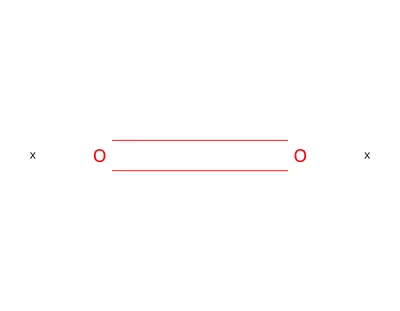
Solution
Lewis (electron-dot) structure of $$\mathrm{X_2}$$:
- Write the two symbols X side by side.
- Place two pairs of shared dots (or draw two lines) between them to show the double covalent bond.
- Distribute the remaining two lone pairs around each X to make eight electrons around every atom.
Description to draw:
"X : : X" with two dots above and two dots below each X, indicating that each atom possesses four non-bonding electrons, while the two pairs of dots (or two lines) between the X’s represent the shared electrons.
Answer
Draw two X symbols joined by a double bond (two lines or two shared pairs of dots); around each X show the remaining four electrons as two lone pairs so that every X has eight electrons in total.
(iv)
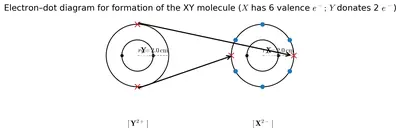
Solution
Element Y has the electronic configuration: K L → $$2,2$$ (four electrons in all). The two electrons present in its L-shell are its valence electrons.
- Y can most readily attain the noble-gas configuration of helium (2) by losing these two valence electrons, becoming $$\mathrm{Y^{2+}}$$.
- The atom X (with six valence electrons) can achieve an octet by gaining the same two electrons, becoming $$\mathrm{X^{2-}}$$.
Thus, two electrons are transferred from Y to X, producing oppositely charged ions that attract one another. The compound formed is ionic and has the formula $$\mathrm{YX}$$.
Structure to draw:
- Write Y inside square brackets with no dots (it has lost its two electrons) and label it as $$^{2+}$$.
- Write X inside square brackets surrounded by eight dots (it has gained two extra electrons) and label it as $$^{2-}$$.
- Indicate the transfer of two electrons by arrows from Y to X, and finally show the electrostatic attraction between the resulting ions.
Answer
The molecule is an ionic pair $$[\mathrm{Y}]^{2+}\;[\mathrm{X}]^{2-}$$, obtained by transfer of Y’s two valence electrons to X.
3
You want to design a new ionic compound, where the total positive charge is $$6+$$ and the total negative charge is $$6-$$. Which of the following combinations gives the correct number of ions?
(i) $$2 \, \mathrm{Al^{3+}}$$ and $$3 \, \mathrm{Cl^{-}}$$
(ii) $$3 \, \mathrm{Mg^{2+}}$$ and $$1 \, \mathrm{PO_4^{3-}}$$
(iii) $$2 \, \mathrm{Fe^{3+}}$$ and $$3 \, \mathrm{O^{2-}}$$
(iv) $$3 \, \mathrm{Ca^{2+}}$$ and $$2 \, \mathrm{SO_4^{2-}}$$
Solution
Given goal: the ionic compound must be electrically neutral, i.e. the algebraic sum of all positive and negative charges must be zero.
Therefore we need:
\[\text{Total positive charge}= +6, \qquad \text{Total negative charge}= -6\]
Analyse every combination one by one.
-
Option (i): $$2\,\mathrm{Al^{3+}}$$ and $$3\,\mathrm{Cl^-}$$
- Positive charge: $$2\times(+3)=+6$$
- Negative charge: $$3\times(-1)=-3$$
The algebraic sum is $$+6+(-3)=+3\neq0$$.
Not neutral ⇒ reject. -
Option (ii): $$3\,\mathrm{Mg^{2+}}$$ and $$1\,\mathrm{PO_4^{3-}}$$
- Positive charge: $$3\times(+2)=+6$$
- Negative charge: $$1\times(-3)=-3$$
Sum: $$+6+(-3)=+3\neq0$$.
Not neutral ⇒ reject. -
Option (iii): $$2\,\mathrm{Fe^{3+}}$$ and $$3\,\mathrm{O^{2-}}$$
- Positive charge: $$2\times(+3)=+6$$
- Negative charge: $$3\times(-2)=-6$$
Sum: $$+6+(-6)=0$$.
Charges cancel exactly ⇒ neutral compound obtained. -
Option (iv): $$3\,\mathrm{Ca^{2+}}$$ and $$2\,\mathrm{SO_4^{2-}}$$
- Positive charge: $$3\times(+2)=+6$$
- Negative charge: $$2\times(-2)=-4$$
Sum: $$+6+(-4)=+2\neq0$$.
Not neutral ⇒ reject.
Only option (iii) satisfies the requirement of total $$+6$$ and total $$-6$$, hence gives a neutral ionic compound $$\mathrm{Fe_2O_3}$$.
Answer
(iii) 2 $$\mathrm{Fe^{3+}}$$ and 3 $$\mathrm{O^{2-}}$$
4 Choose the correct statement(s) and correct the false statement(s).
(i) Elements are made up of molecules and compounds are made up of atoms.
Solution
Step 1 – Recall the definitions.
• An element consists of only one kind of atom (all atoms have the same atomic number).
• A compound is a pure substance formed by the chemical combination of two or more different kinds of atoms. It is usually described in terms of molecules (e.g. $$\mathrm{H_2O}$$) or, for ionic compounds, in terms of formula units (e.g. $$\mathrm{NaCl}$$).
Step 2 – Test the statement.
The given sentence says, “Elements are made up of molecules and compounds are made up of atoms.”
• In reality, an element is fundamentally described by the atom; some elements exist as multi-atomic molecules (e.g. $$\mathrm{O_2}$$, $$\mathrm{P_4}$$) but that is not compulsory.
• A compound is described by its molecule or formula unit, which itself is made up of atoms of different elements.
Step 3 – Decision.
The sentence interchanges the words “atom” and “molecule”, so it is false.
Correct statement.
“An element consists of one kind of atoms; a compound consists of molecules (or formula units) that contain atoms of two or more different elements chemically combined.”
Answer
False. Correct: An element is composed of one kind of atoms, whereas a compound is composed of molecules (or formula units) containing atoms of different elements.
(ii) The molecule of a compound is always made up of two or more atoms of the same kind.
Solution
Step 1 – Understand what a compound is.
A compound contains two or more different kinds of atoms chemically combined in a fixed ratio, for example:
$$\mathrm{CO_2}\!: \;1\text{ carbon} + 2\text{ oxygen atoms}$$
$$\mathrm{NH_3}\!: \;1\text{ nitrogen} + 3\text{ hydrogen atoms}$$
Step 2 – Evaluate the statement.
The sentence says, “The molecule of a compound is always made up of two or more atoms of the same kind.”
This directly contradicts the definition above, which requires atoms of different kinds.
Step 3 – Decision.
The statement is therefore false.
Correct statement.
“The molecule of a compound is always made up of two or more atoms of different elements chemically bonded together.”
Answer
False. Correct: A compound’s molecule contains atoms of two or more different elements, not the same element.
(iii) One molecule of nitrogen gas contains three nitrogen atoms.
Solution
Step 1 – Recall the formula of nitrogen gas.
Ordinary nitrogen gas is diatomic: $$\mathrm{N_2}$$.
Step 2 – Count the atoms.
In one molecule of $$\mathrm{N_2}$$ there are exactly two nitrogen atoms.
Step 3 – Decision.
The statement claims that a molecule of nitrogen gas contains three nitrogen atoms, so it is false.
Correct statement.
“One molecule of nitrogen gas, $$\mathrm{N_2}$$, contains two nitrogen atoms.”
Answer
False. Correct: One molecule of nitrogen gas (N2) contains two nitrogen atoms.
(iv) Water is made of two hydrogen atoms, covalently bonded with one oxygen atom.
Solution
Step 1 – Write the formula of water.
Water is represented by $$\mathrm{H_2O}$$.
Step 2 – Interpret the formula.
The subscript ‘2’ with H shows that each molecule has two hydrogen atoms.
Since no subscript follows O, it means one oxygen atom.
The bonding between H and O is covalent (sharing of electrons).
Step 3 – Decision.
The statement matches the formula exactly, so it is true.
Answer
True.
5 Write the chemical formulae for the following compounds.
(i) Aluminium nitrate
Solution
Step 1 – Write the symbols and valencies.
Aluminium (Al): valency = 3 ⇒ $$\mathrm{Al^{3+}}$$
Nitrate ion $$(\mathrm{NO_3^-})$$: valency = 1
Step 2 – Cross-multiply the valencies.
Aluminium gets the valency of nitrate (1); nitrate gets the valency of aluminium (3).
\[\mathrm{Al_1(NO_3)_3}\]
Step 3 – Write the formula.
The sub-script ‘1’ next to Al is not written, so the compound’s formula is
$$\mathrm{Al(NO_3)_3}$$
Answer
$$\mathrm{Al(NO_3)_3}$$
(ii) Calcium oxide
Solution
Step 1 – Write the symbols and valencies.
Calcium (Ca): valency = 2 ⇒ $$\mathrm{Ca^{2+}}$$
Oxide ion (O): valency = 2 ⇒ $$\mathrm{O^{2-}}$$
Step 2 – Cross-multiply the valencies.
Initial product: $$\mathrm{Ca_2O_2}$$
Step 3 – Simplify the subscripts by their highest common factor (2).
$$\mathrm{Ca_2O_2}\;\div\;2\;=\;CaO$$
Step 4 – Write the formula.
$$\mathrm{CaO}$$
Answer
$$\mathrm{CaO}$$
(iii) Ferric oxide
Solution
"Ferric" means iron in the +3 oxidation state.
Step 1 – Write the symbols and valencies.
Iron (III) (Fe): valency = 3 ⇒ $$\mathrm{Fe^{3+}}$$
Oxide ion (O): valency = 2 ⇒ $$\mathrm{O^{2-}}$$
Step 2 – Cross-multiply the valencies.
\[\mathrm{Fe_2O_3}\]
Step 3 – Write the formula.
$$\mathrm{Fe_2O_3}$$
Answer
$$\mathrm{Fe_2O_3}$$
6 Write the formulae of the compounds formed from the following pairs of ions.
(i) $$\mathrm{Ca^{2+}}$$ and $$\mathrm{Br^{-}}$$
Solution
We must combine the ions so that the total positive charge equals the total negative charge.
- Write the symbols with their charges:
$$\mathrm{Ca^{2+}}\;\;\;\;\mathrm{Br^{-}}$$ - Find the lowest common multiple (LCM) of the magnitudes of the charges 2 and 1. The LCM is 2.
- Decide how many of each ion are needed to make the total charge zero.
- One $$\mathrm{Ca^{2+}}$$ contributes +2.
- Each $$\mathrm{Br^{-}}$$ contributes −1. To make −2, we need two bromide ions.
- Write the ratio Ca : Br = 1 : 2 and drop the charge signs. Remember that the subscript “1” is not written.
Hence the formula is
$$\mathrm{CaBr_2}$$
Answer
$$\mathrm{CaBr_2}$$
(ii) $$\mathrm{Al^{3+}}$$ and $$\mathrm{CO_3^{2-}}$$
Solution
Balance the total charges of aluminium(III) and carbonate(II) ions.
- Symbols with charges:
$$\mathrm{Al^{3+}}\;\;\;\;\mathrm{CO_3^{2-}}$$ - The LCM of the charge numbers 3 and 2 is 6.
- Choose numbers of ions so that the total charge becomes zero:
- Two $$\mathrm{Al^{3+}}$$ give +6.
- Three $$\mathrm{CO_3^{2-}}$$ give −6.
- Write the ratio Al : CO3 = 2 : 3. Because more than one polyatomic ion is present, enclose it in brackets.
Thus the formula is
$$\mathrm{Al_2(CO_3)_3}$$
Answer
$$\mathrm{Al_2(CO_3)_3}$$
(iii) $$\mathrm{K^{+}}$$ and $$\mathrm{SO_4^{2-}}$$
Solution
Equalise the charges of potassium(I) and sulphate(II) ions.
- Symbols with charges:
$$\mathrm{K^{+}}\;\;\;\;\mathrm{SO_4^{2-}}$$ - The sulphate ion bears −2, so we require two $$\mathrm{K^{+}}$$ ions to supply +2.
- Ratio K : SO4 = 2 : 1.
The final formula is
$$\mathrm{K_2SO_4}$$
Answer
$$\mathrm{K_2SO_4}$$
(iv) $$\mathrm{NH_4^{+}}$$ and $$\mathrm{Cl^{-}}$$
Solution
Combine the ammonium(I) and chloride(I) ions.
- Symbols with charges:
$$\mathrm{NH_4^{+}}\;\;\;\;\mathrm{Cl^{-}}$$ - The charges are +1 and −1, already equal and opposite, so a 1:1 ratio suffices.
Therefore the formula is
$$\mathrm{NH_4Cl}$$
Answer
$$\mathrm{NH_4Cl}$$
7
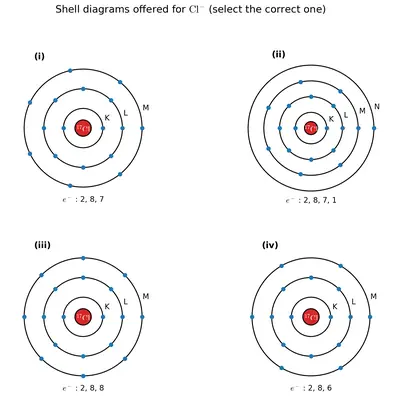
Solution
Step 1 — Recall the data for chlorine
For a neutral chlorine atom: atomic number = 17, therefore it possesses $$17$$ protons and (neutral state) $$17$$ electrons.
Electronic configuration (maximum 2 electrons in K-shell, 8 in L-shell, etc.):
$$\text{Cl (neutral)}: \; 2,\;8,\;7$$
Step 2 — Convert the atom into the chloride ion
A chloride ion $$\mathrm{Cl^{-}}$$ is formed when the atom gains one extra electron:
$$17\;e^- + 1\;e^- \;\longrightarrow\; 18\;e^-$$
Thus, for $$\mathrm{Cl^{-}}$$
- protons (positive charges) = 17 (unchanged, they reside in the nucleus);
- electrons = 18.
Step 3 — Distribute the 18 electrons into shells
Applying the 2 $$n^{2}$$ rule (maximum electrons a shell n may hold):
- K-shell (n = 1): maximum 2 ⇒ fill 2.
- L-shell (n = 2): maximum 8 ⇒ fill 8.
- M-shell (n = 3): electrons left = 18 − (2+8)=8 ⇒ place 8.
Step 4 — Match with the given diagrams
You must choose the diagram in which the nucleus is surrounded by three concentric shells containing 2, 8 and 8 electrons respectively (total 18).
Examining Fig. 9.18, only option (iv) shows exactly this 2–8–8 arrangement, while the other three options either end with 7 electrons in the outermost shell or have the wrong total count.
Conclusion
Diagram (iv) is the correct representation of the $$\mathrm{Cl^{-}}$$ ion.
Answer
(iv)
8 Determine the formula unit mass of the following substances.
(i) Ammonium nitrate ($$\mathrm{NH_4NO_3}$$), used as a nitrogen fertiliser, which is essential for plant growth.
Solution
Step 1 — Write the chemical formula
Ammonium nitrate = $$\mathrm{NH_4NO_3}$$.
Step 2 — Note the atomic masses
- $$\mathrm{N}$$ = 14 u
- $$\mathrm{H}$$ = 1 u
- $$\mathrm{O}$$ = 16 u
Step 3 — Count the number of each atom in one formula unit
| Element | No. of atoms | Atomic mass (u) |
|---|---|---|
| N | 2 | 14 |
| H | 4 | 1 |
| O | 3 | 16 |
Step 4 — Multiply and add
$$\text{Formula unit mass}=2\times14+4\times1+3\times16$$
$$=28+4+48$$
$$=80\,\text{u}$$
Answer
80 u
(ii) Phosphoric acid ($$\mathrm{H_3PO_4}$$), used to make phosphate fertiliser and detergents.
Solution
Step 1 — Write the chemical formula
Phosphoric acid = $$\mathrm{H_3PO_4}$$.
Step 2 — Note the atomic masses
- $$\mathrm{H}$$ = 1 u
- $$\mathrm{P}$$ = 31 u
- $$\mathrm{O}$$ = 16 u
Step 3 — Count the number of each atom in one molecule
| Element | No. of atoms | Atomic mass (u) |
|---|---|---|
| H | 3 | 1 |
| P | 1 | 31 |
| O | 4 | 16 |
Step 4 — Multiply and add
$$\text{Formula unit (molecular) mass}=3\times1+1\times31+4\times16$$
$$=3+31+64$$
$$=98\,\text{u}$$
Answer
98 u
(iii) Sodium hydrogencarbonate ($$\mathrm{NaHCO_3}$$), used to relieve acidity and helps in digestion.
Solution
Step 1 — Write the chemical formula
Sodium hydrogencarbonate = $$\mathrm{NaHCO_3}$$.
Step 2 — Note the atomic masses
- $$\mathrm{Na}$$ = 23 u
- $$\mathrm{H}$$ = 1 u
- $$\mathrm{C}$$ = 12 u
- $$\mathrm{O}$$ = 16 u
Step 3 — Count the number of each atom in one formula unit
| Element | No. of atoms | Atomic mass (u) |
|---|---|---|
| Na | 1 | 23 |
| H | 1 | 1 |
| C | 1 | 12 |
| O | 3 | 16 |
Step 4 — Multiply and add
$$\text{Formula unit mass}=1\times23+1\times1+1\times12+3\times16$$
$$=23+1+12+48$$
$$=84\,\text{u}$$
Answer
84 u
9 Write the formulae for the compounds formed by the reaction of:
(i) Magnesium and nitrogen
Solution
Given elements : Magnesium (Mg) and Nitrogen (N)
Step 1 – Write the valencies.
Magnesium belongs to Group 2 → valency $$2$$ (ion $$\mathrm{Mg^{2+}}$$).
Nitrogen belongs to Group 15 → valency $$3$$ (ion $$\mathrm{N^{3-}}$$).
Step 2 – Arrange the symbols with their valencies.
$$\mathrm{Mg^{2+}\;\;N^{3-}}$$
Step 3 – Criss-cross the valencies to obtain subscripts.
The valency of Mg becomes the subscript of N, and that of N becomes the subscript of Mg:
$$\mathrm{Mg_3N_2}$$
Step 4 – Simplify if necessary.
The subscripts 3 and 2 have no common factor, so the empirical formula is already simplest.
Compound formed : $$\mathrm{Mg_3N_2}$$ (magnesium nitride).
Answer
(ii) Lithium and nitrogen
Solution
Given elements : Lithium (Li) and Nitrogen (N)
Step 1 – Write the valencies.
Lithium is in Group 1 → valency $$1$$ (ion $$\mathrm{Li^{+}}$$).
Nitrogen is in Group 15 → valency $$3$$ (ion $$\mathrm{N^{3-}}$$).
Step 2 – Arrange the symbols with valencies.
$$\mathrm{Li^{1}\;\;N^{3}}$$
Step 3 – Criss-cross the valencies.
$$\mathrm{Li_3N_1}$$
Step 4 – Omit the subscript 1.
$$\mathrm{Li_3N}$$
Compound formed : $$\mathrm{Li_3N}$$ (lithium nitride).
Answer
(iii) Sodium and sulfur
Solution
Given elements : Sodium (Na) and Sulfur (S)
Step 1 – Write the valencies.
Sodium is in Group 1 → valency $$1$$ (ion $$\mathrm{Na^{+}}$$).
Sulfur is in Group 16 → valency $$2$$ (ion $$\mathrm{S^{2-}}$$).
Step 2 – Arrange the symbols with valencies.
$$\mathrm{Na^{1}\;\;S^{2}}$$
Step 3 – Criss-cross the valencies.
$$\mathrm{Na_2S_1}$$
Step 4 – Omit the subscript 1.
$$\mathrm{Na_2S}$$
Compound formed : $$\mathrm{Na_2S}$$ (sodium sulfide).
Answer
(iv) Aluminium and oxygen
Solution
Given elements : Aluminium (Al) and Oxygen (O)
Step 1 – Write the valencies.
Aluminium is in Group 13 → valency $$3$$ (ion $$\mathrm{Al^{3+}}$$).
Oxygen is in Group 16 → valency $$2$$ (ion $$\mathrm{O^{2-}}$$).
Step 2 – Arrange the symbols with valencies.
$$\mathrm{Al^{3+}\;\;O^{2-}}$$
Step 3 – Criss-cross the valencies.
$$\mathrm{Al_2O_3}$$
Step 4 – Check for common factors.
The subscripts 2 and 3 share none → simplest form achieved.
Compound formed : $$\mathrm{Al_2O_3}$$ (aluminium oxide).
Answer
10
Complete the Table 9.3 by writing the formulae of the compounds formed by the cations on the left and the anions at the top. $$\mathrm{LiNO_3}$$ is given as an example.
| $$\mathrm{NO_3^{-}}$$ | $$\mathrm{SO_4^{2-}}$$ | $$\mathrm{PO_4^{3-}}$$ | |
|---|---|---|---|
| $$\mathrm{NH_4^{+}}$$ | |||
| $$\mathrm{Li^{+}}$$ | $$\mathrm{LiNO_3}$$ | ||
| $$\mathrm{Al^{3+}}$$ | |||
| $$\mathrm{Cu^{2+}}$$ |
Solution
Key idea: An ionic compound is electrically neutral, so the total positive charge supplied by the cation(s) must exactly cancel the total negative charge supplied by the anion(s). To obtain the simplest (empirical) formula, we look for the lowest common multiple (LCM) of the magnitudes of the two charges and then decide how many ions of each kind are needed to reach that LCM.
In symbolic language, if the cation has charge $$+m$$ and the anion has charge $$-n$$, the LCM of $$m$$ and $$n$$ is $$\text{LCM}(m,n)$$. The number of cations required is $$\dfrac{\text{LCM}(m,n)}{m}$$ and the number of anions required is $$\dfrac{\text{LCM}(m,n)}{n}$$. These become the subscripts in the formula. Any subscript equal to 1 is omitted, and poly-atomic ions are enclosed in round brackets if the subscript is greater than 1.
We carry this out for every pair in Table 9.3.
| Step | Cation | Anion | Charge ratio considered | LCM | Numbers required | Resulting formula |
|---|---|---|---|---|---|---|
| 1 | $$\mathrm{NH_4^{+}}$$ | $$\mathrm{NO_3^{-}}$$ | $$+1 : -1$$ | 1 | 1 NH4+, 1 NO3− | $$\mathrm{NH_4NO_3}$$ |
| 2 | $$\mathrm{NH_4^{+}}$$ | $$\mathrm{SO_4^{2-}}$$ | $$+1 : -2$$ | 2 | 2 NH4+, 1 SO42− | $$\mathrm{(NH_4)_2SO_4}$$ |
| 3 | $$\mathrm{NH_4^{+}}$$ | $$\mathrm{PO_4^{3-}}$$ | $$+1 : -3$$ | 3 | 3 NH4+, 1 PO43− | $$\mathrm{(NH_4)_3PO_4}$$ |
| 4 | $$\mathrm{Li^{+}}$$ | $$\mathrm{SO_4^{2-}}$$ | $$+1 : -2$$ | 2 | 2 Li+, 1 SO42− | $$\mathrm{Li_2SO_4}$$ |
| 5 | $$\mathrm{Li^{+}}$$ | $$\mathrm{PO_4^{3-}}$$ | $$+1 : -3$$ | 3 | 3 Li+, 1 PO43− | $$\mathrm{Li_3PO_4}$$ |
| 6 | $$\mathrm{Al^{3+}}$$ | $$\mathrm{NO_3^{-}}$$ | $$+3 : -1$$ | 3 | 1 Al3+, 3 NO3− | $$\mathrm{Al(NO_3)_3}$$ |
| 7 | $$\mathrm{Al^{3+}}$$ | $$\mathrm{SO_4^{2-}}$$ | $$+3 : -2$$ | 6 | 2 Al3+, 3 SO42− | $$\mathrm{Al_2(SO_4)_3}$$ |
| 8 | $$\mathrm{Al^{3+}}$$ | $$\mathrm{PO_4^{3-}}$$ | $$+3 : -3$$ | 3 | 1 Al3+, 1 PO43− | $$\mathrm{AlPO_4}$$ |
| 9 | $$\mathrm{Cu^{2+}}$$ | $$\mathrm{NO_3^{-}}$$ | $$+2 : -1$$ | 2 | 1 Cu2+, 2 NO3− | $$\mathrm{Cu(NO_3)_2}$$ |
| 10 | $$\mathrm{Cu^{2+}}$$ | $$\mathrm{SO_4^{2-}}$$ | $$+2 : -2$$ | 2 | 1 Cu2+, 1 SO42− | $$\mathrm{CuSO_4}$$ |
| 11 | $$\mathrm{Cu^{2+}}$$ | $$\mathrm{PO_4^{3-}}$$ | $$+2 : -3$$ | 6 | 3 Cu2+, 2 PO43− | $$\mathrm{Cu_3(PO_4)_2}$$ |
The required entries are now placed in the original grid.
| $$\mathrm{NO_3^{-}}$$ | $$\mathrm{SO_4^{2-}}$$ | $$\mathrm{PO_4^{3-}}$$ | |
|---|---|---|---|
| $$\mathrm{NH_4^{+}}$$ | $$\mathrm{NH_4NO_3}$$ | $$\mathrm{(NH_4)_2SO_4}$$ | $$\mathrm{(NH_4)_3PO_4}$$ |
| $$\mathrm{Li^{+}}$$ | $$\mathrm{LiNO_3}$$ | $$\mathrm{Li_2SO_4}$$ | $$\mathrm{Li_3PO_4}$$ |
| $$\mathrm{Al^{3+}}$$ | $$\mathrm{Al(NO_3)_3}$$ | $$\mathrm{Al_2(SO_4)_3}$$ | $$\mathrm{AlPO_4}$$ |
| $$\mathrm{Cu^{2+}}$$ | $$\mathrm{Cu(NO_3)_2}$$ | $$\mathrm{CuSO_4}$$ | $$\mathrm{Cu_3(PO_4)_2}$$ |
All cells have been filled with the correct neutral chemical formulae.
Answer
| $$\mathrm{NO_3^{-}}$$ | $$\mathrm{SO_4^{2-}}$$ | $$\mathrm{PO_4^{3-}}$$ | |
|---|---|---|---|
| $$\mathrm{NH_4^{+}}$$ | $$\mathrm{NH_4NO_3}$$ | $$\mathrm{(NH_4)_2SO_4}$$ | $$\mathrm{(NH_4)_3PO_4}$$ |
| $$\mathrm{Li^{+}}$$ | $$\mathrm{LiNO_3}$$ | $$\mathrm{Li_2SO_4}$$ | $$\mathrm{Li_3PO_4}$$ |
| $$\mathrm{Al^{3+}}$$ | $$\mathrm{Al(NO_3)_3}$$ | $$\mathrm{Al_2(SO_4)_3}$$ | $$\mathrm{AlPO_4}$$ |
| $$\mathrm{Cu^{2+}}$$ | $$\mathrm{Cu(NO_3)_2}$$ | $$\mathrm{CuSO_4}$$ | $$\mathrm{Cu_3(PO_4)_2}$$ |
11 $$5.3 \, \mathrm{g}$$ of sodium carbonate and $$6.0 \, \mathrm{g}$$ of acetic acid react to produce $$2.2 \, \mathrm{g}$$ of carbon dioxide, $$0.9 \, \mathrm{g}$$ of water, and $$8.2 \, \mathrm{g}$$ of sodium acetate. Verify whether the law of conservation of mass is valid.
Solution
Law of conservation of mass: In a chemical reaction, the total mass of the reactants equals the total mass of the products.
Given data
- Mass of sodium carbonate $$\mathrm{(Na_2CO_3)} = 5.3 \, \mathrm{g}$$
- Mass of acetic acid $$\mathrm{(CH_3COOH)} = 6.0 \, \mathrm{g}$$
- Mass of carbon dioxide $$\mathrm{(CO_2)} = 2.2 \, \mathrm{g}$$
- Mass of water $$\mathrm{(H_2O)} = 0.9 \, \mathrm{g}$$
- Mass of sodium acetate $$\mathrm{(CH_3COONa)} = 8.2 \, \mathrm{g}$$
Step 1 – Total mass of reactants
Reactants are sodium carbonate and acetic acid.
$$\text{Total mass of reactants} = 5.3 \, \mathrm{g} + 6.0 \, \mathrm{g}$$
$$ = 11.3 \, \mathrm{g}$$
Step 2 – Total mass of products
Products are carbon dioxide, water and sodium acetate.
$$\text{Total mass of products} = 2.2 \, \mathrm{g} + 0.9 \, \mathrm{g} + 8.2 \, \mathrm{g}$$
$$ = 11.3 \, \mathrm{g}$$
Step 3 – Comparison
\[11.3 \, \mathrm{g \; (reactants)} = 11.3 \, \mathrm{g \; (products)}\]
Since the total mass before and after the reaction is the same, the law of conservation of mass is verified.
Answer
Verified — total mass of reactants and products are both $$11.3 \, \mathrm{g}$$, so the law of conservation of mass holds.
12 If a species has 11 protons, 12 neutrons and 10 electrons then
(i) what is its atomic number and mass number?
Solution
The atomic number Z equals the number of protons.
Given number of protons = 11, therefore
$$Z = 11$$
The mass number A is the sum of protons and neutrons.
Number of neutrons = 12, so
$$A = \text{protons} + \text{neutrons} = 11 + 12 = 23$$
Answer
Atomic number = 11, mass number = 23
(ii) is it neutral, a cation or an anion? Explain.
Solution
Compare the numbers of protons (positive charges) and electrons (negative charges).
- Protons = 11 → charge = +11
- Electrons = 10 → charge = –10
Net charge
$$+11 + (-10) = +1$$
Since it possesses an overall +1 charge, the species is a cation (positively charged ion), not neutral or an anion.
Answer
The species is a cation with a +1 charge
(iii) write its electronic configuration.
Solution
The ion contains 10 electrons. Fill the orbitals in the order of increasing energy:
1s → 2s → 2p → 3s ...
Placing 10 electrons:
- 1s: 2 electrons
- 2s: 2 electrons (total 4)
- 2p: 6 electrons (total 10)
Electronic configuration
$$1s^2\,2s^2\,2p^6$$
In the simple (K-L-M) format: $$2,\,8$$
Answer
Electronic configuration: $$1s^2\,2s^2\,2p^6$$ (or 2, 8)
(iv) name the species.
Solution
A neutral atom having 11 protons is sodium (Na). Losing one electron gives the +1 ion.
Hence the species is the sodium ion:
$$\mathrm{Na^+}$$
Answer
Sodium ion, $$\mathrm{Na^+}$$
13 Two elements, A and B, have the following configurations —
A: 2, 8, 5 B: 2, 8, 7
(i) Which element is more reactive?
Solution
Step 1 ― Find the valence (outer-shell) electrons
A: 2, 8, 5 ⇒ 5 valence electrons.
B: 2, 8, 7 ⇒ 7 valence electrons.
Step 2 ― Locate the groups in the periodic table
5 valence electrons ⇒ Group 15 (nitrogen family).
7 valence electrons ⇒ Group 17 (halogen family).
Step 3 ― Use the trend for non-metals
Among non-metals, reactivity increases as we go from left to right within a period and reaches a maximum at the halogens (Group 17). Halogens need only one electron to complete the octet, so they react most readily.
Conclusion
B belongs to the halogen family and requires just one electron to achieve an octet; therefore B is more reactive than A.
Answer
B is the more reactive element.
(ii) Will A and B form ionic or covalent bonds when they combine? Explain using electron transfer or sharing.
Solution
Step 1 ― What does each atom need?
A has 5 valence electrons and needs 3 more to reach 8.
B has 7 valence electrons and needs 1 more to reach 8.
Step 2 ― Ionic vs covalent?
An ionic bond requires one species to lose electrons and the other to gain them. Both A and B are non-metals; neither can easily lose electrons to form positive ions. Instead they tend to share electrons.
Step 3 ― Show the sharing
If one atom of A shares one electron each with three atoms of B, A gets the 3 electrons it needs (total 8), and each B gets 1 extra electron (also 8). Thus three single covalent bonds are formed.
Conclusion
A and B will combine through covalent bonding by sharing electrons.
Answer
They form covalent bonds (electron sharing, not transfer).
(iii) Predict the formula of the compound they would form.
Solution
Step 1 ― Write the valencies
Valency of A = 3 (needs 3 electrons).
Valency of B = 1 (needs 1 electron).
Step 2 ― Criss-cross the valencies
$$\text{A}^{3}\;\text{B}^{1} \;\longrightarrow\; \mathrm{A_1B_3}$$
Step 3 ― Simplify subscripts
The subscripts 1 and 3 are already in the simplest ratio, so the formula is
\[\mathrm{AB_3}\]
If actual elements are named, A = P and B = Cl, so the compound is $$\mathrm{PCl_3}$$ (phosphorus trichloride).
Answer
The compound has the formula $$\mathrm{AB_3}$$ (i.e. $$\mathrm{PCl_3}$$).
14
Assertion (A): Copper sulfate conducts electricity in the molten state but not in the solid state.
Reason (R): Copper and sulfate ions are fixed in the lattice in molten state, while in solid state they can move freely.
Choose the correct option:
(i) Both A and R are true, and R is the correct explanation of A.
(ii) Both A and R are true, but R is not the correct explanation of A.
(iii) A is true, but R is false.
(iv) A is false, but R is true.
Solution
Step 1 – Check the Assertion (A)
In solid $$\mathrm{CuSO_4}$$ each $$\mathrm{Cu^{2+}}$$ and $$\mathrm{SO_4^{2-}}$$ ion is locked in a rigid ionic lattice. Because the ions cannot leave their fixed positions, no charge can flow, so solid copper sulfate is a non-conductor.
On melting, the lattice breaks down and the ions become mobile in the liquid. Free ions can carry charge from one electrode to the other, therefore molten $$\mathrm{CuSO_4}$$ does conduct electricity.
Hence the Assertion is true.
Step 2 – Check the Reason (R)
R says: “Copper and sulfate ions are fixed in the lattice in molten state, while in solid state they can move freely.”
This is exactly the reverse of what really happens (ions are fixed in the solid and free in the molten state). Therefore the Reason is false.
Step 3 – Match with the options
• A is true.
• R is false.
The only choice that fits is option (iii).
Answer
(iii) A is true, but R is false.
15 The species $$\mathrm{^{27}Al}$$, $$\mathrm{^{80}Br^{-}}$$ and $$\mathrm{^{201}Hg^{2+}}$$ have 13, 35 and 80 protons, respectively. How many electrons and neutrons do they have?
Solution
Key ideas to be used
- For any nuclide the mass number is $$A = Z + N$$, where $$Z$$ is the number of protons and $$N$$ is the number of neutrons.
- The symbol always writes $$A$$ at the top-left of the element symbol, e.g. $$\mathrm{^{27}Al}$$ means $$A = 27$$.
- The electronic charge:
- Neutral atom → electrons $$= Z$$.
- Negative ion with charge $$n^-$$ → electrons $$= Z + n$$ (extra electrons).
- Positive ion with charge $$n^+$$ → electrons $$= Z - n$$ (electrons lost).
We now apply these facts one species at a time.
1. $$\mathrm{^{27}Al}$$
Given: $$Z = 13$$, $$A = 27$$. It is neutral.
Neutrons: $$N = A - Z = 27 - 13 = 14$$.
Electrons (neutral): $$13$$.
2. $$\mathrm{^{80}Br^-}$$
Given: $$Z = 35$$, $$A = 80$$, ion charge $$= -1$$.
Neutrons: $$N = A - Z = 80 - 35 = 45$$.
Electrons: neutral atom would have $$35$$, the extra $$1$$ electron gives
$$\text{electrons} = 35 + 1 = 36$$.
3. $$\mathrm{^{201}Hg^{2+}}$$
Given: $$Z = 80$$, $$A = 201$$, ion charge $$= +2$$.
Neutrons: $$N = A - Z = 201 - 80 = 121$$.
Electrons: the neutral atom has $$80$$, losing $$2$$ electrons gives
$$\text{electrons} = 80 - 2 = 78$$.
Summary table
| Species | Protons ($$Z$$) | Electrons | Neutrons ($$N$$) |
|---|---|---|---|
| $$\mathrm{^{27}Al}$$ | 13 | 13 | 14 |
| $$\mathrm{^{80}Br^-}$$ | 35 | 36 | 45 |
| $$\mathrm{^{201}Hg^{2+}}$$ | 80 | 78 | 121 |
Answer
$$\mathrm{^{27}Al}$$ : 13 electrons, 14 neutrons
$$\mathrm{^{80}Br^-}$$ : 36 electrons, 45 neutrons
$$\mathrm{^{201}Hg^{2+}}$$ : 78 electrons, 121 neutrons


