 91- 6303239042


Intext Questions
Think It Over
- Are atoms the smallest indivisible particles?
- Why do electrons not fall into the nucleus even though they are attracted to protons in it?
- Why did scientists keep modifying atomic models?
Solution
Given questions
- Are atoms the smallest indivisible particles?
- Why do electrons not fall into the nucleus even though they are attracted to the protons in it?
- Why did scientists keep modifying atomic models?
(1) Are atoms the smallest indivisible particles?
• Dalton’s Atomic Theory (1808) stated that matter is made of tiny, indivisible particles called atoms.
• About a century later, three kinds of sub-atomic particles were discovered : electrons (J. J. Thomson, 1897), protons (E. Goldstein, 1886; Rutherford, 1919) and neutrons (J. Chadwick, 1932).
• Hence an atom itself can be split into still smaller constituents, so it is not the smallest indivisible particle of matter.
Conclusion : An atom is divisible into electrons, protons and neutrons; therefore atoms are not the ultimate, smallest or indivisible particles.
(2) Why do electrons not fall into the nucleus even though they are attracted to protons in it?
The behaviour of electrons can be understood with the help of Bohr’s postulates.
- Bohr proposed that an electron moves round the nucleus only in certain permitted circular paths called orbits or energy levels.
- While it remains in any one orbit, the centrifugal force of its motion exactly balances the electrostatic force of attraction between the electron and the nucleus, so its total energy stays constant.
- Mathematically, for an electron of mass $$m$$ and speed $$v$$ moving in an orbit of radius $$r$$ around a nucleus of charge $$+Ze$$ (for hydrogen, $$Z = 1$$):
$$\frac{mv^{2}}{r} = \frac{1}{4\pi\varepsilon_{0}}\;\frac{Ze^{2}}{r^{2}}$$ - Because the energy is constant in an orbit, the electron does not spiral into the nucleus.
- An electron can move to a lower orbit only by emitting exactly the energy difference $$\Delta E$$ as radiation. The lowest orbit (ground state) has minimum but still finite radius, so the electron never reaches the nucleus.
Hence, the quantised angular-momentum condition $$mvr = n\hbar$$ (where $$n = 1,2,3\ldots$$ and $$\hbar = \frac{h}{2\pi}$$) prevents a continuous loss of energy, so electrons remain outside the nucleus.
(3) Why did scientists keep modifying atomic models?
Each atomic model was proposed to explain the experimental facts known at that time. As new experiments revealed additional facts that the earlier model could not explain, scientists refined or replaced the model.
| Period | Main discovery/experiment | Model adjusted or replaced |
|---|---|---|
| 1897 | Discovery of electron | Dalton’s solid-sphere model replaced by Thomson’s “plum-pudding” model |
| 1911 | Rutherford’s gold-foil α-scattering experiment | Showed a tiny, dense nucleus; discarded Thomson’s model |
| 1913 | Atomic spectra lines | Bohr introduced quantised orbits to explain fixed spectral lines |
| 1924-1926 | Wave nature of electrons, Heisenberg’s uncertainty | Bohr’s planetary orbits replaced by quantum-mechanical electron clouds (Schrödinger model) |
Thus, atomic theory evolves because science is evidence-based; when new evidence conflicts with an existing theory, the theory must be modified so that predictions agree with all observations.
Answer
(i) No. Experiments have shown that atoms themselves contain smaller particles—electrons, protons and neutrons—so an atom is divisible.
(ii) According to Bohr, electrons can exist only in fixed energy levels where the outward centrifugal force balances nuclear attraction and their energy remains constant; therefore they do not spiral into the nucleus.
(iii) Each atomic model explained the facts known at its time. When new experiments (electron discovery, α-scattering, line spectra, wave nature of electrons, etc.) produced facts the old model could not explain, scientists modified or replaced the model to match the complete set of observations.
1 Suppose you made up your own 'atom', as Thomson described, using clay for the positive charge and small beads for the electrons spread through it. What will happen if:
(i) the positive charge on the clay is lesser than the total negative charge of the beads?
Solution
Step 1 — Assign symbols to the charges
Let the positive charge carried by the clay be $$+Q\,(\text{coulomb})$$.
Let each bead (electron) carry its ordinary negative charge $$-e$$.
If there are $$n$$ beads, the total negative charge due to the electrons is
$$\;\;\;Q_{\text{e}} = n(-e) = -ne.$$
Step 2 — State the given condition
The problem says that the positive charge is less than the total negative charge:
$$|+Q| < | -ne| \;\Longrightarrow\; Q < ne.$$
Step 3 — Find the net charge
Net charge on the model
$$Q_{\text{net}} = (+Q) + (-ne) = Q - ne.$$
Because $$Q < ne$$, the right-hand side is negative,
so
$$Q_{\text{net}} < 0$$
Step 4 — Interpretation
A negative net charge means the object behaves like a negatively charged ion (an anion), not like a neutral atom. The extra electrons would also repel one another, so in reality such a configuration would not be stable inside matter.
Answer
The model acquires a net negative charge (it would represent a negatively charged ion, not a neutral atom).
(ii) by mistake, the clay itself carries a bit of negative charge? Would your model still represent a neutral atom?
Solution
Step 1 — Redefine the charge inventory
Let the clay, besides providing the intended positive charge $$+Q$$, also pick up an accidental negative charge $$-q$$ (where $$q>0$$).
Total negative charge now consists of
- Electrons: $$-ne$$
- Extra on clay: $$-q$$
Step 2 — Compute the net charge
Net charge
$$Q_{\text{net}} = (+Q) + (-ne) + (-q) = Q - ne - q.$$
Step 3 — Check for neutrality
For neutrality we would need $$Q_{\text{net}} = 0$$, i.e.
$$Q = ne + q.$$
However, in our original “balanced” design we had only tried to satisfy $$Q = ne$$. The extra term $$+q$$ is missing, so generally
$$Q_{\text{net}} = -q \;\neq\; 0$$
Step 4 — Conclusion
Because of the additional negative charge on the clay, the total charges no longer cancel. The model is now negatively charged and therefore does not represent a neutral atom.
Answer
No. The extra negative charge on the clay upsets the balance, so the model becomes negatively charged and is not a neutral atom.
2 Could an orange or a lemon, which also contain seeds inside soft pulp, be a good comparison? In what ways does it match Thomson's idea and where does it fall short?
Solution
Step 1 – Recall Thomson’s “plum–pudding” model
According to J. J. Thomson (1904):
- The entire atom is a single positively-charged sphere. We may picture this uniform positive charge as a soft, continuous “pudding”. In symbols we write the net positive charge as $$+q$$ spread over the whole volume.
- Negatively-charged electrons (each carrying charge $$-e$$) are embedded everywhere inside that sphere, like tiny “plums”.
- The sum of all negative charges equals the total positive charge, so the atom as a whole is electrically neutral:
\[ \sum (-e)= -q, \qquad +q + (-q) = 0. \]
Step 2 – Describe an orange / lemon
- The fruit is roughly spherical and filled with soft juicy pulp.
- Several hard seeds are scattered inside the pulp.
- From outside the fruit looks neutral; only by cutting it open do we see the seeds.
Step 3 – Where the analogy matches Thomson’s idea
- Mixed components: Both objects contain two distinctly different parts – soft, continuous material (pulp / positive charge) and small, discrete inclusions (seeds / electrons).
- Enclosure: The smaller parts are completely surrounded by the softer medium, just as electrons are embedded inside the positive sphere.
- Overall neutrality: Looking from outside we cannot tell that an orange holds seeds, just as an atom shows no net charge from outside.
Step 4 – Where the analogy fails
- Uniform distribution: In Thomson’s model electrons are sprinkled uniformly throughout the positive sphere. Orange seeds are few and cluster in specific locules, not uniformly throughout every bit of pulp.
- Relative mass: Seeds are far heavier and larger than the pulp surrounding them, whereas electrons are about $$1/1836$$ the mass of a proton; the positive matter actually carries almost the entire mass of the atom.
- Amount of positive “pulp”: In the fruit the pulp is a genuine physical substance, not an electric charge. In the atom Thomson had to imagine a continuous positive charge, something that does not have a macroscopic counterpart.
- Charge vs. matter: Seeds are electrically neutral; they do not possess the charge $$-e$$ required by the analogy. Therefore the fruit is not an electrical model at all.
- Removability: Electrons can be knocked out only with very high energy (ionisation). Seeds can be removed easily with fingers – so the binding force in the fruit is nothing like the electrostatic attraction inside an atom.
- Inner empty space: Later experiments (Rutherford 1911) showed that an atom is mostly empty space with a tiny nucleus; an orange is almost completely filled with matter. Hence the orange model could not predict Rutherford’s results.
Step 5 – Conclusion
An orange or lemon is a partial but imperfect everyday illustration of Thomson’s “plum-pudding” atom. It helps beginners visualise small particles lodged in a continuous medium; however, it fails to capture the uniformity of charge distribution, the correct mass ratios, and—most importantly—the electrical nature of the atom. Therefore it should be used only as a loose analogy, not as a faithful physical model.
Answer
Yes—up to a point. The soft pulp can represent Thomson’s continuous positive charge and the hard seeds can stand for the embedded electrons, so the fruit illustrates “small negative particles inside a larger positive mass”. But the match is only superficial: seeds are not spread uniformly, they are neutral not negative, they are far heavier than the pulp, and the fruit gives no idea of the atom’s mainly empty space. Hence an orange (or lemon) is at best a rough, limited analogy to Thomson’s plum-pudding model.
3 Why did Thomson conclude that electrons are present in all atoms?
Solution
Step 1 : Setting up the experiment
Thomson passed very high voltage (of the order of 10 kV) through a discharge tube that had:
- a highly evacuated glass tube (pressure about $$10^{-4} ext{–}10^{-6} ext{ atm}$$),
- two metal electrodes sealed inside — the cathode (–) and the anode (+),
- a small amount of any chosen gas (for example $$\mathrm{H_2}$$, $$\mathrm{N_2}$$, $$\mathrm{CO_2}$$, neon, etc.).
Step 2 : What he observed
Whatever gas or metal electrodes he used, a straight beam started from the cathode and produced a greenish fluorescence on the glass wall. These were called cathode rays.
Step 3 : Proving that the rays are made of negatively-charged particles
(a) The beam was deflected toward the positive plate of an external electric field.
(b) The beam was deflected in a magnetic field exactly as a stream of negative charges (like current moving from – to +).
(c) Thomson measured the charge-to-mass ratio and found the value $$\displaystyle \frac e m = 1.758\times10^{11}\;\mathrm{C\,kg^{-1}}$$, the same no matter which gas filled the tube.
Step 4 : Key logical inference
Because
- the nature of the cathode rays (charge, $${e/m}$$ ratio, velocity, ability to cast shadow, etc.) never changed with the kind of gas inside the tube, and
- the same invariance was seen even when the cathode was made of different metals,
Thomson concluded that the particles making up the cathode rays are identical, universal constituents of matter. He named these particles electrons.
Step 5 : Final statement
Since cathode rays arose from the gas inside the tube and from the cathode itself, and since their properties were independent of what substance was present, the only possible explanation is that every atom of every element contains the same negatively-charged particles. Hence, electrons must be present in all atoms.
Answer
Cathode rays exhibited identical properties—same charge, same $$e/m$$—no matter which gas or electrode material Thomson used. Therefore the particles forming those rays (later named electrons) must be a universal component of all kinds of matter, i.e. they are present in every atom.
Think as a Scientist
Hint: Compare thin foil vs thick foil. How does the thickness affect the chances of hitting a nucleus?
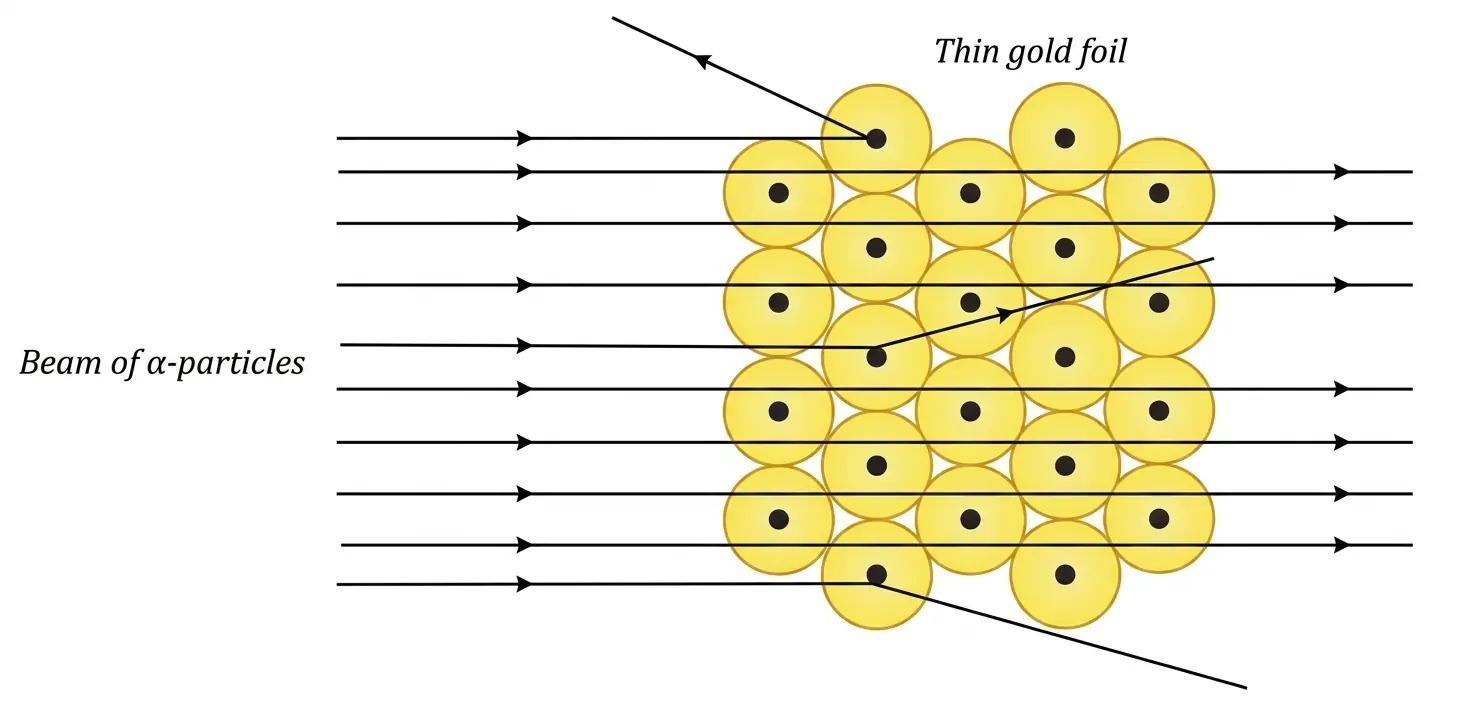
Solution
Step 1 · Recall the original (thin-foil) observations
- More than 99 % of the $$\alpha$$-particles passed straight through the foil without any deviation.
- About 1 in 10 000 was scattered through an angle >$$90^{\circ}$$ (large-angle scattering).
- About 1 in 20 000 was reflected almost backwards (rebound).
This proved that (i) most of the atom is empty space and (ii) every atom contains a very small, massive, positively charged nucleus.
Step 2 · What changes when the foil is made thicker?
Let the original foil have thickness $$t$$ and contain $$n$$ atomic layers. If the same metal is beaten to a thickness of, say, $$2t$$ the number of atomic layers becomes $$2n$$. Hence an incoming $$\alpha$$-particle now meets roughly twice as many gold atoms on its way through the foil.
Therefore the probability $$P$$ that an $$\alpha$$-particle will pass close to at least one nucleus is roughly proportional to the number of layers:
$$P \;\propto\; \text{number of layers}\;\propto\; \text{foil thickness}.$$
Step 3 · Predicted observations for a thicker foil
- Fewer straight-through tracks
Because more particles now experience at least one strong nuclear repulsion, the fraction that goes undeviated (<$$1^{\circ}$$) will decrease from the original >99 %. - More small- and medium-angle deflections
Paths bent by a few degrees to, say, $$30^{\circ}$$ will become noticeably more frequent. - More large-angle (>$$90^{\circ}$$) scattering and rebounds
Instead of 1 in 10 000 or 20 000, several in every 10 000 particles may now be observed returning towards the source. - Possible complete absorption
After suffering many successive small deflections an $$\alpha$$-particle may lose all its kinetic energy inside the thick foil and fail to emerge at all; a few will therefore be stopped in the metal.
Step 4 Reasoning linked to the nuclear model
The nucleus still occupies an extremely small part of each atom, so the chance per layer of a head-on collision remains tiny. Making the foil thicker merely multiplies that tiny chance by the larger number of layers, hence the changes listed above. The basic conclusion of Rutherford’s experiment — a small, dense, positively charged nucleus — remains valid.
Step 5 Suggested diagram to draw
- Draw a wide grey bar (to represent the thicker gold foil) instead of a thin line.
- Mark a beam of $$\alpha$$-particles entering from the left.
- Inside the bar show several circles labelled “nucleus”.
- Draw many curved arrows:
- A few arrows going straight through but now fewer in number.
- More arrows emerging at small and medium angles.
- Several arrows turning back towards the source to indicate rebounds.
- Optionally, one or two arrows ending inside the bar to show absorbed $$\alpha$$-particles.
- Label the percentages qualitatively, e.g. “straight <99 %”, “deflected more”, “rebound larger fraction”.
This single sketch contrasts clearly with the textbook’s thin-foil diagram, highlighting every new feature expected when the foil is thicker.
Answer
With a thicker gold foil the path of every $$\alpha$$-particle crosses more atomic layers, so:
- the fraction that emerges undeviated (straight through) becomes much smaller than 99 %;
- many more particles are scattered through small and medium angles;
- large-angle scattering and backward rebounds become several times more frequent;
- a few $$\alpha$$-particles may be stopped entirely inside the foil.
(Draw a wider foil slab showing fewer straight arrows, more bent arrows, several reflected arrows, and one or two arrows ending inside the slab.)
4 What do you think would happen if $$\alpha$$-particles were replaced with negatively charged particles in Rutherford's gold foil experiment?
Solution
Step 1 · Why Rutherford chose $$\alpha$$-particles
- Charge: each $$\alpha$$-particle carries two positive charges $$\left(+2e\right)$$.
- Mass: $$4\,\mathrm{u}$$, nearly 8000 times the mass of an electron, so their path is almost a straight line unless a very strong force acts on them.
- Speed: about $$10^{7}\,\mathrm{m\,s^{-1}}$$, therefore they can cross a thin metal foil without being absorbed.
Because of these three properties the only sizeable electric force they feel inside an atom is the repulsive force of the tiny positive nucleus, which makes the pattern of deflections easy to interpret.
Step 2 · Force on a negatively charged particle inside the atom
The electrostatic force between two charges is
\[F = \dfrac{1}{4\pi\varepsilon_0}\,\dfrac{q_1 q_2}{r^2}\quad(1)\]For an $$\alpha$$-particle, $$q_1 = +2e$$ and for the gold nucleus, $$q_2 = +79e$$ so $$q_1q_2 > 0$$ and the force is repulsive.
Let the incident particle be an electron. Now $$q_1 = -e$$ while $$q_2 = +79e$$, so $$q_1q_2 < 0$$ and the force given by (1) is attractive. Thus electrons would be pulled towards the nucleus rather than pushed away from it.
Step 3 · Consequences of attraction combined with very small mass
- Curved paths instead of slight deflections
Because the electron is 1836 times lighter than a proton, its momentum $$p = mv$$ is tiny. Even a moderate electric force bends it strongly, so its trajectory inside the atom would be a tight curve or even a spiral toward the nucleus rather than a gentle bend. - Very short range in matter
Before the electron ever feels the nuclear attraction it keeps colliding with the atomic electrons of the gold foil. In every collision it loses energy because its mass is comparable with that of the target electrons. After a few such collisions it would be stopped inside the foil and never reach the fluorescent screen. - No back-scattering
The spectacular $$1\text{ in }20\,000$$ “bounce-back” events seen with $$\alpha$$-particles were due to head-on repulsion from the massive positive nucleus. A negative particle would be pulled toward the nucleus, so there could be no rebound through angles close to $$180^{\circ}$$.
Step 4 · What the experimentalist would actually observe
- The zinc-sulphide screen would show very few scintillations because most electrons never emerge from the foil.
- The few that do emerge would be scattered through many small angles, producing a washed-out halo rather than the clear pattern Rutherford saw.
- Without any large-angle or back-scattered events the conclusion that ‘almost the whole mass and positive charge of the atom is concentrated in a very small nucleus’ could not be drawn.
Step 5 · Final inference
Replacing positively charged, heavy $$\alpha$$-particles with light, negatively charged particles would therefore destroy the very features that made Rutherford’s experiment decisive. Almost all of the incoming particles would be absorbed or only weakly scattered, and the presence of a small, massive, positively charged nucleus would remain hidden.
Answer
With light, negatively charged particles (for example electrons) instead of heavy, positively charged $$\alpha$$-particles, three things would happen: (i) the particles would be attracted toward the gold nuclei, so no large-angle or backward repulsion would be seen; (ii) because the particles are very light, repeated collisions with the foil’s own electrons would stop most of them inside the foil; (iii) the fluorescent screen would therefore record almost no scintillations and no sharp pattern of deflections. In short, Rutherford would not have observed the distinctive scattering that led him to postulate a small, dense, positively charged nucleus.
5 Rutherford found that a few $$\alpha$$-particles bounced back sharply. How does this single surprising result completely rule out Thomson's 'plum pudding model' of the atom?
Solution
Step 1 ‒ Recall the two rival pictures of the atom
- Thomson’s “plum-pudding” model (1904) – the whole atom (radius $$R\approx10^{-10}\,\mathrm m$$) is a soft, positively charged sphere; the much lighter electrons are embedded in it like raisins in a pudding. The positive charge as well as almost the whole mass are uniformly spread out.
- Rutherford’s nuclear model (1911) – the positive charge $$+Ze$$ and practically the entire mass are packed into a tiny central nucleus of radius $$r_n\approx10^{-14}\,\mathrm m$$. Electrons move around this nucleus; most of the atom is empty space.
Step 2 ‒ What the gold-foil experiment actually saw
- Millions of fast $$\alpha$$-particles (charge $$q_\alpha=+2e$$) were aimed at a very thin gold foil.
- More than $$99\%$$ went straight through with no deflection.
- About $$1$$ in $$2\times10^{4}$$ bounced back through an angle greater than $$90^{\circ}$$ – some even retraced their path (≈ $$180^{\circ}$$).
Step 3 ‒ Could Thomson’s model deflect an $$\alpha$$ so strongly?
The only force that can turn an $$\alpha$$-particle is the electrostatic (Coulomb) force:
$$F = \dfrac{1}{4\pi\varepsilon_0}\dfrac{q_\alpha\,q_\text{gold}}{r^2}$$
In Thomson’s picture the gold atom is a uniform positive sphere. Inside such a sphere the electric field is (result from class IX physics):
$$E(r)=\dfrac{1}{4\pi\varepsilon_0}\,\dfrac{Z e\,r}{R^3}\quad(0\le r\le R).$$
The field – and hence the force $$F=q_\alpha E$$ – rises gradually and is zero at the centre. The largest force it can ever exert is at the surface:
$$F_{\max}=\dfrac{1}{4\pi\varepsilon_0}\dfrac{2e\,Z e}{R^2}.$$ Because $$R\approx10^{-10}\,\mathrm m$$, this force acts only for about that same distance. A short calculation (left to students) shows that such a gentle push can change the path of a multi-MeV $$\alpha$$ by at most a few degrees – never by $$90^{\circ}$$ or more. Therefore Thomson’s atom predicts no large-angle scattering.
Step 4 ‒ How a tiny nucleus makes bouncing back possible
Suppose instead all the charge $$+Ze$$ sits inside a nucleus of radius $$r_n\approx10^{-14}\,\mathrm m$$. Then, at a closest approach $$r\approx r_n$$, the Coulomb force is
$$F_{\text{nucleus}}=\dfrac{1}{4\pi\varepsilon_0}\dfrac{2e\,Ze}{r_n^2}.$$
Compare the two forces:
$$\dfrac{F_{\text{nucleus}}}{F_{\max}}=\left(\dfrac{R}{r_n}\right)^2\approx\left(\dfrac{10^{-10}}{10^{-14}}\right)^2=10^{8}.$$
The nuclear force is about $$10^8$$ times stronger – easily enough to reverse an $$\alpha$$-particle’s motion over the tiny distance $$r_n$$, giving the observed backward scattering.
Step 5 ‒ The single “bounce-back” observation kills the plum pudding
- If even a few $$\alpha$$-particles come straight back, there must be something very small, very massive, and very positively charged inside the atom.
- The plum-pudding model has none of these features; its gentle, diffuse positive charge can never supply the required impulsive force.
Hence the moment Rutherford saw large-angle (≈ $$180^{\circ}$$) scattering, Thomson’s model was decisively ruled out and the nuclear model became necessary.
Answer
The huge backward deflections prove that the atom’s positive charge is cramped into a minute, massive nucleus; a uniformly spread “pudding” could never exert a strong enough Coulomb push. Therefore a single bounced-back $$\alpha$$-particle is sufficient to reject Thomson’s plum-pudding model completely.
6 If you could ask Rutherford one question about his work, what would it be?
Solution
Understanding what the question is really asking
The textbook invites you to imagine a personal conversation with Ernest Rutherford. Rather than merely writing any random query, you should formulate a thoughtful scientific question that reveals (i) your grasp of the alpha–particle–scattering experiment, and (ii) an awareness of the problems that still remained unsolved immediately after Rutherford announced his nuclear model (1911).
Step 1: Recap Rutherford’s main experimental facts
- He bombarded an ultra-thin gold foil (≈ $$10^{-7}\,\text{m}$$ thick) with $$\alpha$$-particles coming from $$\mathrm{^{214}Po}$$.
- Most $$\alpha$$-particles passed straight through $$\Rightarrow$$ the atom is mainly empty space.
- About 1 in $$10^{20}$$ (roughly) were deflected by angles $$\ge 90^{\circ}$$ $$\Rightarrow$$ the entire positive charge and almost the whole mass are packed in a tiny central region he called the nucleus, whose radius he estimated to be $$\approx 10^{-14}\,\text{m}$$, while the atomic radius is $$\approx 10^{-10}\,\text{m}$$.
Step 2: Identify the puzzles that Rutherford’s model left open
- Stability of the nucleus: Positive protons should repel one another by Coulomb’s law: $$F_{\mathrm{electrostatic}} = k\,\dfrac{q_1q_2}{r^2}$$. Why, then, does a nucleus not fly apart?
- Stability of the atom itself: According to classical electrodynamics, an electron moving in a circular orbit should constantly radiate energy and spiral into the nucleus in about $$10^{-8}\,\text{s}$$.
- Atomic spectra: Rutherford’s model could not explain the discrete line spectra of hydrogen and other elements.
Step 3: Choose the most penetrating question
Among the above, point 1 (intra-nuclear stability) addresses brand-new physics that would not be answered until the 1930s with the discovery of the neutron and the idea of the strong nuclear force. Hence asking Rutherford about this aspect would both acknowledge his achievement and probe the deepest mystery still open in 1911.
Step 4: Formulate the question clearly
Remember that Rutherford thought in terms of protons only (the neutron was unknown). The question should therefore focus on how the repulsive electrostatic force could possibly be overcome within $$\approx10^{-14}\,\text{m}$$.
Proposed question to Rutherford
“Sir Ernest, once your scattering data had convinced you that almost the whole mass and the entire positive charge of the atom are squeezed into a nucleus only about $$10^{-14}\,\mathrm{m}$$ wide, what mechanism do you envisage that keeps so many like-charged protons packed together without the nucleus flying apart?”
Why this is a good question
- It shows you understand the experimental basis: the astonishingly small nuclear radius derived from scattering angles.
- It pinpoints a genuine gap in 1911 physics.
- It paves the way to later discoveries (neutron, strong nuclear force).
Note for students: Any thoughtful question that singles out an unsolved issue—electron collapse, spectral lines, source of $ $$(+)$ $ charge—would also be acceptable. The key is to connect the question to Rutherford’s own findings, not to something unrelated.
Answer
“Sir Ernest, after discovering that an atom’s positive charge and almost all of its mass are crammed into a nucleus barely $$10^{-14}\,\text{m}$$ across, how do you think so many positively charged protons manage to stay bound together instead of repelling one another and blowing the nucleus apart?”
7 Assertion (A): Rutherford concluded that most of the mass of an atom is concentrated in a small region at the centre called the nucleus.
Reason (R): According to Thomson's model, electrons are embedded in a uniformly distributed positive charge sphere.
Choose the correct option:
(i) Both A and R are true, and R is the correct explanation of A.
(ii) Both A and R are true, but R is not the correct explanation of A.
(iii) A is true, but R is false.
(iv) A is false, but R is true.
Solution
Step 1 – Check the truth of the Assertion (A)
Rutherford performed the gold-foil α-particle scattering experiment and noted three observations: (a) about 99 % of the α-particles passed straight through the foil, (b) a small fraction were deflected through measurable angles, and (c) an extremely small number (roughly 1 in 20 000) were back-scattered, i.e. they rebounded almost straight back along the incoming direction. The only way to account for such sharp, large-angle deflections is to assume that almost all the positive charge and almost the entire mass of an atom are packed into an extremely small, dense central core. Rutherford named this core the nucleus. Hence the Assertion is true.
Step 2 – Check the truth of the Reason (R)
According to J. J. Thomson's 1904 plum-pudding (or water-melon) model, an atom is imagined as a positively charged, uniformly spread sphere in which the negatively charged electrons are embedded like raisins or seeds. This is exactly what the Reason states, so R is also true.
Step 3 – Does R explain A?
The idea of a nucleus came from Rutherford's experimental observations of large-angle α-particle scattering. It has no logical connection with Thomson's embedded-electron picture; in fact, Thomson's model would have predicted no large-angle scattering at all. Even though both sentences are factually correct, the statement in R is not the cause or logical explanation for Rutherford's conclusion in A.
Step 4 – Choose the correct option
Both A and R are true, but R is not the correct explanation of A. Hence option (ii) is correct.
Answer
(ii) Both A and R are true, but R is not the correct explanation of A.
8 Imagine you are a scientist who has discovered a new element. Name this element after yourself and justify that the symbol you have chosen follows the IUPAC rules.
Solution
Step 1 – Choosing an appropriate name
Suppose my name as the discoverer is Dr. Chat GPT. To honour this discovery I coin the element name
Chatgptium
The chosen ending “-ium” is the standard suffix recommended by IUPAC for newly discovered metallic elements (just as in curium, einsteinium, etc.).
Step 2 – Proposing its chemical symbol
I suggest the two-letter symbol
$$\mathrm{Ch}$$
Step 3 – Verifying the symbol against each IUPAC rule
| IUPAC rule for symbols | Explanation | How $$\mathrm{Ch}$$ satisfies it |
|---|---|---|
| 1. A symbol contains one or two letters only. | Ensures ease of writing and uniqueness. | Exactly two letters are used. |
| 2. The first letter is always a capital letter. | Distinguishes symbols from ordinary words. | The first letter is C. |
| 3. If there is a second letter, it must be written in lower-case. | Prevents confusion with two separate symbols. | The second letter is lower-case h. |
| 4. The symbol is derived from the element’s English or Latin name. | Keeps a logical connection between name and symbol. | Both letters are the first two of Chatgptium. |
| 5. A symbol already in use for another element may not be reused. | Guarantees each element a unique symbol. | No existing element has the symbol $$\mathrm{Ch}$$ (e.g. $$\mathrm{C}$$ is carbon; $$\mathrm{Cl}$$ is chlorine). |
Step 4 – Conclusion
Because the proposed symbol $$\mathrm{Ch}$$ observes every IUPAC convention enumerated above, it is a valid and acceptable chemical symbol for my newly discovered element Chatgptium.
Answer
The new element is named Chatgptium and its symbol is $$\mathrm{Ch}$$, which fulfils all IUPAC rules for element symbols.
9 What problems could arise if every scientist used different symbols for the same element?
Solution
Step 1 — Recall the purpose of a symbol
A chemical symbol is a universally accepted shorthand for the name of an element. For example, the symbol $$\mathrm{O}$$ represents the element oxygen everywhere in the world. By convention, the symbol contains either one capital letter (e.g. $$\mathrm{H}$$ for hydrogen) or a capital letter followed by a small letter (e.g. $$\mathrm{Na}$$ for sodium).
Step 2 — Imagine each scientist inventing a personal symbol
Suppose:
- Scientist A writes copper as $$\mathrm{C}$$,
- Scientist B writes the same element as $$\mathrm{Cp}$$,
- Scientist C stays with the IUPAC symbol $$\mathrm{Cu}$$.
Now look at the simple reaction in universal notation
$$\mathrm{Cu} + 2\,\mathrm{AgNO_3} \;\longrightarrow\; 2\,\mathrm{Ag} + \mathrm{Cu(NO_3)_2}$$
If the three scientists publish their own versions, we might see:
- Scientist A: $$\mathrm{C} + 2\,\mathrm{AgNO_3} \to \ldots$$
- Scientist B: $$\mathrm{Cp} + 2\,\mathrm{AgNO_3} \to \ldots$$
Readers could easily mistake $$\mathrm{C}$$ for carbon or wonder whether $$\mathrm{Cp}$$ is a new, undiscovered element. The same reaction would appear to involve different substances.
Step 3 — List the concrete problems that follow
- Communication breakdown Journal articles, textbooks and data tables would all use dissimilar symbols, forcing every reader to learn dozens of private codes before understanding any chemical statement.
- Calculation errors While balancing equations or computing molar masses, a student might treat $$\mathrm{C}$$ as carbon (molar mass $$12\,\mathrm{g\,mol^{-1}}$$) instead of copper ($$63.5\,\mathrm{g\,mol^{-1}}$$), giving completely wrong numerical results.
- Safety hazards Misidentifying chemicals in the laboratory can lead to dangerous reactions. For instance, mistaking $$\mathrm{Na}$$ (sodium) for $$\mathrm{N}$$ (nitrogen) when reading a procedure could cause an explosion on contact with water.
- Trade and industry confusion Chemical names and formulae appear on container labels, import–export documents and safety data sheets. Non-standard symbols would make international trade unreliable and legally complicated.
- Loss of cumulative knowledge Databases such as the periodic table, thermodynamic tables and spectral libraries rely on unique symbols. Multiplying symbols would fragment information and slow scientific progress.
Step 4 — State the conclusion
Therefore, using different symbols for the same element would introduce ambiguity, errors and safety risks, defeating the very purpose of chemical symbolism. A single, standard set of symbols—adopted worldwide—prevents these problems.
Answer
If scientists did not use the same, standard symbol for each element, every chemical equation, data table and safety label would become ambiguous. Communication would break down, calculations could be wrong, experiments could turn dangerous and industrial trade would be confused. Hence a uniform set of symbols is essential.
10 An atom with an atomic number of 26 has 56 nucleons. Find out its number of electrons, protons and neutrons.
Solution
Given data
- Atomic (proton) number: $$Z = 26$$
- Total number of nucleons (mass number): $$A = 56$$
We must deduce three quantities for a neutral atom:
- Number of protons
- Number of electrons
- Number of neutrons
1. Protons
The atomic number $$Z$$ is by definition the number of protons present in the nucleus.
Therefore
\[\text{Number of protons} = Z = 26\]
2. Electrons
For an electrically neutral atom, the positive charge of the protons must be exactly balanced by an equal number of negatively charged electrons. Hence
$$\text{Number of electrons} = \text{Number of protons} = 26$$
3. Neutrons
The mass number $$A$$ is the total count of nucleons (protons + neutrons). Thus
$$A = \text{protons} + \text{neutrons}$$
Substituting the known values:
$$56 = 26 + \text{neutrons}$$
Re-arranging gives
$$\text{neutrons} = 56 - 26 = 30$$
Final counts
\[\boxed{\text{Protons} = 26,\; \text{Electrons} = 26,\; \text{Neutrons} = 30}\]
Answer
Protons = 26 Electrons = 26 Neutrons = 30
11 The nucleus of an atom contains 20 protons. If its mass number is 41, find the number of neutrons in it.
Solution
Step 1 — Recall the definitions
- The atomic number is the number of protons in the nucleus. We denote it by $$Z$$.
- The mass number is the total number of nucleons (protons + neutrons). We denote it by $$A$$ and write $$A = Z + N$$, where $$N$$ is the number of neutrons.
Step 2 — Write down the known data
- Protons in the nucleus: $$20$$. Hence $$Z = 20$$.
- Mass number: $$A = 41$$.
Step 3 — Use the relation between A, Z and N
From the definition, $$A = Z + N$$. Rearranging for neutrons $$N$$ gives
$$N = A - Z$$
Step 4 — Substitute the numerical values
$$N = 41 - 20$$
$$N = 21$$
Conclusion
The nucleus contains $$21$$ neutrons.
Answer
Number of neutrons = 21
12 An atom has 18 neutrons and an atomic number of 17. What is its mass number?
Solution
Given data
- Number of neutrons in the atom, nn = 18
- Atomic number (proton number) of the element, $$Z = 17$$
Step 1 : Recall the definition of mass number
The mass number $$A$$ of an atom is the total number of heavy nuclear particles, i.e. the sum of its protons and neutrons:
$$A = \text{number of protons} + \text{number of neutrons}$$
Step 2 : Identify the required quantities
The atomic number $$Z$$ gives the number of protons. Hence:
Number of protons = $$Z = 17$$
Number of neutrons = 18 (already given).
Step 3 : Substitute and calculate
Plug the values into the formula for $$A$$:
$$A = 17 + 18$$
$$A = 35$$
Result
The mass number of the atom is therefore
\[A = 35\]
Answer
Mass number $$= 35$$
13 An atom $$^{23}\mathrm{A}$$ has 11 electrons. Find the number of neutrons in it.
Solution
The nuclear symbol $$^{23}\mathrm{A}$$ tells us two separate facts:
- The superscript 23 is the mass number: $$A = 23$$.
- The chemical symbol’s (missing) subscript is the atomic number $$Z$$, which equals the number of protons and, in a neutral atom, also equals the number of electrons.
Because the atom is neutral and has 11 electrons,
$$Z = 11$$
The number of neutrons $$N$$ in any nuclide is obtained from
$$N = A - Z$$
Substituting the known values,
$$N = 23 - 11$$
\[N = 12\]
Hence, the atom contains 12 neutrons.
Answer
Number of neutrons = 12
14 Identify the number of electrons in the outermost shell of the following elements:
(i) $$^{12}_{6}\mathrm{C}$$
Solution
The nuclide is written as $$^{12}_{6}\mathrm{C}$$.
- The sub-script (atomic number) $$Z = 6$$ gives the number of protons.
- Because the atom is electrically neutral, the number of electrons is also $$6$$.
We now distribute these $$6$$ electrons into shells using the $$2n^{2}$$ capacity rule:
| Shell (n) | Maximum electrons $$2n^{2}$$ | Electrons filled |
|---|---|---|
| K (n = 1) | $$2$$ | First $$2$$ electrons |
| L (n = 2) | $$8$$ | Remaining $$6-2 = 4$$ electrons |
Electronic configuration: $$2,\;4$$.
Hence the outermost (L) shell contains 4 electrons.
Answer
4
(ii) $$^{19}_{9}\mathrm{F}$$
Solution
The nuclide is $$^{19}_{9}\mathrm{F}$$.
- Atomic number $$Z = 9$$ ⇒ $$9$$ protons and $$9$$ electrons.
Fill the electrons:
| Shell | Capacity | Electrons filled |
|---|---|---|
| K | $$2$$ | $$2$$ |
| L | $$8$$ | $$9-2 = 7$$ |
Electronic configuration: $$2,\;7$$.
The outermost (L) shell therefore has 7 electrons.
Answer
7
(iii) $$^{28}_{14}\mathrm{Si}$$
Solution
The nuclide is $$^{28}_{14}\mathrm{Si}$$.
- Atomic number $$Z = 14$$ ⇒ $$14$$ electrons.
Step-wise filling:
| Shell | Capacity | Electrons filled | Electrons remaining |
|---|---|---|---|
| K | $$2$$ | $$2$$ | $$14-2 = 12$$ |
| L | $$8$$ | $$8$$ | $$12-8 = 4$$ |
| M | $$18$$ (but only 4 needed) | $$4$$ | 0 |
Electronic configuration: $$2,\;8,\;4$$.
The outermost (M) shell holds 4 electrons.
Answer
4
15 Write the electronic configuration of the elements having atomic numbers 12, 16 and 18.
Solution
Concept recalled – 2n2 rule
For the n-th shell the maximum electrons it can hold is $$2n^{2}$$. Therefore
- K–shell (n=1): $$2\times 1^{2}=2$$ electrons
- L–shell (n=2): $$2\times 2^{2}=8$$ electrons
- M–shell (n=3): $$2\times 3^{2}=18$$ electrons
We successively fill the shells from the nucleus outward until the atomic number Z is reached.
(i) Z = 12
- K–shell gets its maximum 2 electrons ⇒ still $$12-2 = 10$$ left.
- L–shell now takes its maximum 8 electrons ⇒ still $$10-8 = 2$$ left.
- M–shell takes the remaining 2.
Shell notation : 2, 8, 2
Sub-shell (orbital) notation : $$1\mathrm{s}^{2}\;2\mathrm{s}^{2}\;2\mathrm{p}^{6}\;3\mathrm{s}^{2}$$
(ii) Z = 16
- K–shell → 2 electrons ⇒ $$16-2 = 14$$ left.
- L–shell → 8 electrons ⇒ $$14-8 = 6$$ left.
- M–shell → 6 electrons.
Shell notation : 2, 8, 6
Sub-shell notation : $$1\mathrm{s}^{2}\;2\mathrm{s}^{2}\;2\mathrm{p}^{6}\;3\mathrm{s}^{2}\;3\mathrm{p}^{4}$$
(iii) Z = 18
- K–shell → 2 electrons ⇒ $$18-2 = 16$$ left.
- L–shell → 8 electrons ⇒ $$16-8 = 8$$ left.
- M–shell → 8 electrons.
Shell notation : 2, 8, 8
Sub-shell notation : $$1\mathrm{s}^{2}\;2\mathrm{s}^{2}\;2\mathrm{p}^{6}\;3\mathrm{s}^{2}\;3\mathrm{p}^{6}$$
Answer
(i) Z = 12 (Mg) : 2, 8, 2
(ii) Z = 16 (S) : 2, 8, 6
(iii) Z = 18 (Ar) : 2, 8, 8
16 Solve this riddle: I am an atom with a mass number of 23 and 11 protons. I am a soft metal and react vigorously with water. Who am I and how many neutrons do I have? You can also create one such riddle.
Solution
Step 1 — Identify the given data
- Mass (nucleon) number, $$A = 23$$
- Number of protons (atomic number), $$Z = 11$$
Step 2 — Recall the key relations
- The atomic number $$Z$$ equals the number of protons.
- The mass number $$A$$ equals the total number of nucleons: $$A = \text{protons} + \text{neutrons}$$.
- Therefore, $$\text{neutrons} = A - Z$$.
Step 3 — Find the neutron number
Substitute the given values:
$$\text{neutrons} = A - Z = 23 - 11 = 12$$
Hence, the atom contains 12 neutrons.
Step 4 — Identify the element
An atom with $$Z = 11$$ is sodium, symbol $$\mathrm{Na}$$. Sodium is well known to be
- a soft, silvery metal, and
- reacts vigorously with water to give $$\mathrm{NaOH}$$ and $$\mathrm{H_2}$$ gas.
Therefore, the riddle describes the sodium atom $$\prescript{23}{11}\mathrm{Na}$$, which has 11 protons and 12 neutrons.
Step 5 — A new riddle for practice
"I am an atom whose mass number is 19 and I have 9 protons. I am a pale-yellow gas that is added to toothpaste to prevent cavities. Who am I and how many neutrons do I have?"
Answer to the new riddle (for the teacher): The element is fluorine $$\prescript{19}{9}\mathrm{F}$$, and it contains $$19 - 9 = 10$$ neutrons.
Answer
The riddle’s atom is sodium, $$\prescript{23}{11}\mathrm{Na}$$, and it possesses 12 neutrons.
17 Two different atoms have 11 protons each, but one has 12 neutrons, and the other has 13 neutrons. How do their atomic numbers and mass numbers compare? Are they the same element or different elements?
Solution
Step 1 : Recall the definitions
- Atomic number, written $$Z$$, equals the number of protons present in the nucleus: \[Z = \text{number of protons}\]
- Mass number, written $$A$$, equals the sum of protons and neutrons: \[A = \text{protons} + \text{neutrons}\]
Step 2 : Write the given nuclear information
| Protons | Neutrons | |
|---|---|---|
| Atom I | 11 | 12 |
| Atom II | 11 | 13 |
Step 3 : Calculate the atomic number for each atom
Because both atoms have 11 protons, for each one
$$Z = 11$$
Hence the atomic number is 11 for both atoms.
Step 4 : Calculate the mass number for each atom
- Atom I: $$A_1 = 11 + 12 = 23$$
- Atom II: $$A_2 = 11 + 13 = 24$$
Thus the mass numbers are different: one is 23 and the other is 24.
Step 5 : Decide whether they are the same element
Elements are identified by their atomic number $$Z$$. Since both atoms have $$Z = 11$$, they belong to the same element, namely sodium ($$\mathrm{Na}$$).
Atoms of the same element that differ only in their number of neutrons (and therefore in mass number) are called isotopes.
Conclusion
Both atoms are isotopes of sodium: one is $$\mathrm{^{23}_{11}Na}$$ and the other is $$\mathrm{^{24}_{11}Na}$$. Their atomic numbers are identical (11), but their mass numbers are 23 and 24, respectively.
Answer
Atomic number of both atoms = 11.
Mass numbers = 23 and 24, respectively.
Because they share the same atomic number, they are isotopes of the same element (sodium), not different elements.
18 If a bromine atom is available in the form of, say two isotopes, $$^{79}_{35}\mathrm{Br}$$ (49.7%) and $$^{81}_{35}\mathrm{Br}$$ (50.3%), calculate the average atomic mass of the bromine atom.
Solution
Step 1 – Recall the formula for average (relative) atomic mass
If an element exists as two or more isotopes, the average atomic mass (in atomic mass units, u) is the weighted mean of the isotopic masses, each multiplied by its percentage abundance and then divided by 100 %. Symbolically, for two isotopes 1 and 2:
$$\text{Average atomic mass}=\dfrac{\left(m_1\times\%_1\right)+\left(m_2\times\%_2\right)}{100}$$
where
- $$m_1,m_2$$ are the mass numbers of the two isotopes, and
- $$\%_1,\%_2$$ are their percentage abundances.
Step 2 – Insert the data for bromine
For bromine we have:
- Isotope 1: $$^{79}_{35}\mathrm{Br}$$ – mass number $$m_1=79$$, abundance $$\%_1=49.7\%$$
- Isotope 2: $$^{81}_{35}\mathrm{Br}$$ – mass number $$m_2=81$$, abundance $$\%_2=50.3\%$$
Substituting these values into the formula gives
$$\text{Average atomic mass}=\dfrac{\left(79\times49.7\right)+\left(81\times50.3\right)}{100}$$
Step 3 – Perform the multiplications
Compute each product separately:
$$79\times49.7 = 3926.3$$
$$81\times50.3 = 4074.3$$
Step 4 – Add the two products
$$3926.3 + 4074.3 = 8000.6$$
Step 5 – Divide by 100 % to get the mean
$$\text{Average atomic mass}=\dfrac{8000.6}{100}=80.006$$
Step 6 – Round off to an appropriate number of significant figures
To match the precision of the data (three significant figures), we round to $$80.0$$.
\[\boxed{\text{Average atomic mass of bromine}\;\approx\;80.0\,\mathrm{u}}\]
Answer
Average atomic mass of bromine ≈ $$80.0\,\mathrm{u}$$.
Revise, Reflect, Refine
1 Choose the correct options and explain the reason for the correct and incorrect options in the context of Ernest Rutherford's gold foil experiment:
(i) The experiment clearly showed the existence of neutrons in the nucleus.
Solution
Rutherford’s apparatus bombarded a very thin gold foil with $$\alpha$$-particles (helium nuclei carrying a $$+2$$ charge). The path of an $$\alpha$$-particle is influenced only by electric forces. Because a neutron has no electric charge it could not affect the trajectory, so no information about neutrons can come from the scattering pattern.
Historically as well, the neutron was discovered later by James Chadwick in 1932, whereas the gold-foil experiment was performed in 1909. Hence the experiment did not “show the existence of neutrons”.
Therefore statement (i) is incorrect.
Answer
Incorrect
(ii) The results disproved the plum pudding model and led to the idea of a nucleus at the centre of the atom.
Solution
The statement makes two claims about Rutherford's gold-foil experiment:
- It disproved the plum-pudding model.
- It led to the idea of a nucleus at the centre of the atom.
We check each claim against what Rutherford actually saw.
1. What the plum-pudding model predicted. In J. J. Thomson's model, the atom is a sphere of uniformly spread positive charge with electrons embedded in it like raisins in a pudding. A diffuse, smeared-out positive charge can exert only weak, gentle forces on an incoming $$\alpha$$-particle (a $$+2e$$ helium nucleus). Therefore every $$\alpha$$-particle should pass through with at most a tiny deflection; none should ever bounce back.
2. What Rutherford actually observed.
- Almost all $$\alpha$$-particles passed straight through the foil — so the atom is mostly empty space.
- A small fraction were deflected through measurable angles.
- A very small fraction (about 1 in 20 000) were deflected through angles greater than $$90^{\circ}$$, and a few rebounded almost straight back.
3. Why this disproves the plum-pudding model (claim 1). The large-angle deflections and back-scattering are impossible if the positive charge is spread out as Thomson assumed — a diffuse charge cloud simply cannot supply the strong, concentrated repulsion needed to turn a fast $$\alpha$$-particle through more than $$90^{\circ}$$. So claim 1 is verified: the results do disprove the plum-pudding model.
4. Why it led to the nuclear picture (claim 2). The back-scattering can only happen if almost all the positive charge (and, since $$\alpha$$-particles are also massive, almost all of the atom's mass) is concentrated in an extremely small region. Rutherford named this tiny, dense, positive region the nucleus. So claim 2 is also verified.
Conclusion. Both claim 1 (disproof of the plum-pudding model) and claim 2 (introduction of a central nucleus) are supported by the experimental evidence. Hence the overall option (ii) is correct.
Answer
Correct. Both claims in option (ii) are supported by Rutherford's data: (1) the large-angle deflections and back-scattering of $$\alpha$$-particles cannot be explained by Thomson's uniformly spread positive charge, so the plum-pudding model is ruled out; (2) the same observations require that the positive charge and most of the atom's mass be packed into a tiny central region — the nucleus.
(iii) The large deflection of a few alpha particles indicated that most of the mass of the atom and positive charge are packed into a tiny centre.
Solution
The repulsive Coulomb force between an $$\alpha$$-particle and a concentrated positive charge $$+Ze$$ at a distance $$r$$ is
$$F=\dfrac{1}{4\pi\varepsilon_{0}}\dfrac{2Ze^{2}}{r^{2}}$$A turn through a large angle (even a rebound) requires a very strong, short-range force; that can happen only when the $$\alpha$$-particle comes extremely close to a massive, positively charged region. Because only a few $$\alpha$$-particles experienced such encounters, the region must occupy an exceedingly small part of the atom. Hence almost all the mass and the entire positive charge are packed into a minute central nucleus.
Therefore statement (iii) is correct.
Answer
Correct
(iv) The way alpha particles were deflected showed that electrons move around the nucleus.
Solution
The scattering showed that the atom is mostly empty space surrounding a tiny positive nucleus, yet every atom is electrically neutral. Consequently the negative charge (electrons) must be located outside the nucleus and must occupy that empty space. To account for stability—why electrons do not fall into the nucleus—Rutherford proposed that electrons remain in continuous motion around the nucleus.
Thus the pattern of deflections, together with the need for overall neutrality, led directly to the idea that electrons move around the nucleus. Statement (iv) is therefore correct.
Answer
Correct
2 Which of the following statements are correct or incorrect according to the Bohr's atomic model? Give a reason for each statement.
(i) Electrons lose energy while moving in fixed orbits and slowly fall into the nucleus.
Solution
Bohr’s second postulate states:
“While revolving in a permitted (stationary) orbit the electron does not radiate or absorb energy; its total energy remains constant.”
If the electron did radiate energy continuously, its kinetic energy would decrease and it would spiral into the nucleus – a situation Bohr introduced his postulates precisely to avoid. Hence the given statement contradicts the postulate.
Therefore the statement is incorrect.
Answer
Incorrect – in a stationary Bohr orbit the electron does not lose energy, so it cannot gradually fall into the nucleus.
(ii) Electrons can exist anywhere around the nucleus with no fixed energy.
Solution
According to Bohr’s first postulate, electrons are allowed to revolve only in certain fixed orbits (energy levels) denoted by the principal quantum number $$n = 1,2,3,\ldots$$.
The energy of an electron in the hydrogen atom, for example, is given by the discrete expression $$E_n = -\frac{13.6\,\text{eV}}{n^2}$$ which clearly shows that only particular energy values are permitted.
Because electrons are quantised, they cannot exist anywhere in the space surrounding the nucleus with arbitrary energy.
Hence the statement is incorrect.
Answer
Incorrect – Bohr’s model permits electrons only in definite orbits of fixed (quantised) energy, not anywhere with any energy.
(iii) Electrons revolve around the nucleus in orbits of fixed energy without losing energy.
Solution
This is a direct restatement of Bohr’s postulates:
- Electrons revolve round the nucleus in certain fixed circular paths, called energy levels or stationary orbits.
- While in a stationary orbit, the electron neither loses nor gains energy.
Consequently the statement perfectly matches the model and is therefore correct.
Answer
Correct – electrons move in fixed-energy (stationary) orbits without radiating energy.
(iv) Electrons can be found between energy levels as they move around the nucleus.
Solution
Bohr’s theory further says that an electron can change its energy only by jumping from one allowed orbit to another, absorbing or emitting a photon of energy $$E = h\nu$$ during the jump.
The transition is assumed to be instantaneous; no stable position exists between two energy levels. Thus the electron cannot be located in the space separating two stationary orbits.
Therefore the statement is incorrect.
Answer
Incorrect – electrons are never found between two stationary energy levels; they jump instantaneously from one allowed orbit to another.
3
| X | Y | Z | |
|---|---|---|---|
| Number of protons | 18 | 17 | 17 |
| Number of neutrons | 19 | 18 | 20 |
(i) Y and Z
Solution
Given data
| Y | Z | |
|---|---|---|
| Number of protons ($$Z$$) | 17 | 17 |
| Number of neutrons | 18 | 20 |
Step 1: Calculate the mass number $$A$$ of each species
For Y:
$$A_Y = Z + N = 17 + 18 = 35$$
For Z:
$$A_Z = Z + N = 17 + 20 = 37$$
Step 2: Recall the definition of isotopes
Isotopes are atoms of the same element that have the same atomic number $$Z$$ but different mass numbers $$A$$.
Step 3: Compare Y and Z
- Atomic number: $$Z_Y = Z_Z = 17$$ (same)
- Mass number: $$A_Y = 35 \neq A_Z = 37$$ (different)
Because they have identical atomic numbers but unequal mass numbers, Y and Z satisfy the definition of isotopes.
Answer
Y and Z are isotopes of chlorine.
(ii) Z and X
Solution
Given data
| Z | X | |
|---|---|---|
| Number of protons ($$Z$$) | 17 | 18 |
| Number of neutrons | 20 | 19 |
Step 1: Calculate the mass number $$A$$ of each species
For Z:
$$A_Z = Z + N = 17 + 20 = 37$$
For X:
$$A_X = Z + N = 18 + 19 = 37$$
Step 2: Recall the definition of isobars
Isobars are atoms that have the same mass number $$A$$ but different atomic numbers $$Z$$.
Step 3: Compare Z and X
- Mass number: $$A_Z = 37 = A_X$$ (same)
- Atomic number: $$Z_Z = 17 \neq Z_X = 18$$ (different)
Because Z and X possess the same mass number yet differ in atomic number, they are isobars.
Answer
Z and X are isobars.
4 What conclusion did Rutherford draw about the position and characteristics of the atom's positively charged part based on the few alpha particles that bounced back or were deflected at large angles in the gold foil experiment?
Solution
Step 1 — Rutherford’s key observation
- When a narrow beam of $$\alpha$$-particles (helium nuclei with charge $$+2e$$) was directed at an extremely thin gold foil, almost all particles passed straight through without any noticeable change in their paths.
- However, a very tiny fraction (about 1 in $$10\,000$$) either:
• bounced straight back (deflection $$\approx 180^{\circ}$$), or
• were scattered through very large angles (close to $$90^{\circ}$$).
Step 2 — What this tells us about the atom’s interior
- If the positive charge were spread uniformly throughout the atom (as the earlier “plum-pudding” model suggested), the repulsive electric field that an $$\alpha$$-particle felt while crossing the atom would be very weak and diffuse. Large-angle deflections would then be practically impossible.
- The fact that a few $$\alpha$$-particles were turned back implies they experienced an intense repulsive force in a very tiny region. From Coulomb’s law the electric force rises sharply when the distance $$r$$ from a positive charge becomes very small $$\bigl(F \propto 1/r^{2}\bigr)$$. Therefore the entire positive charge of the atom must be concentrated in a minuscule core rather than smeared out.
- Because only about $$0.01\%$$ of the incoming particles met this strong field, the high-charge region must occupy only about $$10^{-4}$$ (or even less) of the atom’s volume — i.e. its linear size is roughly $$10^{-2}$$ of the atomic radius.
Step 3 — Rutherford’s conclusion
- The atom contains a small, dense, positively charged centre.
- This centre — later named the nucleus — holds almost the entire mass of the atom.
- The nucleus is located at the geometric centre of the atom, while the electrons move in the relatively vast empty space surrounding it.
Thus, the rare but dramatic large-angle or back-scattering events in the gold-foil experiment led Rutherford to propose the nuclear model of the atom: a tiny central nucleus carrying all the positive charge and nearly all the mass, with the rest of the atom being mostly empty space filled by electrons.
Answer
Rutherford concluded that all the positive charge (and almost the whole mass) of the atom is concentrated in an extremely small, dense central core called the nucleus; because so few $$\alpha$$-particles were deflected through large angles, this nucleus must occupy only a minute fraction of the atom’s volume and is located at its centre.
5 Explain and arrange the following statements in the correct chronological order to show how atomic models have evolved over time.
(i) Bohr's model proposed that electrons move in fixed orbits around the nucleus, each with a definite energy.
(ii) Thomson's model depicted the atom as a 'plum pudding' with electrons embedded in a sphere of positive charge.
(iii) Rutherford's model proposed that atoms have a dense central nucleus.
(iv) Dalton's model described atoms as indivisible particles.
Solution
Step 1 — Understand each statement
- (iv) Dalton’s model: In his Atomic Theory (around 1808) John Dalton said that matter is made of tiny, hard, indivisible particles called atoms. At this stage there was no idea of sub-atomic particles, charge, or internal structure.
- (ii) Thomson’s model: After the discovery of the electron (1897), J. J. Thomson pictured the atom as a positively charged sphere with negatively charged electrons scattered inside it—known as the “plum-pudding” or “water-melon seed” model (≈ 1898–1904).
- (iii) Rutherford’s model: In 1911 Ernest Rutherford’s α-particle scattering experiment showed that almost all the mass and positive charge of an atom is concentrated in a very small, dense nucleus; electrons move in the empty space around it.
- (i) Bohr’s model: Niels Bohr (1913) kept Rutherford’s nuclear atom but added the idea that electrons revolve only in certain allowed circular orbits (called shells) without radiating energy. Each permitted orbit has a fixed energy, explaining the line spectra of elements.
Step 2 — Place them in historical order
The time-line of development is therefore:
- (iv) Dalton’s indivisible solid-sphere model (1808)
- (ii) Thomson’s plum-pudding model (≈ 1898–1904)
- (iii) Rutherford’s nuclear model (1911)
- (i) Bohr’s planetary, fixed-orbit model (1913)
Step 3 — Explain how each new model improved the previous one
- Dalton’s theory introduced atoms but could not account for sub-atomic particles or electrical properties.
- Thomson incorporated the newly discovered electron and explained overall electrical neutrality, but could not explain α-particle scattering.
- Rutherford’s model correctly localised positive charge and mass in a nucleus, explaining the scattering experiment, yet could not explain atomic stability or spectral lines (because moving electrons should radiate energy and spiral in).
- Bohr solved the stability and spectrum problem by quantising electron orbits, laying the foundation for modern quantum mechanics.
Hence, arranging the given statements chronologically gives the logical evolution of the atomic model from a solid, indivisible sphere to the quantised nuclear atom.
Answer
Chronological order : (iv) → (ii) → (iii) → (i)
6 Electrons move around the nucleus in orbits. Why do they not fly away from the atom? Explain what keeps them attracted to the nucleus.
Solution
Step 1 – Understand the basic charges inside an atom
- The nucleus is made up of protons (+ve charge) and neutrons (neutral).
- Each proton carries a positive charge $$+e = +1.6 \times 10^{-19}\,\text{C}$$.
- Each electron in the surrounding space carries an equal but opposite charge $$-e$$.
Step 2 – Recall the law of electrostatic attraction
According to Coulomb’s law, two point charges $$q_1$$ and $$q_2$$ separated by a distance $$r$$ exert equal and opposite forces on each other of magnitude
\[F = k\frac{|q_1 q_2|}{r^2}\]
where $$k = 9 \times 10^9\,\text{N m}^2\,\text{C}^{-2}$$ is the electrostatic constant.
Because the signs of $$q_1$$ and $$q_2$$ are opposite (+e on the proton and –e on the electron), the force is attractive.
Step 3 – Link the attraction to circular motion of an electron
- In the Bohr model an electron moves around the nucleus in a nearly circular orbit of radius $$r$$.
- For any body executing uniform circular motion, a centripetal force $$F_c$$ is required and is given by $$F_c = m_e\,\dfrac{v^2}{r}$$, where $$m_e$$ is the mass of the electron and $$v$$ its speed.
- Bohr postulated that the needed centripetal force is provided exactly by the electrostatic force:
\[k\frac{e^2}{r^2} = m_e\,\frac{v^2}{r}\;\;\Rightarrow\;\;F_{\text{electrostatic}} = F_{\text{centripetal}}\]
Thus the attractive electrostatic force keeps pulling the electron toward the nucleus and supplies the inward force required to bend its path into an orbit instead of letting it fly off in a straight line.
Step 4 – Energy viewpoint (why it remains bound)
- The electron–nucleus system possesses potential energy $$U = -k\dfrac{e^2}{r}$$ (negative sign shows attraction).
- The electron’s kinetic energy is $$K = \dfrac{1}{2}m_e v^2$$.
- For the allowed Bohr orbits, the total energy $$E = K + U$$ is negative, meaning the electron is in a bound state. An external supply of energy equal to $$|E|$$ would be needed to remove it from the atom.
Because the electron does not have that much spare energy by itself, and because the electrostatic attraction is continuously acting, it stays tied to the nucleus instead of escaping.
Conclusion
The negatively charged electrons remain in orbit because the attractive electrostatic (Coulomb) force between them and the positively charged nucleus provides the necessary centripetal force and keeps their total energy negative; hence they do not fly away from the atom.
Answer
An electron stays bound to the atom because the electrostatic attraction between the negatively charged electron and the positively charged nucleus supplies the required centripetal force, keeping its total energy negative; this prevents the electron from flying away.
7 Assertion (A): The discovery of subatomic particles helped in understanding the atomic structure.
Reason (R): The number of electrons is equal to the number of protons in an atom.
Choose the correct option:
(i) Both A and R are true, and R is the correct explanation of A.
(ii) Both A and R are true, but R is not the correct explanation of A.
(iii) A is true, but R is false.
(iv) A is false, but R is true.
Solution
Step 1 – Check the truth of the Assertion (A)
The discovery of sub-atomic particles—electrons by J. J. Thomson, protons by E. Goldstein/Rutherford, and neutrons by Chadwick—made it possible to build realistic atomic models (Thomson’s ‘plum-pudding’, Rutherford’s nuclear model, Bohr’s model, etc.). Hence the discovery did help scientists to understand how an atom is arranged.
Therefore, Assertion (A) is true.
Step 2 – Check the truth of the Reason (R)
Inside a neutral atom the negative charge carried by $$e^-$$ must cancel the positive charge carried by $$p^+$$, so
\[\text{Number of electrons} = \text{Number of protons}\]
Thus Reason (R) is also true.
Step 3 – Does R explain A?
The fact that the two numbers are equal only states the condition for electrical neutrality; it does not explain how the discovery of sub-atomic particles helped us understand atomic structure (which involves locating these particles and proposing models).
Hence R is not the correct explanatory reason for A.
Conclusion
Both A and R are true, but R is not the correct explanation of A. So option (ii) is correct.
Answer
(ii)
8 Magnesium is essential for many biological processes, including muscle contraction. For an atom of magnesium with a mass number of 24 and atomic number 12, determine the number of (i) protons, (ii) neutrons, (iii) electrons, and also illustrate the arrangement of electrons in a magnesium atom.
Solution
Given data
- Mass number (also called nucleon number) of magnesium: $$A = 24$$
- Atomic number (also called proton number) of magnesium: $$Z = 12$$
(i) Number of protons
The atomic number equals the number of protons present in the nucleus:
$$\text{No. of protons} = Z = 12$$
(ii) Number of neutrons
The nucleus contains protons and neutrons. Their total is the mass number:
$$A = Z + N$$ where $$N$$ is the number of neutrons.
Re-arrange for $$N$$:
$$N = A - Z$$
Substitute the given values:
$$N = 24 - 12 = 12$$
Hence a magnesium-24 nucleus has $$12$$ neutrons.
(iii) Number of electrons
A neutral atom has the same number of electrons as protons:
$$\text{No. of electrons} = 12$$
(iv) Arrangement of electrons (electronic configuration)
Electrons occupy successive energy shells (K, L, M, …). Each shell has a maximum capacity:
- K-shell: $$2$$ electrons
- L-shell: $$8$$ electrons
- M-shell: $$18$$ electrons (but we will need only $$2$$ here)
Total electrons to place: $$12$$.
- First fill the K-shell: $$2$$ electrons remaining $$12-2 = 10$$
- Next fill the L-shell up to its capacity $$8$$: remaining $$10-8 = 2$$
- Place the last $$2$$ electrons in the M-shell.
The electronic configuration is therefore written as
$$2,\;8,\;2$$
Illustration to draw: Show a central nucleus labelled “12 p, 12 n”. Around it draw three concentric circles. On the innermost circle mark 2 small dots (K-shell), on the second circle mark 8 dots (L-shell), and on the outermost circle mark 2 dots (M-shell).
Answer
Magnesium-24 atom:
- Protons = 12
- Neutrons = 12
- Electrons = 12
- Electronic configuration = $$2,8,2$$ (K 2, L 8, M 2)
9
(i) Name of the element
(ii) Symbol
(iii) Total number of electrons
(iv) Number of valence electrons
(v) Valency of the element
(vi) Number of protons
(vii) Atomic number
(Fig. 8.17 shows the schematic atomic structures of four elements labelled (a), (b), (c), and (d).)
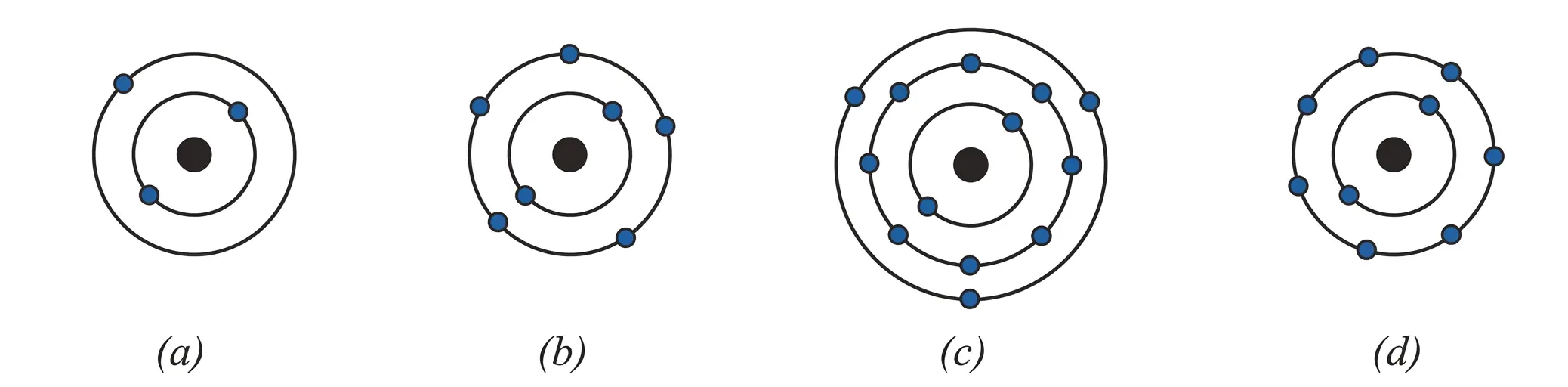
Solution
Given from Fig. 8.17 – Four schematic Bohr models are shown. Counting the dots (electrons) present in each shell we get:
| Model | K–shell (n = 1) | L–shell (n = 2) | M–shell (n = 3) | Total electrons |
|---|---|---|---|---|
| (a) | 2 | 7 | 0 | $$2 + 7 = 9$$ |
| (b) | 2 | 8 | 0 | $$2 + 8 = 10$$ |
| (c) | 2 | 8 | 1 | $$2 + 8 + 1 = 11$$ |
| (d) | 2 | 8 | 2 | $$2 + 8 + 2 = 12$$ |
For a neutral atom
$$\text{Atomic number }(Z) = \text{Number of protons} = \text{Number of electrons}$$
The valence electrons are the electrons present in the outer-most shell. The valency is obtained from the octet rule:
- If valence electrons ≤ 4, valency = number of valence electrons.
- If valence electrons > 4, valency = 8 − (valence electrons).
Using the Periodic Table to match each atomic number with its element, we obtain:
| Model | Element name | Symbol | Total electrons / protons | Valence electrons | Valency | Atomic number (Z) |
|---|---|---|---|---|---|---|
| (a) | Fluorine | F | 9 | 7 | $$8-7 = 1$$ | 9 |
| (b) | Neon | Ne | 10 | 8 | 0 (octet complete) | 10 |
| (c) | Sodium | Na | 11 | 1 | 1 | 11 |
| (d) | Magnesium | Mg | 12 | 2 | 2 | 12 |
Thus all the required quantities for the four elements have been determined directly from their Bohr diagrams.
Answer
(a) Fluorine (F): 9 e⁻, 7 valence e⁻, valency 1, 9 protons, Z = 9
(b) Neon (Ne): 10 e⁻, 8 valence e⁻, valency 0, 10 protons, Z = 10
(c) Sodium (Na): 11 e⁻, 1 valence e⁻, valency 1, 11 protons, Z = 11
(d) Magnesium (Mg): 12 e⁻, 2 valence e⁻, valency 2, 12 protons, Z = 12
10 Both Rutherford's and Bohr's models have electrons orbiting the nucleus. Why did Rutherford's model fail to explain atomic stability, while Bohr's model succeeded?
Solution
Background ideas
- From Coulomb’s law the electrostatic force between a nucleus of charge $$+Ze$$ and an electron of charge $$-e$$ at distance $$r$$ is $$F = \dfrac{1}{4\pi\varepsilon_0}\dfrac{Ze^2}{r^2}$$.
- For an electron moving in a circle this force supplies the required centripetal force, so classically we write $$\dfrac{1}{4\pi\varepsilon_0}\dfrac{Ze^2}{r^2}=m\omega^2r$$ where $$m$$ is the electron mass and $$\omega$$ its angular speed.
- Physics you study in Class 9 also says: a charge that is being accelerated (its direction is changing even if the speed is constant) continuously emits electromagnetic radiation and therefore continuously loses energy.
Step 1 – What Rutherford’s model predicts
According to Rutherford, the electron is always in such a circular orbit. Because the electron is accelerating toward the centre, it must radiate energy.
Its total mechanical energy at distance $$r$$ is
\[E = K + U = \tfrac12 m\omega^2 r^2 - \dfrac{1}{4\pi\varepsilon_0}\dfrac{Ze^2}{r}\]
When radiation carries this energy away, $$E$$ decreases, so $$r$$ must also decrease (the electron spirals inward). Calculations using the Larmor radiation formula show that the time required to hit the nucleus is about $$10^{-8}\,\text{s}$$ – a hundred–millionth of a second!
Yet ordinary matter around us is perfectly stable for years. Hence Rutherford’s picture contradicts experience.
Step 2 – Bohr’s two postulates that remove the difficulty
- Stationary orbits (non-radiating states): The electron is allowed to revolve only in certain special circular paths where, by postulate, it does not emit radiation in spite of being accelerated.
- Quantisation of angular momentum: For those special paths, the electron’s angular momentum is restricted to the values\[mvr = n\hbar\quad (n = 1,2,3,\ldots)\]where $$\hbar = \dfrac{h}{2\pi}$$.
Because energy is lost or gained only when the electron jumps from one permitted orbit to another, it can stay forever in a single permitted orbit (especially the lowest one, $$n=1$$) without collapsing. Thus Bohr’s ideas give stable atoms and explain line spectra through the transition formula
\[\Delta E = E_{\text{high}} - E_{\text{low}} = h\nu\]
Conclusion
- Rutherford’s model is unstable because classical physics forces its orbiting electron to radiate continuously and collapse.
- Bohr assumed special “stationary” orbits and quantised angular momentum; inside those orbits the electron does not radiate, so the atom remains intact and its discrete energy differences match spectral lines.
Answer
Rutherford failed because, under classical physics, an accelerating electron must radiate energy, lose speed, and crash into the nucleus, so the atom could not remain intact.
Bohr succeeded by postulating “stationary” circular orbits with quantised angular momentum ( $$mvr = n\hbar$$ ) in which electrons do not radiate; energy is emitted or absorbed only when the electron jumps between these orbits ( $$\Delta E = h\nu$$ ). Hence the atom is stable and its line spectra are explained.
11 An atom $$^{70}\mathrm{X}$$ has 31 electrons. How many neutrons are there in its nucleus?
Solution
For any electrically neutral atom:
- The number of electrons equals the number of protons (atomic number).
- The mass number $$A$$ equals the sum of protons and neutrons.
The symbol of the given isotope is $$^{70}\mathrm{X}$$. The superscript 70 is its mass number:
$$A = 70$$
The atom is neutral and has 31 electrons, therefore
$$Z = \text{number of protons} = \text{number of electrons} = 31$$
Let $$N$$ be the number of neutrons. By definition,
$$A = Z + N$$
Substitute $$A = 70$$ and $$Z = 31$$:
$$70 = 31 + N$$
Rearrange to find $$N$$:
$$N = 70 - 31$$
$$N = 39$$
Hence, the nucleus of $$^{70}\mathrm{X}$$ contains 39 neutrons.
Answer
Number of neutrons = 39
12 An atom has 79 protons and a mass number of 197. Calculate (i) the number of neutrons, and (ii) the number of electrons.
Solution
Given data
- Number of protons (i.e. atomic number) $$Z = 79$$
- Mass number $$A = 197$$
Key ideas recalled
- The mass number $$A$$ of an atom is the total of its protons and neutrons:
$$A = Z + N$$ where $$N$$ is the number of neutrons. - An electrically neutral atom contains as many electrons as protons, so
$$\text{number of electrons} = Z$$.
(i) Calculating the number of neutrons
Start from the definition of mass number:
$$A = Z + N$$
Re-arrange to make $$N$$ the subject:
$$N = A - Z$$
Substitute the given values $$A = 197$$ and $$Z = 79$$:
$$N = 197 - 79 = 118$$
Therefore the atom has \[N = 118\] neutrons.
(ii) Calculating the number of electrons
The atom is neutral, so
$$\text{Number of electrons} = Z = 79$$
Hence it contains \[79\] electrons.
Result
- Number of neutrons = 118
- Number of electrons = 79
Answer
(i) 118 neutrons
(ii) 79 electrons
13
| Atomic number | Mass number | Number of neutrons | Number of protons | Number of electrons | Name of the elements |
|---|---|---|---|---|---|
| 5 | – | 6 | – | – | – |
| – | 14 | – | – | 7 | Nitrogen |
| – | 24 | – | 12 | – | – |
| 15 | – | 16 | – | – | – |
| – | 1 | 0 | – | – | – |
Solution
To fill the missing entries we recall three basic facts for a neutral atom:
- Atomic number $$Z$$ = number of protons $$p$$.
- In a neutral atom, number of electrons $$e$$ equals number of protons, so $$e = Z$$.
- Mass number $$A$$ = protons + neutrons, so $$A = Z + N$$. Equivalently, $$N = A - Z\,.$$
We now treat each row.
Row 1
- Given: $$Z = 5,\; N = 6$$.
- Mass number: $$A = Z + N = 5 + 6 = 11$$.
- Protons: $$p = Z = 5$$.
- Electrons: $$e = Z = 5$$.
- Element with $$Z = 5$$ is Boron.
Row 2
- Given: $$A = 14,\; e = 7$$ and the element is Nitrogen.
- Nitrogen has $$Z = 7$$, therefore $$p = 7,\; e = 7$$ (matches the given).
- Neutrons: $$N = A - Z = 14 - 7 = 7$$.
Row 3
- Given: $$A = 24,\; p = 12$$.
- Atomic number: $$Z = p = 12$$.
- Electrons: $$e = Z = 12$$.
- Neutrons: $$N = A - Z = 24 - 12 = 12$$.
- Element with $$Z = 12$$ is Magnesium.
Row 4
- Given: $$Z = 15,\; N = 16$$.
- Mass number: $$A = Z + N = 15 + 16 = 31$$.
- Protons: $$p = Z = 15$$.
- Electrons: $$e = Z = 15$$.
- Element with $$Z = 15$$ is Phosphorus.
Row 5
- Given: $$A = 1,\; N = 0$$.
- Atomic number: $$Z = A - N = 1 - 0 = 1$$.
- Protons: $$p = Z = 1$$.
- Electrons: $$e = Z = 1$$.
- Element with $$Z = 1$$ is Hydrogen.
Completed Table 8.5
| Atomic number | Mass number | Number of neutrons | Number of protons | Number of electrons | Name of the element |
|---|---|---|---|---|---|
| 5 | 11 | 6 | 5 | 5 | Boron |
| 7 | 14 | 7 | 7 | 7 | Nitrogen |
| 12 | 24 | 12 | 12 | 12 | Magnesium |
| 15 | 31 | 16 | 15 | 15 | Phosphorus |
| 1 | 1 | 0 | 1 | 1 | Hydrogen |
Answer
| Atomic number | Mass number | Number of neutrons | Number of protons | Number of electrons | Name of the element |
|---|---|---|---|---|---|
| 5 | 11 | 6 | 5 | 5 | Boron |
| 7 | 14 | 7 | 7 | 7 | Nitrogen |
| 12 | 24 | 12 | 12 | 12 | Magnesium |
| 15 | 31 | 16 | 15 | 15 | Phosphorus |
| 1 | 1 | 0 | 1 | 1 | Hydrogen |
14 Aman was discussing the structure of atom with his classmates. During the discussion, he learnt that an element X has a mass number of 35 and contains 18 neutrons. Based on this information, answer the following questions:
(i) How many electrons and protons does element X have?
Solution
The mass number (symbol $$A$$) is the total of protons ($$p$$) and neutrons ($$n$$):
$$A = p + n$$
Given
$$A = 35, \; n = 18$$
So,
$$p = A - n = 35 - 18 = 17$$
For a neutral atom, the number of electrons ($$e$$) equals the number of protons:
$$e = p = 17$$
Answer
17 protons and 17 electrons
(ii) What is its atomic number?
Solution
The atomic number ($$Z$$) is defined as the number of protons in the nucleus, i.e. $$Z = p$$.
Step 1 — Find the number of protons. From the relation $$A = p + n$$, with the given mass number $$A = 35$$ and neutrons $$n = 18$$:
$$p = A - n = 35 - 18 = 17$$
Step 2 — State the atomic number.
$$Z = p = 17$$
Answer
Atomic number $$Z = A - n = 35 - 18 = 17$$.
(iii) Identify the element X.
Solution
Step 1 — Find the atomic number. From the relation $$A = p + n$$, with mass number $$A = 35$$ and neutrons $$n = 18$$:
$$Z = p = A - n = 35 - 18 = 17$$
Step 2 — Identify the element. The element having atomic number $$17$$ in the periodic table is chlorine, symbol $$\mathrm{Cl}$$.
Answer
Element X is chlorine ($$\mathrm{Cl}$$), since $$Z = A - n = 35 - 18 = 17$$.
(iv) Write its electronic configuration.
Solution
Total electrons $$= 17$$. Filling them in shells according to the $$2\,8\,18\ldots$$ rule:
- K shell: $$2$$ electrons left $$\;\Rightarrow 17-2 = 15$$
- L shell: $$8$$ electrons left $$\;\Rightarrow 15-8 = 7$$
- M shell: remaining $$7$$ electrons
Hence the electronic configuration is:
$$2,\;8,\;7$$
Answer
Electronic configuration = 2, 8, 7
(v) How many valence electrons does it have?
Solution
Step 1 — Find the atomic number. From $$A = p + n$$ with $$A = 35,\;n = 18$$:
$$Z = p = A - n = 35 - 18 = 17$$
For a neutral atom, total electrons $$= Z = 17$$.
Step 2 — Distribute the 17 electrons into shells using the $$2n^2$$ rule (K = 2, L = 8, M = 18):
- K shell ($$n=1$$): $$2$$ electrons; remaining $$= 17 - 2 = 15$$.
- L shell ($$n=2$$): $$8$$ electrons; remaining $$= 15 - 8 = 7$$.
- M shell ($$n=3$$): the remaining $$7$$ electrons.
Electronic configuration: $$2,\,8,\,7$$.
Step 3 — Count the valence electrons. The valence shell is the outermost occupied shell, here the M shell, which contains $$7$$ electrons.
Hence the number of valence electrons is $$7$$.
Answer
7 valence electrons (electronic configuration $$2,\,8,\,7$$).
(vi) What will be the mass number if two neutrons are added to its nucleus?
Solution
Original neutrons $$= 18$$. After adding two neutrons:
$$n' = 18 + 2 = 20$$
Protons remain $$17$$, so the new mass number is
$$A' = p + n' = 17 + 20 = 37$$
Answer
New mass number = 37
(vii) What will be the relation of X with the new atom?
Solution
Step 1 — Atomic number of X. From $$A = p + n$$ with $$A = 35,\;n = 18$$:
$$Z = p = A - n = 35 - 18 = 17$$
So X has $$17$$ protons.
Step 2 — The new nucleus after adding two neutrons. The number of protons does not change, so $$p = 17$$ still. The neutron count becomes
$$n' = 18 + 2 = 20$$
The new mass number is therefore
$$A' = p + n' = 17 + 20 = 37$$
Step 3 — Compare X and the new atom.
- Both have the same atomic number $$Z = 17$$ (same number of protons, so both are chlorine).
- Their mass numbers differ: $$35$$ for X and $$37$$ for the new atom.
Atoms of the same element that have the same atomic number but different mass numbers are called isotopes. Hence the new atom is an isotope of X; the two are $$\mathrm{^{35}_{17}Cl}$$ and $$\mathrm{^{37}_{17}Cl}$$.
Answer
The new atom is an isotope of X — both are chlorine ($$Z = 17$$), with mass numbers $$35$$ and $$37$$, i.e. $$\mathrm{^{35}_{17}Cl}$$ and $$\mathrm{^{37}_{17}Cl}$$.
15 In an atom, there are 12 protons and 12 neutrons in the nucleus. Now, imagine that all the electrons are replaced with some hypothetical particles that have the same charge as electrons but are 500 times heavier. What effect will this replacement have on the atom's:
(i) Atomic number
Solution
The atomic number $$Z$$ is defined only by the number of protons present in the nucleus.
Given nucleus: $$\text{protons}=12\;\Rightarrow\;Z=12$$.
Replacing the electrons does not touch the nucleus, so the number of protons stays the same.
Therefore, the atomic number remains 12.
Answer
Atomic number = 12 (unchanged)
(ii) Atomic mass
Solution
The approximate atomic mass of an atom is the combined mass (in atomic mass units, u) of its protons, neutrons and (to a very small extent) its electrons.
1. Original atom
- Mass of nucleus: $$12\,p + 12\,n \approx 24\,\text{u}$$ (because $$m_p \approx m_n \approx 1\,\text{u}$$).
- Mass of 12 ordinary electrons: $$12\,m_e = 12\times\frac{1}{1836}\,\text{u} = \frac{12}{1836}\,\text{u}\approx 0.0065\,\text{u}$$ (negligible).
So the ordinary atomic mass is essentially $$24\,\text{u}$$.
2. After replacement
- Each new particle has the same charge as an electron but is 500 times heavier, i.e. $$500\,m_e$$.
- Total mass of 12 such particles: $$12\times500\,m_e = 6000\,m_e$$.
Convert to atomic mass units:
$$6000\,m_e = 6000\times\frac{1}{1836}\,\text{u}=\frac{6000}{1836}\,\text{u}\approx 3.27\,\text{u}$$
3. New atomic mass
\[\text{New atomic mass}=24\,\text{u}+3.27\,\text{u}=27.27\,\text{u}\]
Therefore, the atomic mass increases by about 3.27 u, from roughly 24 u to 27.3 u.
Answer
Atomic mass rises by about 3.3 u, becoming ≈ 27.3 u instead of 24 u.
(iii) Mass number
Solution
The mass number $$A$$ is defined as the total number of protons and neutrons (nucleons) in the nucleus:
$$A = Z + N = 12 + 12 = 24$$.
Since none of the nucleons are altered when we change the electrons, $$A$$ is completely unaffected.
Hence, the mass number stays 24.
Answer
Mass number = 24 (unchanged)
(iv) Overall charge
Solution
Originally the atom is neutral because
$$\text{positive charge}=+12e\;\text{(from protons)}$$
$$\text{negative charge}=-12e\;\text{(from electrons)}$$
After replacement:
- Number of negative particles = 12
- Charge on each = $$-e$$ (same magnitude as an electron)
So the total negative charge is still $$-12e$$, exactly cancelling the $$+12e$$ of the protons.
The atom therefore remains electrically neutral; its overall charge is zero.
Answer
Overall charge = 0; the atom remains neutral.


